
By Marc Phu · Cosmetics Product Development & Ingredients · Published 12 May 2026
Before it was a NYSE-listed company with roughly 20 luxury brands under its roof, The Estée Lauder Companies was a husband-and-wife operation selling four skincare products to women sitting under hair dryers in New York beauty salons. Founded in 1946 by Estée Lauder, born Josephine Esther Mentzer, and her husband Joseph Lauder, the company grew into the world’s second-largest cosmetics group largely on the strength of an idea that seems almost too simple in hindsight: let the customer try the product before asking her to buy it.
This profile traces how a personal-demonstration sales model scaled into a global prestige-beauty conglomerate, how the company’s manufacturing network is structured today, and what its origin story still has to teach brands building direct, high-touch relationships with customers.
Key takeaways
- Estée Lauder founded her company with her husband Joseph in New York in 1946, initially selling just four skincare products through in-person salon demonstrations.
- The company grew into the world’s second-largest cosmetics group by revenue, reporting roughly US$15.6 billion in net sales for fiscal year 2024.
- Its portfolio today spans around 20 brands, including Clinique, La Mer, Jo Malone London and Tom Ford Beauty, reaching consumers in about 150 countries.
- The company’s Oevel, Belgium manufacturing and fulfillment campus, opened in 1965, celebrated its 60th anniversary in 2025 as one of the group’s largest production hubs by volume.
- Its founding sales model — letting customers personally experience a product before buying — remains a recognisable thread through the company’s modern retail and sampling strategy.
Four products and a demonstration table
Estée Lauder’s founding approach was built around personal contact rather than mass advertising. She would set up in beauty salons and demonstrate her small range of skincare products directly on customers already sitting under hair dryers with time to spare, letting them feel the texture and see the results before being asked to buy anything. That method — product trial before purchase — became a defining feature of the brand’s retail strategy for decades afterward, long after the company had grown well beyond a husband-and-wife operation.
The lesson for a newer brand is not literally about salon demonstrations, but about the underlying principle: removing the risk of trying a new product, in whatever form is practical for a given channel, tends to convert scepticism into loyalty far more effectively than a marketing claim alone ever can.
Growing into a multi-brand prestige portfolio
From its New York City headquarters, the company expanded well beyond its founding namesake brand, building or acquiring a portfolio that today includes roughly 20 labels spanning skincare, makeup and fragrance across different price points and aesthetics — Clinique’s dermatologist-informed positioning, La Mer’s ultra-premium skincare, Jo Malone London’s fragrance house identity, and Tom Ford Beauty’s fashion-adjacent luxury positioning among them.
As with other large beauty groups, this multi-brand approach lets each label maintain a distinct, coherent identity rather than stretching one name across incompatible market segments. For a smaller brand without the capital to acquire additional labels, the transferable principle is choosing one clear positioning and defending it consistently, rather than trying to serve every customer segment under a single name.
The Oevel, Belgium manufacturing campus
The Estée Lauder Companies’ manufacturing and fulfillment campus in Oevel, Belgium opened in 1965 and celebrated its 60th anniversary in October 2025. Over six decades it has grown into what the company describes as a state-of-the-art manufacturing, fulfillment and biotech hub, now more than five times its original footprint and one of the group’s largest production sites by volume, reportedly producing over 100 million prestige beauty products annually for shipment to more than 100 countries.
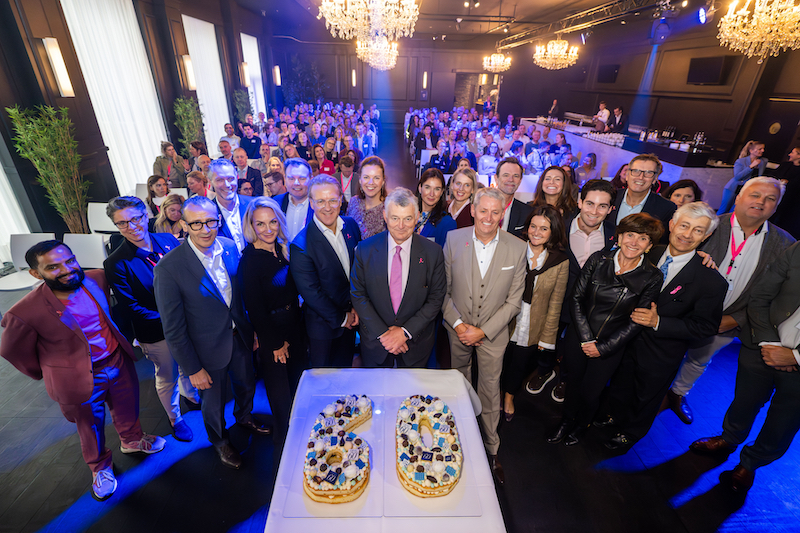
A facility maintaining relevance and expanding for sixty consecutive years, rather than being replaced by a newer site as technology and demand shifted, points to sustained, disciplined reinvestment over decades rather than a single successful construction project. For OEM buyers, it is a useful reminder that a manufacturing partner’s long-term investment pattern is often a better predictor of future reliability than a single site visit or spec sheet can reveal.
Melville, New York: the primary US manufacturing base
Alongside Oevel, the company’s Melville, New York campus serves as its primary United States manufacturing plant, with particular strength in skincare and the group’s second-largest fragrance output, alongside dedicated R&D labs covering skincare, makeup, fragrance and advanced technology. Producing for multiple brands within the portfolio — including Estée Lauder, Clinique, GlamGlow, Tom Ford Beauty and La Mer — from a single site reflects a deliberate efficiency choice: shared manufacturing infrastructure across brands within one group, rather than fully separate production for each label.
This shared-infrastructure model is directly relevant to how many private label and multi-brand OEM operations are structured at a much smaller scale: a single capable manufacturing partner serving several related brand lines, rather than each line requiring its own dedicated factory relationship.
Fiscal year 2024 performance
For fiscal year 2024, the company reported net sales of approximately US$15.6 billion, with operating income around US$970 million and net income of roughly US$409 million, maintaining its position as the world’s second-largest cosmetics company by revenue behind L’Oréal. That scale, built from four original skincare products sold one demonstration at a time, illustrates just how far a strong, repeatable customer-acquisition model can compound over multiple decades.
Lessons for OEM and private label brands
Several threads in the company’s history apply well below its current scale. Removing the risk of a first purchase, whether through sampling, trial sizes or in-person demonstration, tends to build trust faster than advertising claims alone. A clear, well-defended brand positioning within one price tier and aesthetic outperforms an attempt to serve every customer segment under a single name. And a manufacturing partner’s willingness to keep reinvesting in a facility over decades is a more reliable signal of long-term capability than a single audit or site tour.
None of these require anything close to the company’s current scale. A new brand that lets customers try before they buy, stays disciplined about who it’s actually for, and picks a manufacturing partner showing a track record of sustained reinvestment is applying the same underlying logic in miniature.
Where the company stands today
The Estée Lauder Companies remains the world’s second-largest cosmetics group by revenue, trading on the New York Stock Exchange and distributing its roughly 20-brand portfolio through both digital and retail channels in around 150 countries. Its two flagship manufacturing campuses, in Oevel and Melville, continue to anchor a global production network built up gradually over nearly eight decades.
Balancing heritage with continual reinvention
A company built around its founder’s personal name carries a particular challenge most brands never face: the identity of the flagship label is inseparable from a real person’s reputation and story, which can be a powerful asset but also a constraint as consumer tastes and cultural expectations shift over generations. The Estée Lauder Companies has managed this by keeping its founding brand’s core positioning — accessible luxury, backed by real product performance — largely intact, while building or acquiring an entire portfolio of other brands to capture segments and aesthetics the original label was never meant to serve.
For a founder-named brand at any scale, this points to a useful distinction: the founder’s story can remain a genuine asset for the flagship line specifically, without needing to stretch that same personal narrative across every product category a company eventually wants to enter.
Frequently asked questions
When was Estée Lauder founded and by whom?
The company was founded in 1946 in New York City by Estée Lauder and her husband Joseph Lauder, initially selling four skincare products directly in beauty salons.
How large is the Estée Lauder Companies today?
It is the world’s second-largest cosmetics company by revenue, reporting approximately US$15.6 billion in net sales for fiscal year 2024, with roughly 20 brands sold in about 150 countries.
Where does the company manufacture its products?
Its two largest manufacturing hubs are the Oevel, Belgium campus, opened in 1965, and the Melville, New York campus, its primary United States production site, alongside additional facilities supporting other markets.
What can a smaller brand learn from Estée Lauder’s history?
That removing the risk of trying a new product, through sampling or demonstration, can build customer trust faster than advertising alone, and that disciplined brand positioning tends to outperform an attempt to appeal to everyone at once.
Further reading
- The Estée Lauder Companies — official website
- Estée Lauder Companies — Wikipedia
- The Estée Lauder Companies: Oevel Campus 60th Anniversary (official press release)
- For background on how OEM and private label brands typically get built, see our explainer on what OEM manufacturing involves.
- Our OEM Manufacturer category covers other contract manufacturers and industry leaders worth knowing.
This article is an independent editorial profile based on publicly available information. All figures should be verified against the company’s current public disclosures.
About the author
Marc Phu is a China-based professional with experience related to cosmetics and the beauty industry. His background provides an industry perspective on product development, ingredients, innovation and the evolving Chinese beauty market. LinkedIn