In our Founder Spotlight series, OEMReview revisits publicly published interviews with consumer-product founders and draws out the manufacturing and product-development lessons most relevant to OEM and private-label brand owners. This edition looks at VADE Nutrition, the dissolvable-protein brand founded by Joe and Megan Johnson.
A problem born beside a hospital bed
Most protein brands begin with a formula. VADE Nutrition began with a mess. Joe Johnson kept spilling protein powder in his car, and the idea for a cleaner format crystallised during one of the most stressful periods of his life — while his wife Megan was hospitalised at 29 weeks pregnant. The couple sketched out the concept for pre-measured protein servings wrapped in an edible, dissolvable film right there beside her hospital bed.
“We immediately knew this was what we needed to do. I turned down my job and started working on this full time while sitting beside Megan’s hospital bed,” Johnson recalled in his interview.
The part every OEM founder should read: 100+ manufacturers
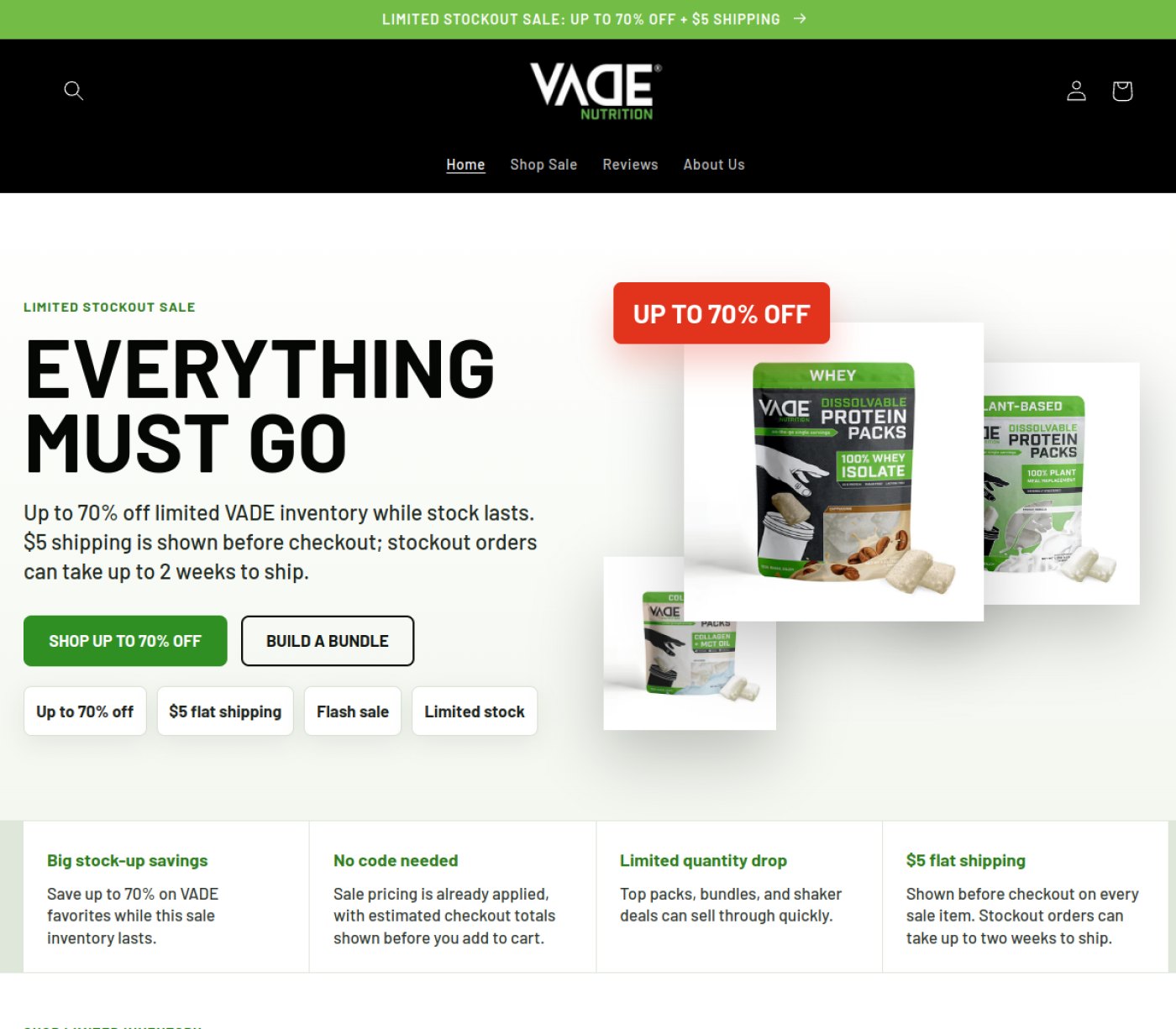
The product idea was novel — a single-serve scoop of protein (20g protein, 90 calories, gluten- and lactose-free) sealed in dissolvable packaging. Novel products are exactly where manufacturing becomes the hardest part of the business, and VADE’s early years prove it.
According to the interview, Johnson contacted more than 100 manufacturers before finding one that could deliver. Two early partners failed outright: one simply cut off communication, and another shipped unflavoured powder before going out of business. Only after extensive trial and error on both formulation and the dissolvable film did the company secure a supply chain it could scale on.
That persistence eventually paid off on national television — a Shark Tank deal with Alex Rodriguez and Mark Cuban — but the durable lesson sits upstream of the fame, in the factory search.
“You don’t need to settle because someone will be able to make it happen!”
— Joe Johnson, VADE Nutrition
What OEM & private-label brand-builders can learn
- The more original your format, the more manufacturers you should expect to approach. A standard capsule or cream may have dozens of ready contract manufacturers; a genuinely new format can require contacting a hundred. Budget time and cash for that search.
- Vet a manufacturer’s stability, not just their sample. Two of VADE’s failures were operational — a partner going silent, a partner going under — not formulation problems. Ask about financial health, capacity and communication process before you commit a launch to them.
- Prototype the packaging as seriously as the product. VADE’s entire value proposition lived in the dissolvable film. For many OEM projects, packaging compatibility and stability testing deserve the same rigour as the formula itself.
- Persistence is a manufacturing strategy. “I try to take action right away even if you’re uncertain,” Johnson said. Founders who keep moving through supplier rejection tend to be the ones who eventually find the right partner.
Written by Dee Truong for OEMReview. Brand names are used for identification and commentary only. Read the original, full interview at Starter Story.
About the author
Dee Truong is a Vietnam-based professional with experience in the beauty and consumer-product sector. Her interests include product development, market trends and the commercial side of bringing consumer products from concept to market. LinkedIn