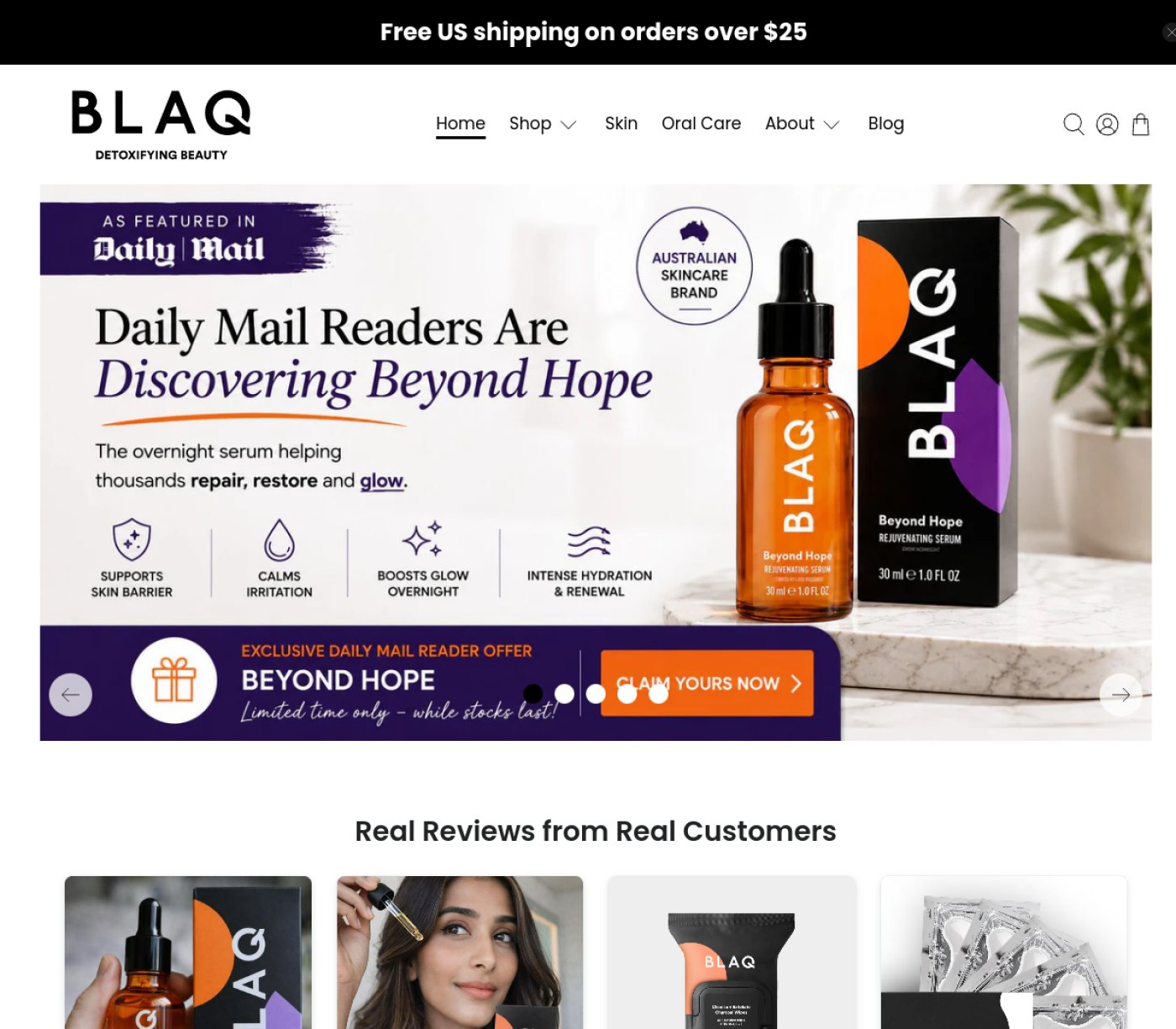
In our Founder Spotlight series, OEMReview revisits publicly published interviews with consumer-product founders and draws out the manufacturing and product-development lessons most relevant to OEM and private-label brand owners. This edition looks at BLAQ, the activated-charcoal skincare brand founded by the late Ryan Channing.
A trip to Japan, a viral mask
BLAQ began when Ryan Channing encountered the detoxifying reputation of activated charcoal on a trip to Japan. He worked with a formulator to create a peel-off charcoal mask, tested it on friends in the modelling industry, and posted the dramatic before-and-after videos that a peel-off mask is built to produce. The clips went viral, and within twelve months the brand had reportedly generated over $8 million in Australian sales.
The failure that taught the manufacturing lesson
The most instructive part of BLAQ’s story isn’t the viral win — it’s a product that failed. As the range expanded, the team launched a “Meteor Shower” body wash combining pumice and charcoal. It failed catastrophically in the field: it turned customers’ bathrooms black.
That expensive misstep changed how the company manufactured. The lesson Channing took away was to partner exclusively with experienced contract manufacturers and to put products through rigorous testing before release — exactly the discipline that separates a lucky viral hit from a durable brand.
“Failing to plan is planning to fail, and that is certainly true in business.”
— Ryan Channing, BLAQ
Growth brings a cash-flow problem, not just a supply problem
BLAQ’s scale-up also illustrates a challenge OEM founders underestimate: big distribution can strain you more than it rewards you in the short term. A partnership with the subscription beauty box FabFitFun put BLAQ in front of millions of subscribers but required large upfront production investment — funded, at points, with credit cards and personal loans — against payment terms that could stretch 90 to 180 days. Manufacturing capacity and working capital have to grow together.
What OEM & private-label brand-builders can learn
- Test every SKU as if it will fail in public — because it can. The “Meteor Shower” disaster is a reminder that stability and real-world use testing are not optional line items. One bad launch can cost more than the R&D you skipped.
- Choose experienced contract manufacturers as the range grows. A single hero product can be made almost anywhere; a growing catalogue of formats needs partners who have solved these problems before.
- Fund production before you chase distribution. Beauty boxes and big retail can demand large runs on long payment terms. Model the working capital, not just the order size.
- A demonstrable result sells itself. The peel-off format gave BLAQ built-in visual proof. Where honest and safe, choosing a product experience that shows its result is a marketing advantage designed in at the formulation stage.
Written by Dee Truong for OEMReview. Brand names are used for identification and commentary only. Read the original, full interview at Starter Story.
About the author
Dee Truong is a Vietnam-based professional with experience in the beauty and consumer-product sector. Her interests include product development, market trends and the commercial side of bringing consumer products from concept to market. LinkedIn