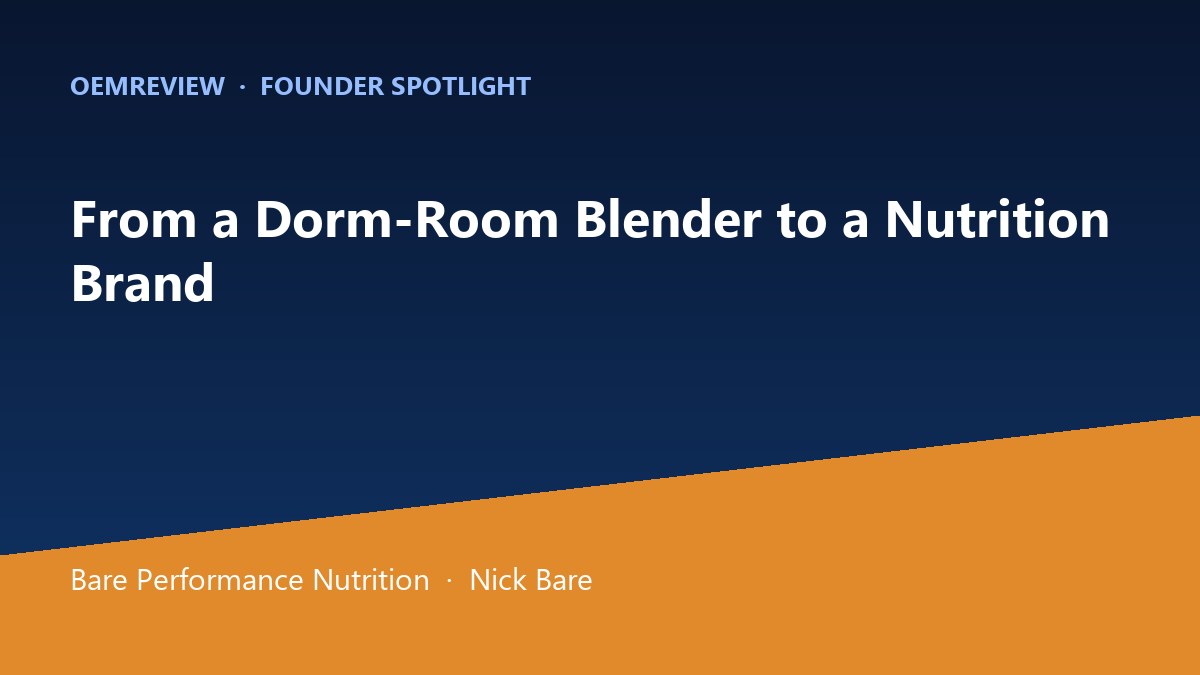
In our Founder Spotlight series, OEMReview revisits publicly published interviews with consumer-product founders and draws out the manufacturing and product-development lessons most relevant to OEM and private-label brand owners. This edition looks at Bare Performance Nutrition, the sports-nutrition brand founded by Nick Bare.
A dorm-room blender and a $25,000 bet
Bare Performance Nutrition (BPN) started in 2012, when Nick Bare — a nutrition student and ROTC cadet at Indiana University of Pennsylvania — was mixing homemade pre-workout supplements with friends in his dorm room. He turned the hobby into a company using a $25,000 military loan, then commissioned as an Infantry Officer and kept building the brand around Army deployments, including a nine-month posting to South Korea during which the business crossed $100,000 in monthly revenue.
How a first-time founder handled manufacturing
Bare didn’t outsource the thinking. He personally formulated the first two products — a pre-workout (Flight) and an intra-workout BCAA (Intra-Flight) — through his own research, then found a contract manufacturer online and worked hand-in-hand with their R&D team.
The collaboration wasn’t only about taste and ingredients; it was about unit economics. Working with the manufacturer’s R&D over roughly twelve weeks, Bare brought his cost per unit down from an unworkable ~$30 to a market-viable price. For any OEM founder, that detail matters: a good contract manufacturer is a partner in costing and reformulation, not just a producer.
“We are a BRAND and not just a PRODUCT.”
— Nick Bare, Bare Performance Nutrition
Brand first, and a hard early lesson on demand
Bare is candid that the early days were rough. “We had zero demand. I was trying to sell to everyone… with no target market,” he said. The turnaround came from treating BPN as a brand — investing in organic content on YouTube and Instagram, and building an audience around education and his military story — rather than as a commodity tub of powder. A mid-growth rebrand reportedly drove a large jump in revenue, and the company was on track for around $6M annually at the time of the interview.
What OEM & private-label brand-builders can learn
- Use your contract manufacturer’s R&D team on cost, not just recipe. Bare’s move from ~$30 to a viable unit cost happened with the manufacturer. Bring your target retail price to the table and reformulate toward it together.
- You can start with a formula you developed yourself — then let professionals productionise it. Founder-led formulation gives you conviction and a story; the manufacturer makes it consistent, compliant and scalable.
- “Brand not product” is a manufacturing decision too. Deciding you are a brand changes packaging, consistency and range planning — all of which flow back to your OEM brief.
- Define a target market before you scale production. Selling “to everyone” wasted BPN’s early inventory and cash. A sharp customer definition makes your first production run far less risky.
Written by Dee Truong for OEMReview. Brand names are used for identification and commentary only. Read the original, full interview at Starter Story.
About the author
Dee Truong is a Vietnam-based professional with experience in the beauty and consumer-product sector. Her interests include product development, market trends and the commercial side of bringing consumer products from concept to market. LinkedIn