
By Marc Phu · Cosmetics Product Development & Ingredients · Published 13 May 2026
The distinctive blue tin of Nivea Crème has barely changed in over a century, and neither has the company behind it in one important respect: Beiersdorf still manufactures in the same Hamburg district where it built its first dedicated factory in 1892. Founded on a pharmacist’s 1882 patent for a medicated skin plaster, Beiersdorf grew into a global personal care company whose Hamburg-Eimsbüttel site remains, by the company’s own account, its single largest production facility worldwide.
This profile looks at how a single 1882 patent became a multi-brand personal care company, why Beiersdorf’s manufacturing base has stayed so geographically concentrated for over a century, and what that continuity can teach other brands about the value of staying close to a company’s origins even while scaling internationally.
Key takeaways
- Beiersdorf’s founding document is a March 1882 patent granted to pharmacist Paul C. Beiersdorf for a “coated pflaster,” a medicated skin plaster.
- Pharmacist Dr. Oscar Troplowitz acquired the small operation in 1890 and rapidly expanded it into a branded goods company, building a new Hamburg-Eimsbüttel factory in 1892 that remains the company’s headquarters site today.
- Nivea Crème launched in December 1911, built around the emulsifier Eucerit, and remains one of the world’s most recognisable skincare products more than a century later.
- Beiersdorf Manufacturing Hamburg is described by the company as its largest production site worldwide, employing over 600 people from more than 18 nations and producing around 3 million products daily.
- The company’s continued concentration of manufacturing in the same district where it began, rather than fully relocating production abroad, is an unusually long-lived example of staying close to a brand’s origins.
A pharmacist’s patent as the founding document
Beiersdorf’s official history begins not with a company registration but with a patent: on 28 March 1882, the Imperial Patent Office in Berlin granted pharmacist Paul C. Beiersdorf patent number 20057 for the manufacture of a coated medical plaster. Beiersdorf had trained as a pharmacist and settled in Hamburg two years earlier, working from a small pharmacy near the city’s landmark St. Michael’s church.
He sold the pharmacy itself the following year and relocated the laboratory to Altona, now part of greater Hamburg, but the patent remains the document the company itself treats as its founding moment — an intellectual property milestone rather than a formal incorporation date, which is unusual among companies of Beiersdorf’s age and scale.
The Troplowitz era: from patent to branded company
The transformation from a small patent-holding laboratory into a genuine branded goods company came in 1890, when pharmacist Dr. Oscar Troplowitz acquired the operation from Beiersdorf and expanded it rapidly. In 1892, Troplowitz built a new factory in Hamburg-Eimsbüttel, establishing the site that remains the company’s headquarters and largest production facility to this day, well over 130 years later.
Troplowitz’s contribution illustrates a pattern seen in several long-lived companies: the founder often establishes a core technical or intellectual asset, while a subsequent leader builds the commercial infrastructure and brand discipline needed to scale it into an enduring business. Recognising these as genuinely distinct skill sets, rather than assuming a single founder must excel at both, is a useful lesson for any growing brand thinking about when to bring in outside leadership.
Nivea Crème and the Eucerit breakthrough
The product that would define Beiersdorf’s global identity arrived in December 1911: Nivea Crème, made possible by chemist Isaac Lifschütz’s discovery of Eucerit, an emulsifier that allowed water and oil to combine into a genuinely stable cream formulation, a significant technical achievement for the period. Nivea Crème’s blue tin and white lettering have remained recognisably consistent for well over a century since, an unusually long packaging lifespan in an industry where most products are refreshed every few years.
That packaging consistency is itself a deliberate brand asset: a formulation and visual identity stable enough to remain instantly recognisable across multiple generations of consumers is difficult to build and, once established, valuable enough that Beiersdorf has evidently chosen continuity over frequent redesign.
Staying concentrated in Hamburg
Unlike many global consumer goods companies that have progressively shifted manufacturing toward lower-cost regions over recent decades, Beiersdorf has kept its largest production site concentrated in the same Hamburg district where Troplowitz built the original 1892 factory. Beiersdorf Manufacturing Hamburg today spans facilities in both Hamburg-Eimsbüttel and Hamburg-Billbrook, employing more than 600 people from over 18 nations and producing an estimated 3 million products daily, including roughly 1.5 million of the iconic blue Nivea Crème tins.
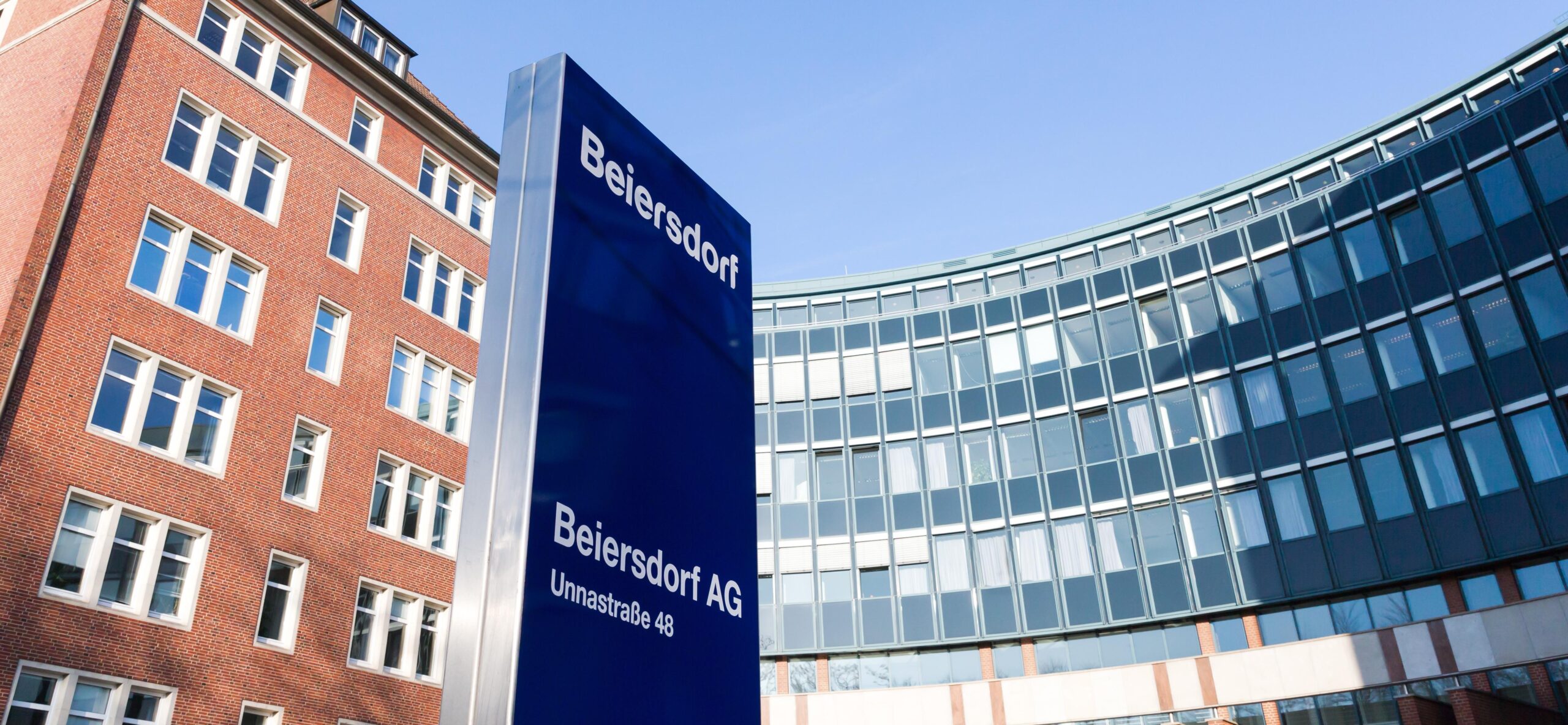
Maintaining this level of geographic concentration for well over a century is a genuinely unusual choice among companies of Beiersdorf’s international scale, and it suggests the company sees real value, whether in institutional knowledge, quality consistency, or brand storytelling, in keeping its flagship production close to its origins rather than dispersing it purely on cost grounds.
Beyond Nivea: building a genuine multi-brand portfolio
Beiersdorf has expanded well beyond its original Nivea line to include Eucerin, a dermocosmetic skincare brand building on the same Eucerit emulsifier technology that made the original Nivea Crème possible; Hansaplast, a plaster and wound-care brand with a direct lineage back to the company’s founding patent; and Labello, a lip care brand. Each occupies a distinct category and positioning rather than competing directly with Nivea, allowing Beiersdorf to serve genuinely different consumer needs under separate, clearly defined brand identities.
This kind of category-adjacent brand expansion, building outward from a core technical capability, such as skin-barrier and emulsion science, rather than into entirely unrelated categories, is a pattern worth noting for any brand considering how to grow beyond a single flagship product.
Lessons for OEM and private label brands
Several elements of Beiersdorf’s history apply at a much smaller scale. Recognising when a founder’s core technical contribution needs a different kind of commercial leadership to scale into an enduring business is a genuinely useful distinction for any founder-led brand to make honestly. Packaging and formulation consistency, maintained deliberately over a long period rather than refreshed reflexively, can become a genuine brand asset rather than a sign of stagnation. And expanding into adjacent categories that build on a company’s actual core technical capability tends to produce more coherent growth than diversifying into unrelated ones.
None of these require Beiersdorf’s scale or history. A newer brand that is honest about which of its own capabilities are genuinely core, and expands deliberately from that base rather than chasing unrelated trends, is applying the same underlying discipline.
Where the company stands today
Beiersdorf remains headquartered in the same Hamburg-Eimsbüttel district where Dr. Oscar Troplowitz built its first dedicated factory in 1892, with Nivea, Eucerin, Hansaplast and Labello forming the core of its global consumer brand portfolio. Its Hamburg manufacturing operation continues to serve as the company’s largest production site worldwide, a rare example of sustained geographic concentration across more than a century of international growth.
What over a century of packaging continuity signals
Very few consumer products anywhere retain a recognisable core visual identity across more than a hundred years of otherwise constant advertising, packaging design and retail trends. Nivea Crème’s blue tin has survived multiple design eras that saw countless competing products redesigned repeatedly, which suggests Beiersdorf has treated the tin’s visual identity as something closer to a permanent brand asset than a marketing choice subject to periodic refresh cycles.
That level of restraint, choosing not to redesign a product’s core visual identity even as design trends shift repeatedly around it, requires genuine organisational discipline over multiple leadership generations, since each new marketing team inevitably faces some internal pressure to modernise a long-standing look. Beiersdorf’s willingness to resist that pressure for over a century is itself part of what has made the tin so consistently recognisable.
Frequently asked questions
When was Beiersdorf founded?
The company treats a 28 March 1882 patent granted to pharmacist Paul C. Beiersdorf for a medicated skin plaster as its founding document.
Who built Beiersdorf into a branded company?
Dr. Oscar Troplowitz, who acquired the operation in 1890 and built the Hamburg-Eimsbüttel factory in 1892 that remains the company’s headquarters today.
When did Nivea Crème launch?
In December 1911, made possible by the discovery of the emulsifier Eucerit, which allowed a stable water-and-oil cream formulation.
Where does Beiersdorf manufacture most of its products?
Primarily at Beiersdorf Manufacturing Hamburg, spanning Hamburg-Eimsbüttel and Hamburg-Billbrook, which the company describes as its largest production site worldwide.
Further reading
- Beiersdorf — official corporate website
- Beiersdorf — Wikipedia
- Beiersdorf: Founding History (official)
- For background on how OEM and private label brands typically get built, see our explainer on what OEM manufacturing involves.
- Our Ingredients & Formulations coverage looks at other formulation innovations shaping the industry.
This article is an independent editorial profile based on publicly available information. All figures should be verified against the company’s current public disclosures.
About the author
Marc Phu is a China-based professional with experience related to cosmetics and the beauty industry. His background provides an industry perspective on product development, ingredients, innovation and the evolving Chinese beauty market. LinkedIn