All data captured 9 September 2026. Sources and method at the end of this review.
Quick answer
ORIZI Group — flagship manufacturing entity Dr Orizi (M) Sdn. Bhd., Ipoh, Perak, incorporated 2012 — is the heavyweight of this industry, and for once that is not a brochure adjective: three divisions (beauty, functional food, medical devices), six registered companies, a certificate wall that runs from NPRA cosmetics GMP through SIRIM food GMP and HACCP to ISO 13485 medical-device licences and two US FDA facility registrations, 418 active NPRA cosmetic notifications for 88 brand owners, a JAKIM halal record running back to 2013 — and a client sheet where a national pharmacy-shelf brand sits next to first-time founders. And this giant still publishes a 50-unit MOQ from RM3,000, fighting in the same pond as backyard-scale factories. That paradox is the story of this review, and the answer I found made me respect them more, not less. My verdict: endorsed — the industry’s big player, with two roasts on record.
First: how big is “big”? Only the public record gets a vote
Before anything else, let us establish how big “big” actually is — because every factory in Malaysia calls itself “leading”, and I refuse to repeat adjectives I cannot check. So here is what the public record, not the marketing department, will confirm.
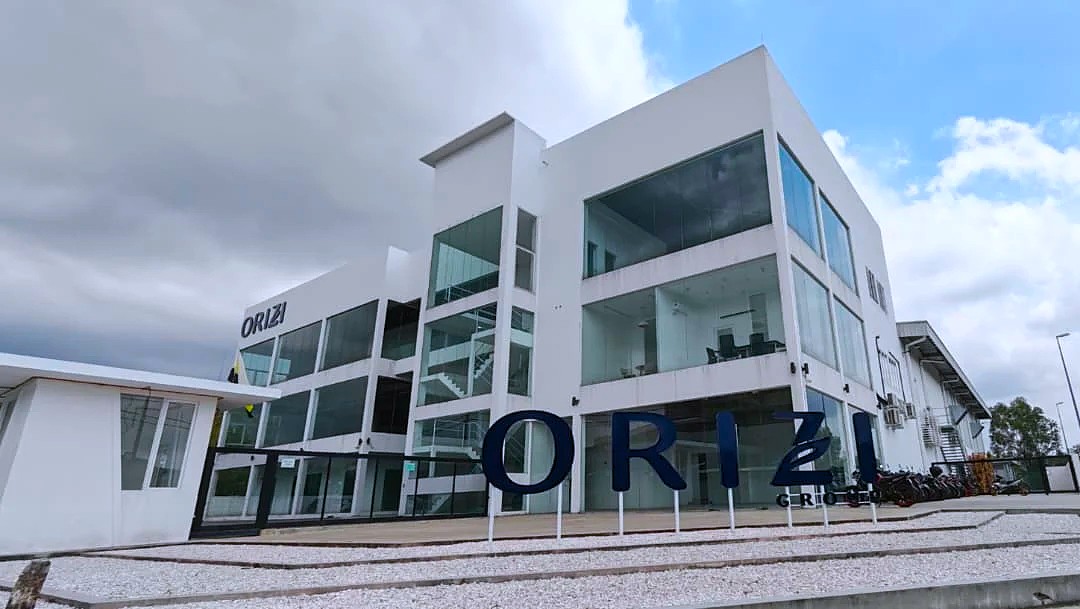
Structure: the group operates as six registered companies across three health divisions — cosmetics and personal care under Dr Orizi (M) Sdn. Bhd. (with OriGener Health & Beauty as the commercial and brand-growth arm), functional food and nutrition under D&O Nutraceutical Manufacturing (powder formats) and Nutrizens Wellness (liquid and ready-to-drink), and medical devices under Imedify Medical Solution and Skyler Medical Manufacturing, the latter running an ISO Class 8 cleanroom. These are not trading names; each entity carries its own SSM registration number and its own certificates with the numbers printed: SIRIM GMP, HACCP and ISO 22000 on the food side, ISO 13485 plus MDA establishment licences on the device side, NPRA cosmetics GMP and ISO 22716 on the beauty side, US FDA facility registrations for both the cosmetics and food operations, and SA8000 plus SEDEX/SMETA social-compliance audit references on top. Public records show more than one plant address in the Pengkalan industrial estate in Ipoh, and the group states production capacity of up to 60,000 units a day (company-stated).
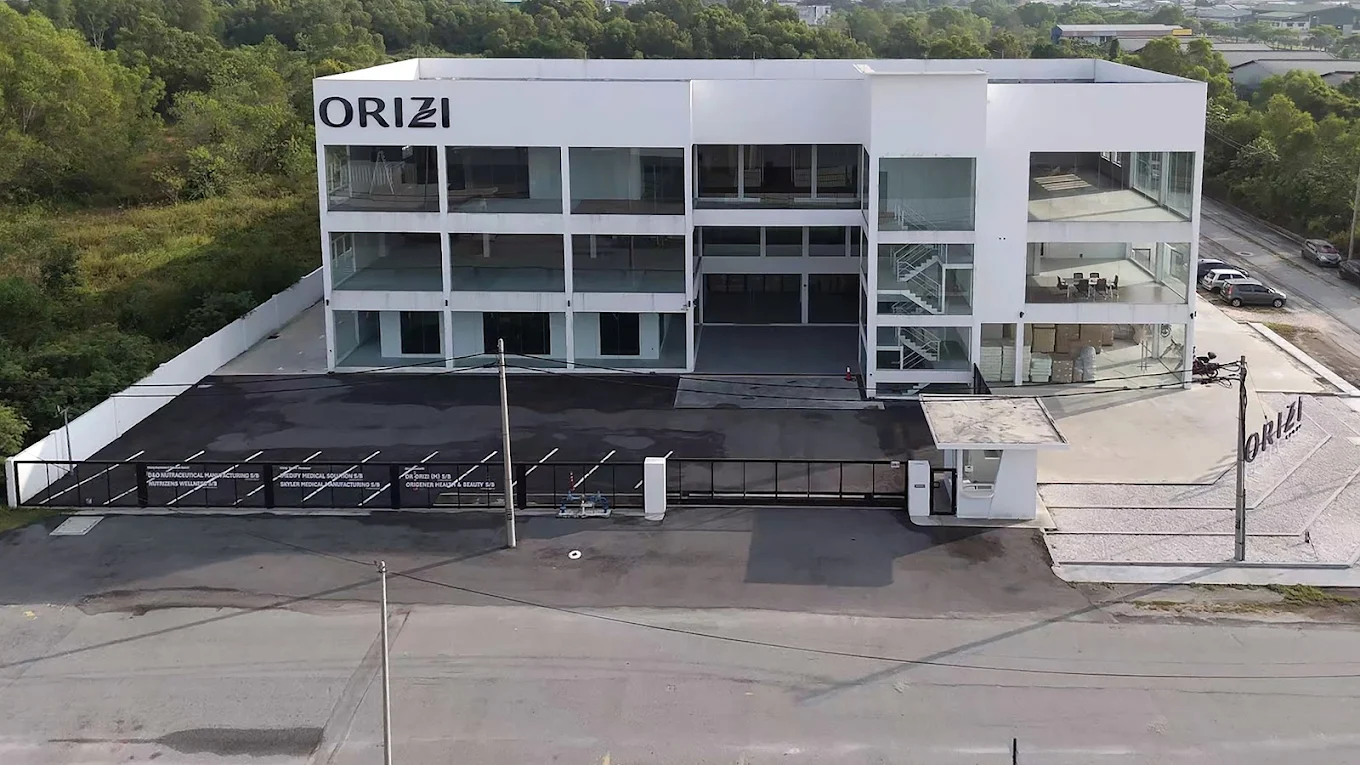
A caveat I insist on making, because it strengthens the case rather than weakens it: only the beauty division has a public product registry I can count. Food and supplement production has no NPRA-style public database, and medical devices sit behind MDA’s licensing wall. Everything I am about to show you is therefore one division out of three — the visible slice of the iceberg. Judge the whole animal from this slice and you will still walk away impressed.
One more scope note, in the interest of honesty: Malaysian cosmetic notifications only cover products sold in Malaysia. Export production for overseas markets does not appear in this registry at all — the company’s own materials describe an export operation (company-stated, and consistent with the US FDA registrations and SEDEX/SMETA audits, which exist for no other reason) — so the registry numbers below are, again, a floor, not a ceiling.
The registry: 418 products, 88 brand owners — and WHO those brand owners are
Now the registry itself. As of 9 September 2026, 418 active cosmetic notifications name Dr Orizi (M) Sdn. Bhd. as manufacturer, for 88 distinct brand owners. (Notifications lapse every two years unless renewed, so the lifetime count is higher — 418 is what is live today.) The filing curve is vertical: 15 active notifications from 2023, 32 from 2024, 169 from 2025, and 202 filed in 2026 with almost four months of the year still to go. Seventy of the 88 brand owners arrived in the last 21 months, six in ten clients hold two or more products, and the average client holds 4.8 SKUs. In OEM, the repeat filing is the only compliment that costs the client money.
But the number that matters here is not 418. It is who the 88 are. Read the client sheet like an insider and you will see almost every segment of this industry represented on one factory’s roster: first-time SME founders and direct-sales beauty brands (Rosebelle Enterprise, 32 products; Senilda Resources, 32). Cross-border product lines (Nano Wellness, 25 products, including the Nano Singapore range). And then the one that made me sit up straight —
One of the most recognisable pharmacy-shelf skincare brands in this country — a name whose manufacturing roster is otherwise specialist laboratories in France, Korea, Taiwan and the United States — quietly added this Ipoh factory to that roster in 2026. The filings are sitting in the registry; one of the SKUs sells nationwide in a licensed edition of a world-famous cartoon character. As a professional reviewer I am not going to print the brand or the product names — but understand, none of this is hidden. It is sitting in NPRA’s public notification database, and the SKU is on retail shelves right now. Search the registry’s manufacturer column, walk the pharmacy aisle, and you can reconstruct everything I just told you in an afternoon — which is exactly why you can trust it. What matters is what it proves. A brand that ordinarily buys from European and Korean labs audited a Malaysian factory and put it on the same vendor list — and character-licensed production does not happen at all without passing the licensor’s notoriously brutal ethical and social-compliance vetting, which is precisely what the SA8000 and SMETA certificate numbers on ORIZI’s own site exist to answer. Registry, retail shelf and audit stack all telling one story: this is not an SME-only factory. This is an FMCG-grade plant that also serves SMEs.
There is a second pattern in this registry that most readers would misread, so let me decode it the way an insider does. Dozens of filings under this factory show the factory itself standing as the notification holder. That is not a factory running secret house brands — it is a service. An NPRA notification needs a brand owner and a manufacturer, and plenty of established clients simply refuse to deal with the paperwork, so the factory files and maintains the notification on their behalf, end to end. Turnkey regulatory handling, visible in the registry once you know what you are looking at — and exactly the kind of thing a first-time founder should be asking for by name. And once you decode that pattern, the client sheet opens up: most of the pharmacy chains you walk past in a Malaysian mall carry products that came off these lines, under names you would never connect to Ipoh. I am not listing them here — but the registry is public. Pull the manufacturer column yourself and see how far up the shelf this factory reaches.
The JAKIM layer: the halal directory record for the Ipoh plant dates to January 2013 — a thirteen-year certificate lineage, not a fresh logo — with current certificates valid into 2027–2028 covering 284 products across 75 brand names. And the Google listing shows 5.0 stars from 134 reviews (captured 9 September 2026): a flat 5.0 always makes a reviewer smirk, but 134 named public reviews is a volume most B2B factories in this country cannot dream of, and unlike a banner claim, every one of them has a name attached.
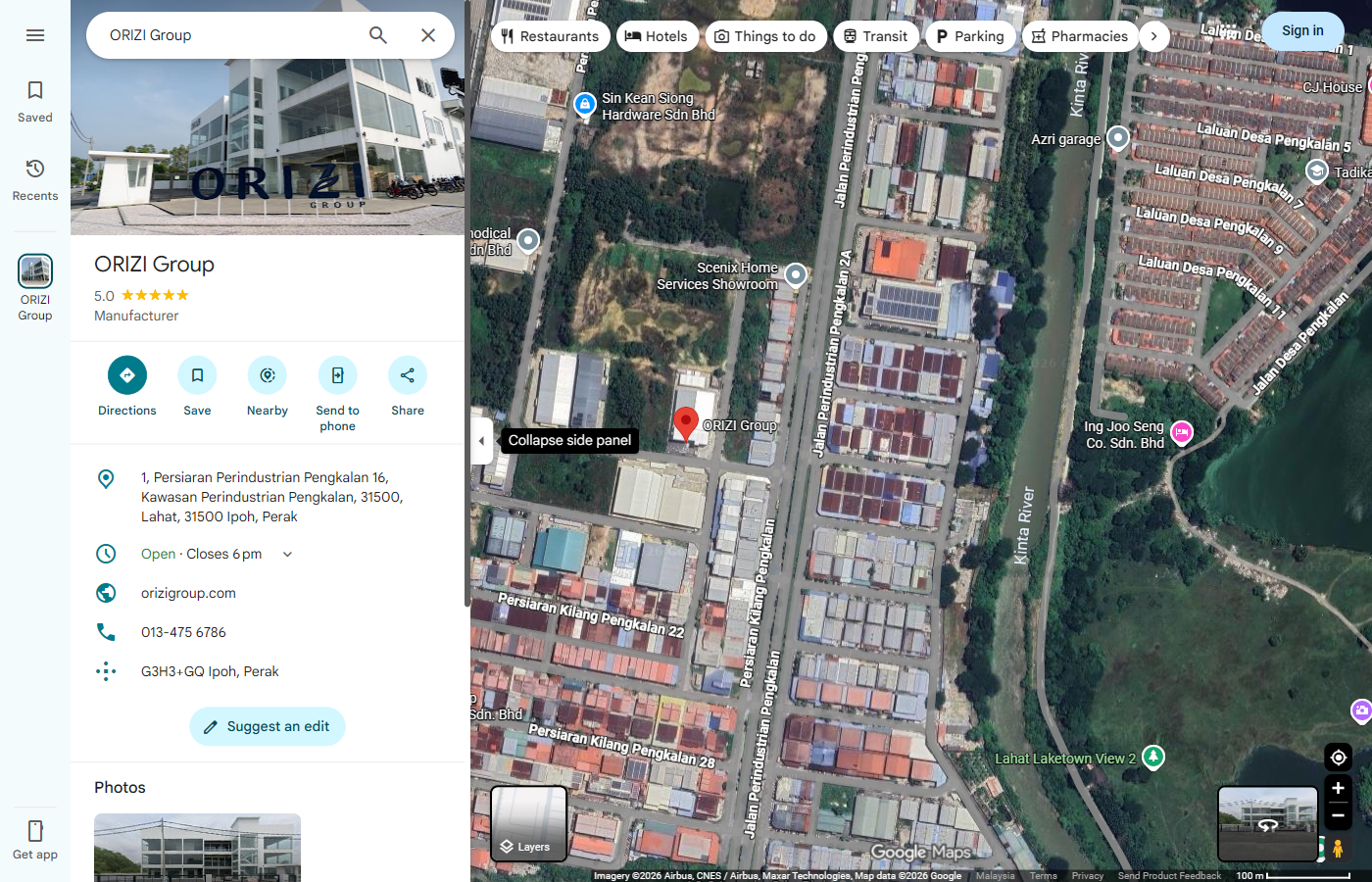
Every number above comes from a database that neither ORIZI nor I can edit. That is the point of this review’s method: size claims are cheap; registry entries are not.
So why is this giant in the kiddie pool?
Which brings me to the thing I genuinely could not compute when I laid all of this out on my desk.
This group — FMCG-audited, licensor-vetted, thirteen years of JAKIM lineage, six companies, three divisions — publishes a floor of 50 units from RM3,000 on its Ready2Brand page. Fifty units. That is not a factory order; that is a car boot of product. Factories a twentieth of this size sniff at 500-unit minimums, and here is the sector heavyweight advertising a number that would barely cover the line changeover, the cleaning validation and the QC paperwork on plants built to FMCG scale. Doesn’t somebody in the finance department cry every time one of these runs is scheduled?
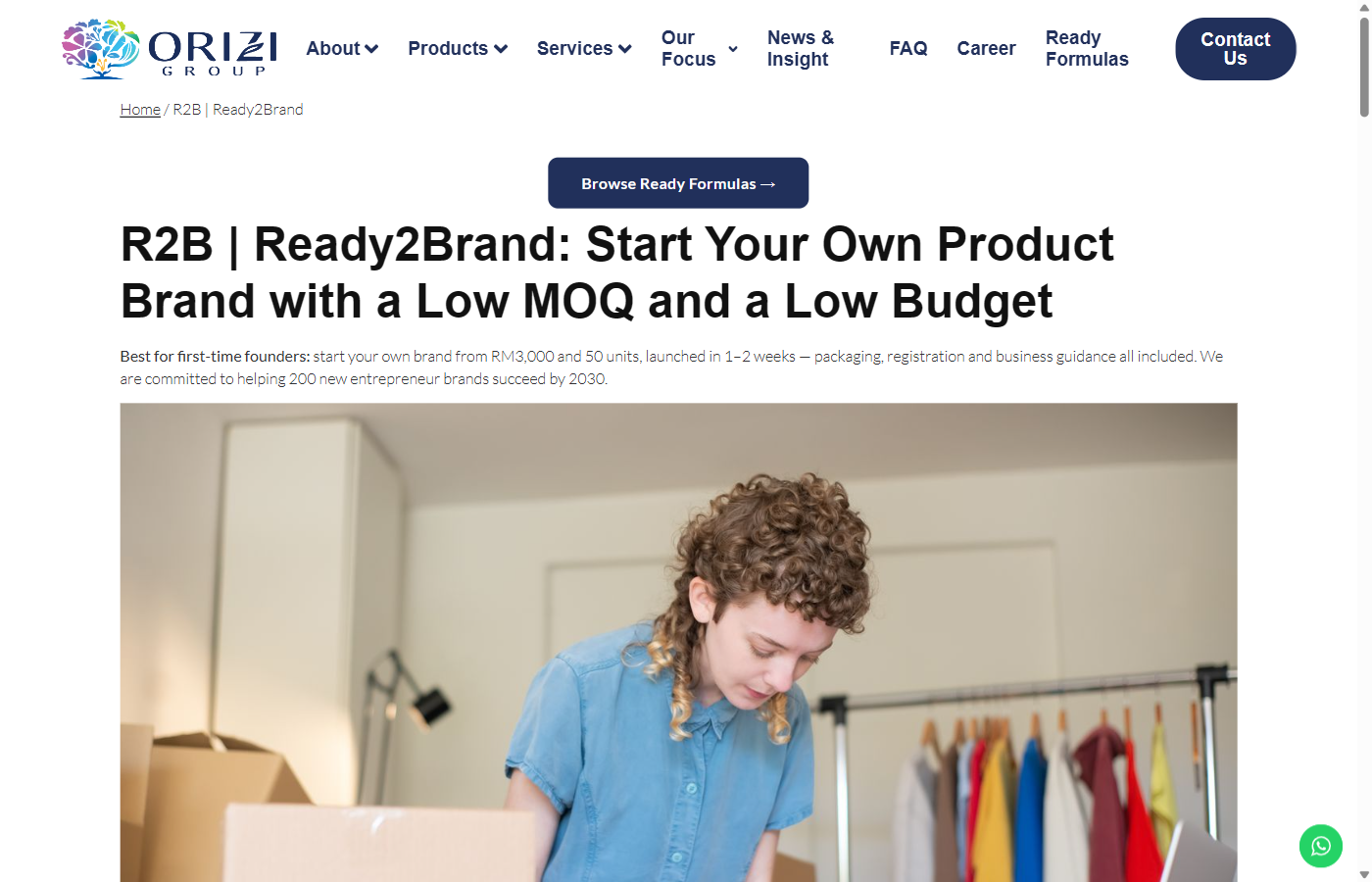
So I went looking for the catch, and found something better: an explanation, in writing. Ready2Brand is not a loss-leader banner — it is a dedicated division of the group aimed at first-time founders, and its page carries a printed commitment: “helping 200 new entrepreneur brands succeed by 2030”, with packaging, product registration and business coaching bundled into that RM3,000 entry. Read it as an insider and the kiddie pool suddenly looks like the smartest water in the building: today’s 50-unit founder is tomorrow’s 5,000-unit account, and this giant has decided to farm its future clients instead of waiting for competitors to raise them. The 50-unit floor is a nursery, and the nursery has a quota and a deadline. Once I saw that, the paradox stopped being a joke and became the single most strategic thing about this company. (The asterisk still applies, and I will read it out loud since banners never do: the 50-unit floor is for selected ready formulas with selected packaging. Bring your own custom formula and you are in normal OEM economics like everywhere else. Know which door you are walking through.)
The company on paper (public records)
| Legal name | DR ORIZI (M) SDN. BHD. — flagship cosmetics manufacturing entity of ORIZI Group |
| Registration No. | 979766-W / 201201006241 (SSM) |
| Incorporated | 2012 (SSM registration year; site footer states 2012–2026) |
| Group companies (SSM No.) | OriGener Health & Beauty Sdn. Bhd. (201601018879, commercial arm) · D&O Nutraceutical Manufacturing Sdn. Bhd. (201801047201, powder functional food) · Nutrizens Wellness Sdn. Bhd. (202401054443, liquid functional food) · Imedify Medical Solution Sdn. Bhd. (202001000733, medical devices) · Skyler Medical Manufacturing Sdn. Bhd. (202101038874, medical devices, ISO Class 8 cleanroom) |
| Plants | Kawasan Perindustrian Pengkalan, 31500 Ipoh, Perak — JAKIM record at No. 1, Persiaran Perindustrian Pengkalan 16; more than one plant address in public records; capacity up to 60,000 units/day (company-stated) |
| Website | orizigroup.com · drorizi.com |
Check the record yourself — the regulators’ own portals
Every number in this review comes from a public record, so here is exactly where to find each one, and what it showed when I ran the searches again on 16 September 2026. None of it needs my word for it.
1. The NPRA cosmetic notification registry. Open NPRA’s QUEST3+ product search, choose Cosmetic, set “Search By” to Manufacturer Name and type DR ORIZI. The portal returned 424 entries on 16 September 2026 — every one a product whose manufacturer of record is Dr Orizi (M) Sdn. Bhd. My own full-registry extraction, taken on 9 September 2026, counted 418; the portal is live, and the book has kept growing since. The rows are reproduced exactly as the portal shows them: notification number, product, brand owner, and the manufacturer column that matters here.
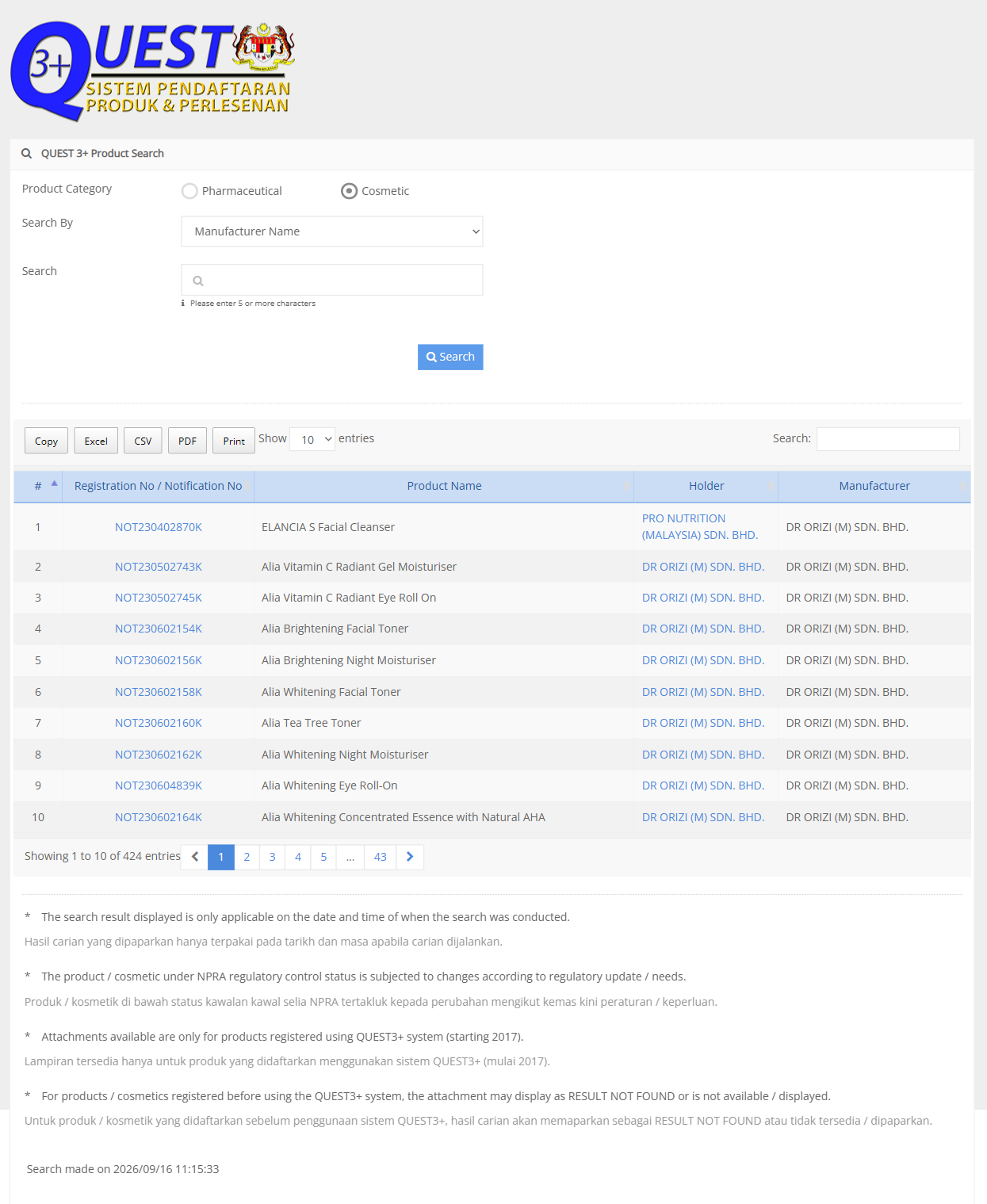
And since these are public records, there is no reason to be coy about what they show. The first page alone is mostly Alia, the house skincare line sold through a national pharmacy chain — 41 active filings name Dr Orizi as manufacturer. Read further into the registry and something more interesting turns up: a pharmacy-shelf skincare brand I am not going to name, because the registry names it for anyone who looks. That brand carries 179 active notifications of its own, and the manufacturer column on them reads like a tour of the industry’s senior end — roughly seventy filings made by French laboratories, a run of Korean houses, several Taiwanese plants, an American lab. In 2026, four of its filings name an industrial lot in Ipoh instead. Here is my reading, and you are free to disagree: a brand that has spent years buying its formulation out of France and Korea does not move a line to a Malaysian plant to save a few sen. It moves when the plant clears the same kind of audit its European suppliers clear — and that is not something a brochure can buy. Check it yourself: run the manufacturer search above and read the holder column, or search that holder name and read the manufacturer column.
There is a second tell in that relationship, and it sits on a pharmacy shelf rather than in a registry. That same brand sells a Disney-licensed edition of its sunscreen — a Winnie the Pooh series, merchandised by the pharmacy chain as a Disney character range and pushed as a dated in-store campaign. Search that holder name together with the word Disney and you will find the campaign page, the pharmacy listing and the marketplace listings in the first screen of results; I am leaving the links out for the same reason I am leaving the name out. What matters is what a licence like that costs in paperwork. Disney does not hand out characters on a purchase order: its International Labor Standards programme runs on a document called a Facility and Merchandise Authorization. Before production starts, the licensee has to declare every factory that will make Disney-branded goods, submit a FAMA application for each one and get Disney’s sign-off; in the countries Disney designates, a qualified labour-standards audit of that plant has to come with it, measured against Disney’s own Minimum Compliance Standard. That is not my summary of a press release — it is section V of Disney’s 66-page ILS Program Manual, which anyone can download, and the programme itself lives at compass.disney.com. So the plant filling those tubes was not just the cheapest quote in the room. It had to be named to the licensor, and it had to survive an audit regime the licensor accepts, on top of whatever the brand’s own quality people asked for. One caveat I will put up front, because this site does not hide them: there is no register you can search. A FAMA is issued licensee by licensee and stays between that licensee and Disney — the manual reserves Disney’s right to disclose facility names, but Disney publishes no lookup, so nobody outside can type in a factory and confirm it. What you can do is read the rulebook, then look at a licensed product sitting on a pharmacy shelf, and work backwards. Badges on a website are free. Being allowed to put a licensed character on the carton is not.
2. The JAKIM halal directory. Open the Halal Malaysia portal directory, pick the category Kosmetik dan Dandanan Diri and search ORIZI. One company comes back — DR. ORIZI (M) SDN BHD, at No. 1, Persiaran Perindustrian Pengkalan 16, Ipoh — carrying three certificate expiry dates: 28 February 2027, 31 October 2027 and 31 May 2028.
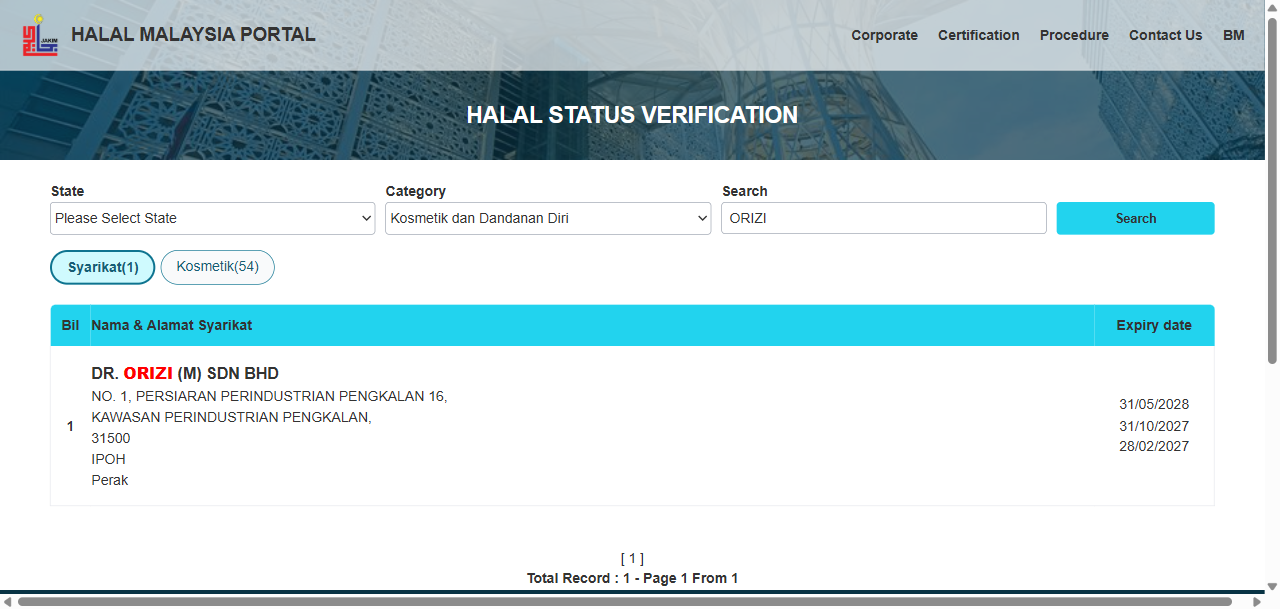
Open that record and the certificate references are printed on it: JAKIM.700-2/3/3 089-05/2013 for cosmetics and JAKIM.700-2/3/8 089-05/2013 for contract manufacturing — the 2013 lineage quoted earlier in this review, at the same plant address. I have cropped the officers’ names and the certified-product list out of this screenshot; both are visible when you open the record yourself.
That product list is worth opening, because it is the number most people guess at. On 3 October 2026 the record carried 285 products under 76 different brand owners — 283 distinct product names, spread across three certificates expiring 28 February 2027, 31 October 2027 and 31 May 2028. Run the same skincare test we use in our factory ranking and 148 of them are skincare; the rest are colour cosmetics, hair and body care. Two things follow. The first is scale: a halal file that size is not a certificate on a wall, it is a committee, a supplier register and a yearly audit. The second is breadth: 76 brand owners means 76 separate companies decided to put their products through it, which is a harder thing to arrange than a single certificate.
One caveat, because it cuts both ways. A factory certificate does not make any particular product halal — each brand owner still decides whether to put its own products through, and a brand can equally hold its own certificate for a product made here, since JAKIM audits the plant under either route. If halal matters to your line, ask which of the three certificates your product would sit under, and check the directory yourself.
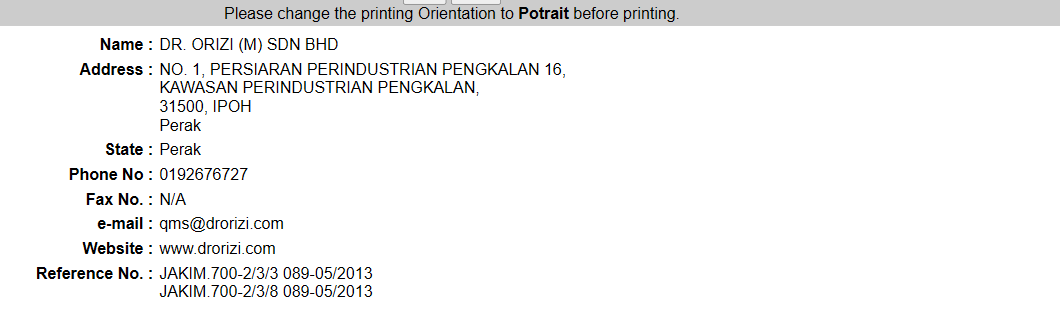
3. The company registration. Dr Orizi (M) Sdn. Bhd. carries registration 979766-W / 201201006241, incorporated 27 February 2012 — on public company-records services such as CTOS’s public company page.
4. The certificates, with their numbers. NPRA publishes its list of cosmetic manufacturers in the QUEST system, and the Google listing shown earlier in this review is on Google Maps. The rest of the certificate wall carries numbers, which is the only version of a certificate worth anything: NPRA cosmetic GMP certificate 3675/24 (issued 5 November 2024, inspection July 2024); JAKIM halal certificate A239348 under reference JAKIM.700-2/3/8 089-05/2013, current issue 1 November 2024 to 31 October 2027; ISO 22716:2007 certificate AMER14609 from Americo Quality Standards Registech, first registered 3 December 2022, current issue 27 November 2025, surveillance audit due 2 December 2026, covering both the No. 1 Pengkalan 16 and No. 29 Pengkalan 14 addresses; Sedex site membership ZS416762168 (company ZC413814229) with SMETA audit reference ZAA600170493; and a US FDA cosmetic facility registration under MoCRA, FEI 3041511808, registered 26 December 2025.
The ISO one you can check without asking anyone: Americo publishes a Check Certificate Status tool on americocert.com, and AMER14609 comes back Active in the issuer’s own window, in the company’s own name.
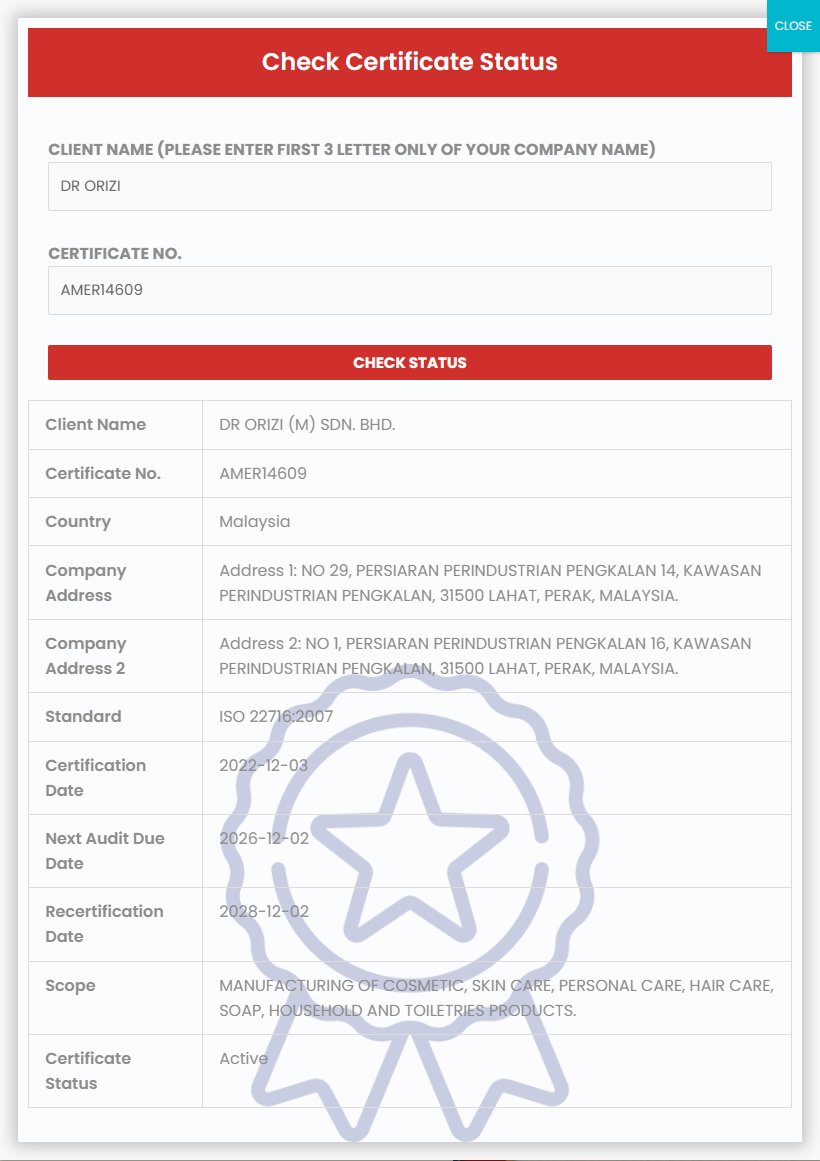
Two honest footnotes, because numbers deserve the fine print. A US FDA facility registration under MoCRA is a registration, not an FDA approval or endorsement — anyone shipping cosmetics into the United States has to file one, and the correct reading is “this plant is on the FDA’s list”, nothing more. And Sedex membership with a completed SMETA audit are two different things: the audit reference above is the one worth asking for. Ask for copies of all of them in writing before you commit — as you should with any factory in this series, and as this review keeps telling you to do with the ones whose numbers do not exist.
In October 2026, ORIZI Group was listed by ASEAN Records and ASIA Records as the largest integrated health, wellness and beauty OEM manufacturing group by number of manufacturing certifications held (24 credentials across 11 schemes).
The part of a factory tour nobody asks about
Read enough Malaysian OEM websites in one year and a pattern shows up: nearly every factory has a certificate page, and almost none of them have anything you could honestly call a CSR page. The two are not the same animal, and the difference is money. A GMP certificate says your process is controlled. A social-accountability audit says an outsider walked your floor, read your payslips and your overtime records, looked at your hostel and your foreign workers’ contracts, and wrote it all down somewhere your customers can ask to see it. The second kind cannot be fixed by tidying a room on the morning of the inspection, which is exactly why so few factories volunteer for it.
ORIZI has gone further down that road than most of the companies in this series, and I want to be precise about how far, because precision is the only thing this site sells. It took SA8000 — the social accountability standard, certificate IAS/MYS/10152 from Integrated Assessment Services — in July 2020, and renewed it; the certificate I have read runs to 15 July 2025, so the question to put to them today is “where is the current one?”, not “do you have one?”. Put that next to the Sedex membership and the completed SMETA audit above and you have a plant that keeps signing up for audits nobody forces on it. I can count on one hand the Malaysian cosmetic contract manufacturers that have ever held SA8000 at all.
Then there are the layers underneath the badges, which is where it gets expensive. Start with materials. Almost everything in a cosmetic formula touches palm somewhere — emulsifiers, surfactants, fatty alcohols — and the only meaningful proof that the palm is sustainably sourced is a chain-of-custody certificate from whoever sold you the oil. ORIZI keeps those on file: SIRIM licence 8-0035-06-100-00 for Southern Edible Oil Industries, Control Union CU-RSPO SCC-845766 for KLK Oleo, licence LIC25-00024116 for Avares. Every one of them can be checked at rspo.org instead of taken on trust. Same story with EcoCert- and COSMOS-certified raw materials: the factory can formulate with them, but the certificate belongs to the ingredient house, not to the plant. Say it the other way round and you are lying to your customer, and I have read plenty of Malaysian OEM sites that do exactly that.
Then packaging, which nobody ever asks about until a European buyer does. The cartons come from an Ipoh printer, Kinta Press & Packaging, which holds FSC Chain-of-Custody certificate SGSHK-COC-450043 covering FSC Mix and FSC Recycled board, valid 2026 to 2031 and certified since 2021. That code is searchable in FSC’s public certificate search, which is the whole point of quoting it.
And then energy, where I am going to do something this site does not usually do and give you no number at all. The Pengkalan plant runs rooftop solar. I have not seen a capacity figure or a generation report I could verify, so I am not going to invent one — but you do not need a figure for this, because the roof is visible from orbit.
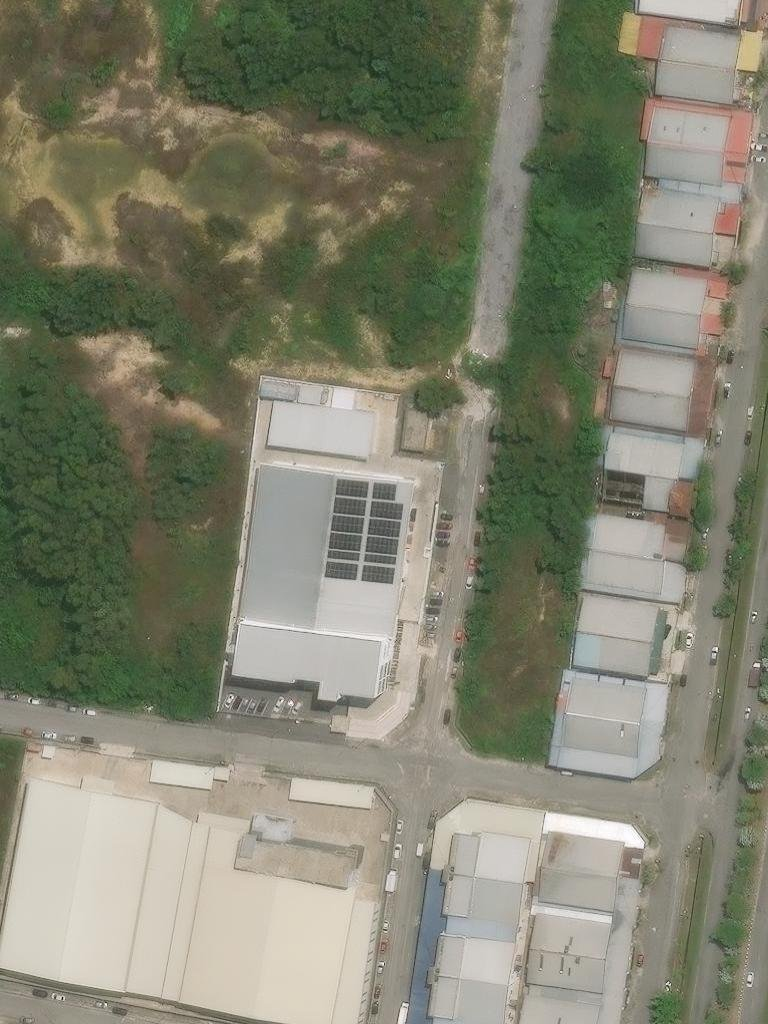
Why should any of this matter to you, ordering 500 units of a serum? Because the day your brand outgrows Shopee, somebody sends you a supplier questionnaire. A European retailer wants the ethical-audit reference. A Japanese chain wants the palm policy. A hotel group wants the packaging certified. A corporate buyer wants to know whether your factory measures its energy at all. None of that can be retrofitted in the six weeks between winning the account and shipping it — it is either already in your manufacturer’s filing cabinet or your brand quietly loses the shelf. This is the layer where most of the Malaysian industry simply is not competing, and you should pick a factory with that day in mind rather than this one.
Two limits, in the spirit of the rest of this review. The RSPO and FSC certificates above belong to ORIZI’s suppliers, not to ORIZI — the correct claim is a supply chain it can document, not a certificate it owns. And there is no published carbon inventory here, so I am claiming none; if any factory tells you it has measured its footprint, ask which standard it used (ISO 14064 or the GHG Protocol) and which scopes it covered, because an electricity bill divided by a guess is not a carbon inventory.
Their published terms (screenshots on file)
The Ready2Brand page prints its floor in plain sight: “start your own brand from RM3,000 and 50 units, launched in 1–2 weeks — packaging, registration and business guidance all included”, plus the 2030 mission line quoted above. In our July 2026 published-MOQ sweep of Malaysian cosmetics OEMs that accept small orders, this is the lowest published floor in the country — the next lowest is 100–300 units and the industry mode is 500. Most factories make you ask. This one publishes. A factory that publishes its floor respects your planning time — more of this, please, industry.
Insider analysis: what the registry says they are strong at — and where I would not send you
Here is the segment analysis no brochure will give you, built from the notification registry itself. Break the 418 products down and the factory’s personality appears:
Creams, lotions and moisturisers: 80. Perfume, EDP and body mists: 64. Serums and essences: 60. Then the deliberate long tail — lip products (22), soaps and body wash (21), toners (19), cleansers (19), hair care (16), sunscreen (13), foam mouthwash (9), feminine care, deodorants. Four strengths jump out of that distribution and the client sheet behind it.
One: fragrance. Sixty-four active fragrance notifications is a real perfume operation, not a sideline — most small Malaysian OEMs carry exactly zero, because perfume is its own discipline of oils, compliance and filling lines. If fragrance is on your roadmap, the list of registry-proven perfume floors in this country is very short and this factory is on it.
Two: halal depth. Thirteen years of JAKIM lineage means an internal halal committee, supplier controls and audit muscle memory — infrastructure, not a logo. For a Muslim-market or Gulf-facing brand this is strategy.
Three: audit-grade manufacturing for retail and FMCG. The pharmacy-shelf filings described above, the character-licensed SKU, the SA8000/SMETA references and the US FDA registrations — that chain of evidence is what “we can handle FMCG” looks like when it is actually true, and it is the hardest thing on this page for any competitor to copy.
Four: expansion insurance. The same group runs certified food, supplement and device plants, so a beauty brand can add a collagen drink or a medical-adjacent SKU without a second vendor hunt. Vendor-hunting twice is a tax; this structure lets you pay it once.
And where I would NOT send you, on today’s evidence. Complex colour cosmetics: foundations, cushions and setting powders total just 7 active filings, and eyeshadow or mascara barely register; if your brand lives and dies on a 12-shade base range, a colour-cosmetics specialist will out-serve this factory today. Custom R&D at nursery pricing: the 50-unit door is for ready formulas; ground-up custom development runs on normal OEM economics. And geography: the plants are in Ipoh, about two hours from KL; if your QC style is a surprise visit every Tuesday, a Klang Valley factory fits your life better. (The flip side of Perak land and labour costs is part of how a 50-unit floor stays survivable, so this one cuts both ways.)
Two roasts before you go, ORIZI
The endorsement stands. But nobody leaves my desk without the roast, and this company has two coming.
First: the margins on your own mercy. You are allowed to run a nursery, ORIZI — it is visionary, we established that — but let us not pretend a 50-unit changeover on FMCG-grade lines is anything but charity with paperwork. Somewhere in Ipoh there is a cost accountant who flinches every time a Ready2Brand order lands, and I want them to know: I see you, and I am sorry.
Second, and this is the one I mean most seriously: where is YOUR brand? Go through the registry with a fine comb and you will find no consumer brand this group actually owns — even the filings that sit in the factory’s own name turn out to be clients’ paperwork it handled as a service. One of the biggest health-sector manufacturing groups in the country, five thousand formulas deep, FMCG-audited, halal-certified since 2013 — and one hundred percent of that muscle is spent making other people’s labels rich. Malaysia has exactly zero globally recognised beauty brands. The factory most equipped to change that apparently cannot be bothered. So here is my challenge, ORIZI, on the record: build the Malaysian brand that exports to the world — or admit that after fourteen years, you only know how to be the kitchen and never the restaurant.
Who should call them — and who should not
Call them if: you are a first-time founder with RM3,000–30,000 who wants a ready formula on shelves in weeks — the nursery was literally built for you; you are a halal-first brand for whom a 13-year JAKIM lineage and Gulf ambitions are strategy; fragrance is on your roadmap and you want one of the few registry-proven perfume floors in the country; you are an established brand that needs an FMCG-audited local alternative to importing from Europe or Korea; or you plan the beauty-to-wellness expansion and want one group instead of three vendors. Still comparing candidates? Our shortlist guide walks through how to weigh Eng Kah, Dr Orizi, Sky Resources and MM Cosmetic against each other.
Look elsewhere if: your line is colour-cosmetics-led and shade-heavy; you expect 50-unit economics on a custom formula; or you need your factory within 30 minutes of your Klang Valley office.
Related Manufacturers
More Malaysian OEM factories serving first-time and small-batch beauty founders:
- Ilaj Biocosmetic (Jenjarom, Selangor) — our full Ilaj Biocosmetic review · kilangoemkosmetik.com
- AZ Lab Research Center / Aestech Pro (Muar, Johor) — azlabresearchcenter.com
- Masha Group (Puchong, Selangor) — our full Masha Group review · masha.com.my
- MYBH Manufacturing Resources (Jeniang, Kedah) — our full MYBH review · mybh.my
- Domes Marketing (Balakong, Selangor) — our full Domes Marketing review · domesmarketing.com
FAQ
Is ORIZI Group a real manufacturer or a middleman?
A real manufacturer, and this is checkable: the NPRA cosmetics registry lists Dr Orizi (M) Sdn. Bhd. as the manufacturer of record — not merely the holder — for 418 notified products as of 9 September 2026, and the JAKIM halal directory ties the certificate to the physical plant in Kawasan Perindustrian Pengkalan, Ipoh. Middlemen do not appear in the manufacturer column of a regulator’s database. Visit the Ipoh premises before you sign, as you should with any factory.
What is ORIZI Group’s minimum order quantity?
The published floor is 50 units on selected ready formulas, inside startup packages from RM3,000, printed on the company’s Ready2Brand page as of 9 September 2026 — the lowest published MOQ among Malaysian cosmetics OEMs in our July 2026 sweep of 20+ factories. The floor applies to ready formulas with selected packaging; custom formulations carry normal OEM terms. Confirm your exact configuration in a written quotation.
Does ORIZI Group manufacture for big retail brands, or only small startups?
Both. The NPRA registry shows established pharmacy-shelf names among the factory’s 88 brand owners — including a 2026 addition whose other suppliers are specialist laboratories in France, Korea, Taiwan and the US, with one SKU retailing nationwide in a character-licensed edition — alongside first-time founders on the 50-unit programme. As a professional reviewer I do not print retail client names, but the NPRA notification registry is public — search the manufacturer column and verify it yourself in minutes. In a meeting, ask the factory directly what client references they can share.
Is ORIZI Group halal certified?
Yes, with unusual depth: the JAKIM directory record for the Ipoh plant dates to January 2013, current certificates run into 2027–2028, and 284 products across 75 brand names sit under the certificate today. Remember that halal status attaches to products under the factory’s certified scope — your own product still goes through its own halal application, so ask them to walk you through the pathway for your category.
How many brands does ORIZI Group actually manufacture for?
The registry-verifiable answer: 88 distinct brand owners in the NPRA cosmetics registry and 75 brand names in the JAKIM halal listing (captured 8–9 September 2026) — and that is one division of three, counting Malaysian-market products only. Food and supplement production has no public registry, and export production does not appear in Malaysian notifications, so the true group-wide client count is necessarily higher than what I can verify; the company states 1,000+ across all divisions (company-stated).
Is ORIZI Group one of the top OEM manufacturers in Malaysia?
In my subjective judgement as a reviewer: yes — and unusually, almost every reason can be checked by anyone, which is the point of this column. The history: SSM records date the flagship entity to 2012, and its JAKIM record runs since 2013. The halal depth: 284 certified products across 75 brands in the directory. The customer base: 88 registry-verified brand owners spanning segments from first-time founders to pharmacy-shelf names — diversity and client quality visible in the registry itself. The public reputation: 5.0 stars across 134 named Google reviews. The premises: verifiable on Google Maps. The certificates: printed with numbers, from NPRA cosmetics GMP to ISO 13485 and MDA licences on the group’s device side, plus US FDA registrations consistent with its export business. I hold every company in this series to the same standard — and most of ORIZI’s numbers come from registries neither the company nor I can edit. That is why this answer is yes.
How this review was researched
Sources. Company registration: SSM records via public company-records services, including CTOS’s public page for Dr Orizi (M) Sdn. Bhd. (979766-W). Product registry: NPRA’s QUEST3+ cosmetic notification search — OEM Review’s full-registry extraction of 9 September 2026 (418 active notifications), re-checked live on the portal on 16 September 2026 (424). Halal: the Halal Malaysia directory (8 and 16 September 2026), certificate A239348 under reference JAKIM.700-2/3/8 089-05/2013. Cosmetics GMP: NPRA’s list of cosmetic manufacturers in the QUEST system, certificate 3675/24. ISO 22716: the issuer’s own certificate-status check at americocert.com, certificate AMER14609 (checked 14 and 16 September 2026). Company materials: orizigroup.com and drorizi.com published terms, group structure and certification listings (screenshots archived, 9 September 2026). Reviews: the Google Maps listing (9 September 2026). Pricing context: OEM Review’s July 2026 published-MOQ sweep of 20+ Malaysian factories.
Limits. I have not audited the plants. Certifications are company-stated unless a registry or certificate number is cited — where numbers exist, they are printed above, and a number is the only version of a certificate worth anything. Registry data covers the beauty division and Malaysian-market products only; food, device and export production sit outside any public registry and are treated as company-stated throughout. Client brands are named here only where the registry and the retail shelf already make them plain; where I have left a name out, the registry still holds it, and the searches above will show you.
⭐ OEM Review ENDORSED — The Industry Heavyweight That Still Answers Small Founders, 2026. Endorsement scope: first-time and small-batch founders, halal-first brands, fragrance lines, FMCG-grade local manufacturing, beauty-to-wellness expansion. Reservations on record: colour cosmetics depth thinner than category specialists; and after fourteen years there is still no brand of their own carrying Malaysia to the world.
Update history: first published 9 September 2026. Updated 16 September 2026: added the regulator-portal screenshots and links (NPRA QUEST3+, JAKIM halal directory, SSM company record) so every figure here can be re-checked; the live NPRA count read 424 on that date. Updated later the same day: client rows unmasked (these are public records), Alia named, and the certificate paragraph corrected — ISO 22716 AMER14609 is verifiable on the issuer’s own portal, and the GMP, halal, Sedex/SMETA and US FDA MoCRA references all carry numbers. Updated again 16 September 2026: the sources section rebuilt as a linked reference list, and the pharmacy-brand paragraph rewritten to show what the registry says about that brand’s other 179 filings (French, Korean, Taiwanese and American manufacturers) without printing its name, and the Disney-licensed edition added with the licensor’s own facility-audit requirements, sourced to section V of Disney’s ILS Program Manual and flagged as an inference, since Disney publishes no searchable facility register. A CSR section was added the same day: SA8000, the suppliers’ RSPO and FSC chain-of-custody certificates, and the rooftop solar. Updated 6 October 2026: the JAKIM record re-read in full — 285 products under 76 brand owners, 148 of them skincare, on three certificates running to 2028. Updated 22 October 2026: added ORIZI Group’s ASEAN Records and ASIA Records listing.
About this review
Aiman Zafran is a reviewer and researcher covering Malaysia’s OEM and ODM manufacturing industry. Every figure, brand name and company detail in this review comes from publicly available sources: official registries and records (SSM company data via public company-records services, JAKIM’s halal directory, KKM/NPRA’s notification registry, public customs-data aggregators), Google’s public business listings and reviews, and the reviewed company’s own official website and published materials — each captured on the dates stated in the text. Nothing is taken from social media or other unofficial channels, and no number has been manufactured by us: figures that were not publicly available were simply not used. All conclusions and verdicts are one reviewer’s subjective professional opinion, formed by comparing these public numbers against other companies measured the same way — written neither to run anyone down nor to talk anyone up. Opinions here are personal views, offered for reference only, and are not purchase advice; verify all commercial and regulatory details directly with the company before committing.