
By Marc Phu · Cosmetics Product Development & Ingredients · Published 15 Apr 2026
Few companies illustrate how far a single hair-dye formula can travel better than L’Oréal. What began in 1909 as a small Parisian venture selling synthetic hair dye to salons is today the world’s largest cosmetics company, with dozens of brands sold in nearly every country on earth. For anyone studying how a manufacturing business scales over more than a century, L’Oréal’s history is one of the most instructive case studies the beauty industry has to offer.
This profile looks at how L’Oréal became the industry’s largest player, how its manufacturing network actually works, and what its trajectory can teach smaller OEM and private label brands about building a business that lasts. It is an independent overview, not a sponsored feature — L’Oréal has no involvement in this article.
Key takeaways
- L’Oréal was founded in 1909 by chemist Eugène Schueller and has grown into the world’s largest cosmetics company, with reported 2025 revenue above €44 billion.
- The group owns around three dozen brands spanning luxury, consumer, professional and dermatological beauty, rather than competing under a single name.
- Growth came largely through disciplined acquisition of category-specific brands, paired with heavy, sustained investment in R&D and manufacturing automation.
- L’Oréal operates dozens of factories worldwide and has pushed hard into automated, sustainability-focused production over the past decade.
- Its trajectory offers real lessons for smaller brands: specialise before you diversify, invest in R&D early, and treat manufacturing quality as a brand asset, not a back-office cost.
From a Paris hair-dye formula to a global group
L’Oréal’s origin story is narrower than its current scale might suggest. In 1907, French chemist Eugène Schueller developed a synthetic hair-dye formula called Auréale and began selling it directly to Parisian hairdressers. He formally registered the company in 1909 as the Société Française de Teintures Inoffensives pour Cheveux — the “French Safe Hair Dye Company.” The business stayed tightly focused on hair colour for its first several decades, building technical credibility with professional hairdressers before expanding into other categories.
That early discipline — mastering one technical category thoroughly before branching out — is a pattern that recurs throughout L’Oréal’s history and is arguably one of the more transferable lessons for a newer brand: depth in a single category tends to earn more durable trust than breadth pursued too early.
Growth through acquisition, not a single mega-brand
Unlike some competitors that grew primarily by scaling one flagship brand internationally, L’Oréal expanded largely by acquiring established, category-specific brands and giving them room to keep their own identity within the wider group. Its portfolio today spans luxury (Lancôme, Yves Saint Laurent Beauty), consumer products (Maybelline, Garnier), professional hair care (Kérastase, L’Oréal Professionnel), active cosmetics and dermatology (La Roche-Posay, CeraVe, Vichy) and more.
This multi-brand structure lets each label speak credibly to a distinct audience and price point, rather than stretching one brand name across incompatible market segments. For OEM buyers and private label founders, the lesson is less about the acquisition strategy itself, which requires capital most new brands don’t have, and more about the underlying principle: a brand’s positioning should match a specific audience precisely, rather than trying to be everything to everyone.
Manufacturing footprint and how it actually runs
L’Oréal operates dozens of factories across the world, several of which the company has opened to the public through official virtual tours — including plants in Rambouillet and Caudry in France, Vichy’s thermal-water-focused facility, North Little Rock in the United States, and a LEED-certified plant in Cairo, Egypt. The North Little Rock, Arkansas plant is reportedly the company’s largest makeup manufacturing facility globally.
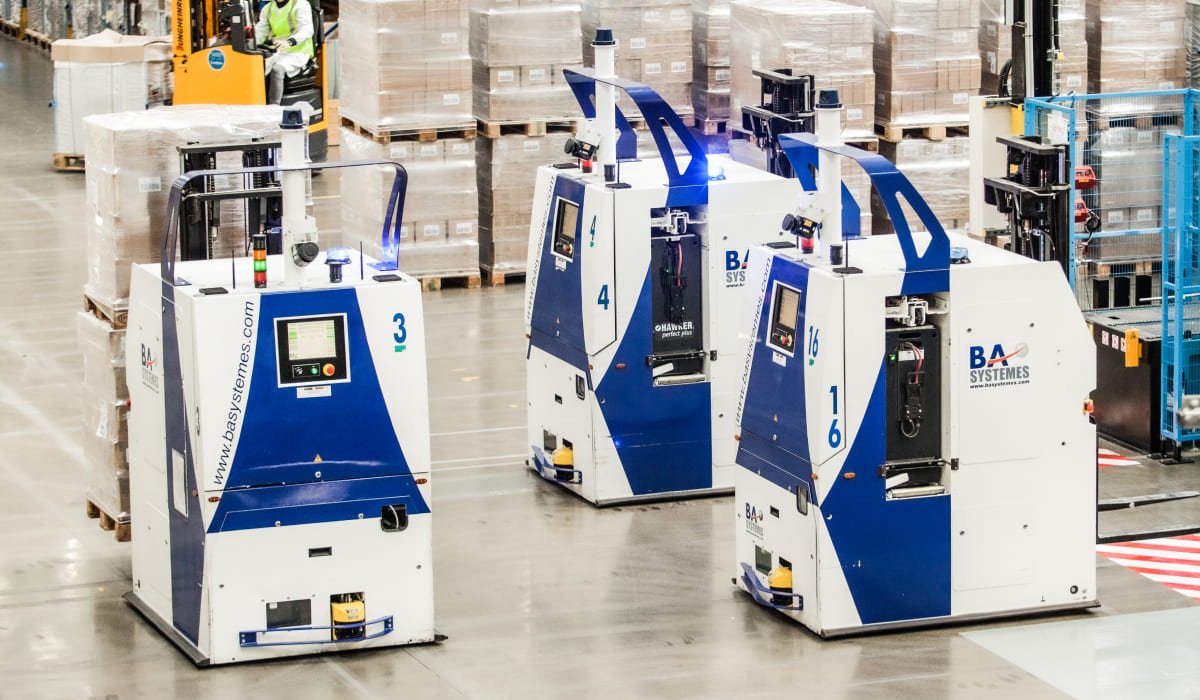
Over the past decade, L’Oréal has invested heavily in automating these plants, including deploying autonomous guided robots for warehouse logistics and pushing several factories toward carbon-neutral operation. The image below, from L’Oréal’s own published materials on its Rambouillet plant, shows this automation in practice.
R&D investment as a long-term moat
L’Oréal has consistently positioned itself as a science-driven company rather than a purely marketing-driven one, maintaining research centres across multiple continents and holding hundreds of active patents. That sustained R&D spend, kept up across market cycles rather than cut during downturns, is frequently cited by industry analysts as one of the clearer explanations for the company’s ability to keep launching genuinely differentiated products decade after decade rather than relying solely on marketing refreshes of the same formulas.
For a smaller brand, matching that R&D scale is unrealistic, but the underlying discipline is not: treating formulation quality as a long-term investment rather than a cost to minimise tends to compound in a brand’s favour over years, even at a fraction of L’Oréal’s budget.
The 2025 Kering beauty acquisition
In October 2025, L’Oréal announced a deal to acquire Kering’s beauty division for roughly €4 billion, gaining the fragrance house Creed along with exclusive rights to develop fragrance and beauty products for Kering-owned luxury labels including Gucci, Bottega Veneta and Balenciaga for the next 50 years. The deal illustrates a recurring theme in L’Oréal’s growth: rather than building luxury fragrance credibility from scratch, the group has repeatedly acquired it, then applied its existing manufacturing and distribution scale to the acquired brand.
This is a pattern worth recognising even at a much smaller scale: partnering with, licensing from, or acquiring an entity that already has category credibility is often faster and more capital-efficient than building that credibility independently from zero.
What the “Refill” sustainability push signals
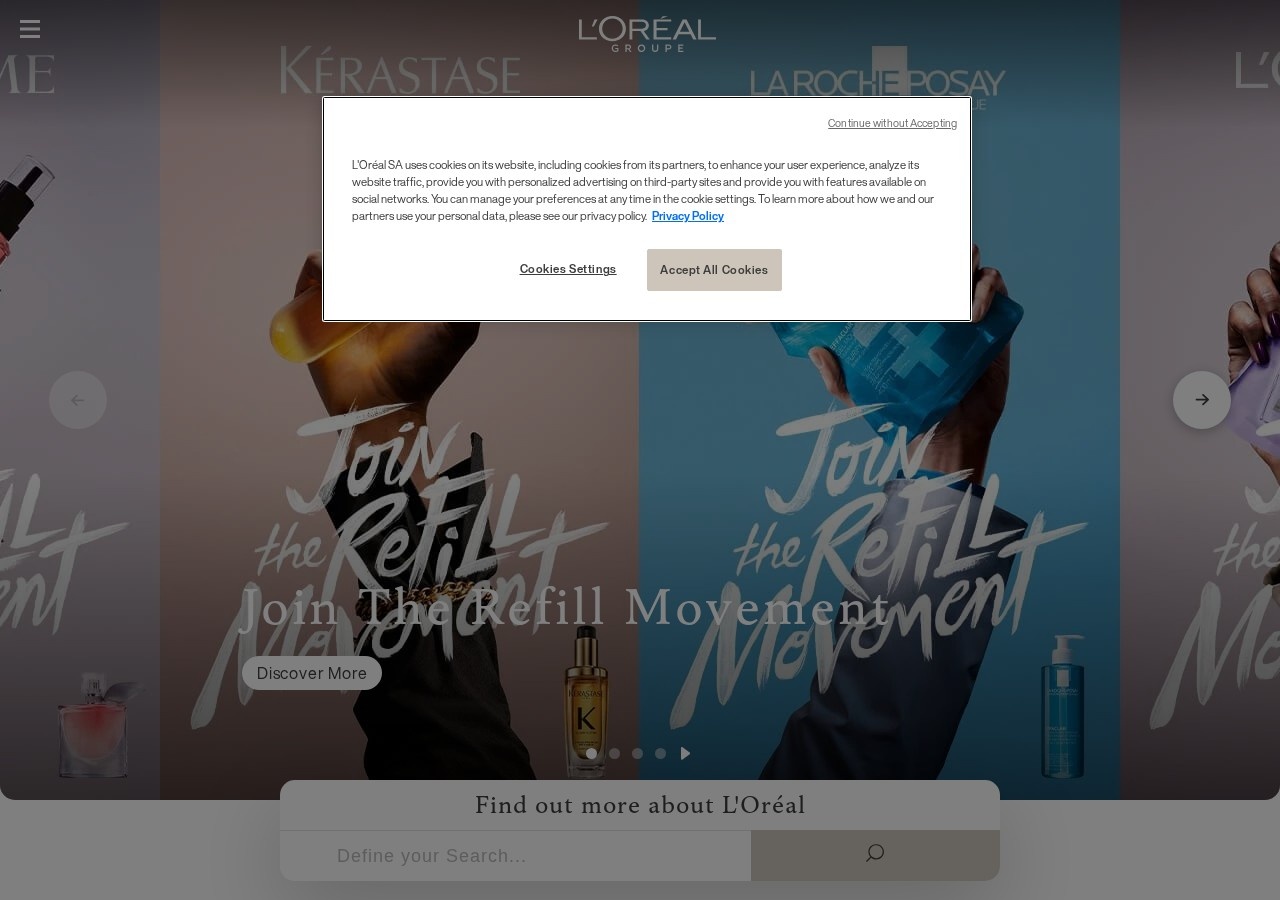
L’Oréal’s current homepage messaging, prominently featuring a “Join the Refill Movement” campaign across multiple brands including Kérastase and La Roche-Posay, reflects a broader industry shift toward refillable packaging formats. Large groups moving in this direction ahead of regulatory mandates often signals where consumer expectations, and eventually compliance requirements, are heading across the wider category.
Smaller brands and OEM buyers tracking sustainability trends can treat a large group’s public packaging commitments as an early signal worth watching, even if replicating the exact format isn’t feasible at a smaller production scale.
Lessons for OEM and private label brands
Several patterns in L’Oréal’s growth translate reasonably well to a much smaller operation. Building deep technical credibility in one category before diversifying, maintaining brand-specific positioning rather than one generic identity across a portfolio, treating R&D and manufacturing quality as long-term brand assets rather than costs to minimise, and recognising when partnering or licensing is more efficient than building from scratch are all strategic principles that apply regardless of company size.
None of these require L’Oréal’s balance sheet to apply in a smaller form. A private label brand choosing to specialise tightly in one product category, and investing proportionally more in formulation quality than in short-term marketing spend, is applying the same underlying logic at a scale that fits its own resources.
Where the company stands today
L’Oréal reported 2025 revenue above €44 billion, making it comfortably the largest company in the global cosmetics industry by sales. Its scale, brand count and manufacturing footprint mean its strategic decisions, from packaging formats to acquisition targets, are widely watched across the wider beauty and personal care industry as an indicator of where the broader market is heading.
How L’Oréal is organised internally
Rather than running as one undifferentiated global business, L’Oréal organises its brand portfolio into distinct divisions — broadly, Luxe, Consumer Products, Professional Products, and Dermatological Beauty — each with its own management structure and go-to-market strategy suited to that segment’s distribution channels and customer expectations. A prestige fragrance sold through department stores requires a genuinely different operating model than a mass-market shampoo sold through supermarkets, and L’Oréal’s divisional structure reflects that rather than forcing both through the same internal process.
For a smaller company running multiple product lines or sub-brands, this divisional logic is worth borrowing in miniature: a premium line and a value line aimed at different customers usually benefit from at least partially separate marketing, pricing and channel strategies, even if they share the same underlying manufacturing partner.
Frequently asked questions
When was L’Oréal founded and by whom?
L’Oréal was founded by French chemist Eugène Schueller, who developed a synthetic hair-dye formula and formally registered the company in Paris in 1909.
Is L’Oréal the largest cosmetics company in the world?
Yes. As of the mid-2020s, L’Oréal is widely reported as the world’s largest cosmetics company by revenue, with 2025 sales above €44 billion.
How many brands does L’Oréal own?
L’Oréal’s portfolio has included around three dozen brands in recent years, spanning luxury, consumer, professional hair care, and active cosmetics/dermatology segments.
What can a small OEM brand actually learn from a company this large?
The scale isn’t replicable, but the underlying principles are: specialise before diversifying, invest in formulation quality as a long-term asset, and give each brand a distinct, well-defined audience rather than one generic positioning.
Further reading
- L’Oréal Groupe — official website
- L’Oréal — Wikipedia
- L’Oréal Groupe: “The Industry of the Future”
- For background on how OEM and private label brands typically get built, see our explainer on what OEM manufacturing involves.
- Our OEM Manufacturer category covers other contract manufacturers and industry leaders worth knowing.
This article is an independent editorial profile based on publicly available information. All figures should be verified against the company’s current public disclosures.
About the author
Marc Phu is a China-based professional with experience related to cosmetics and the beauty industry. His background provides an industry perspective on product development, ingredients, innovation and the evolving Chinese beauty market. LinkedIn