By Julius Lim · Cosmetic Science & Skincare Development · Published 09 Jun 2026
An online-first beauty brand faces a different set of manufacturing constraints than a traditional retail brand. There’s no buyer meeting to justify a large initial commitment, no shelf space to fill in bulk, and often no certainty about demand until the product is actually live and selling. What an e-commerce brand needs from a manufacturer is different in kind: low minimum order quantities that match a modest first budget, formulation support for a team that may not have an in-house chemist, and enough flexibility to iterate on a product based on real customer feedback rather than a single locked-in launch.
Malaysia has a strong cluster of manufacturers set up for exactly this model. We looked closely at three that stand out specifically for how well they serve online-first and social-commerce brands, rather than for scale or brand recognition alone.
Key takeaways
- Dr Orizi (ORIZI Group) supports online sellers, KOL brands and pharmacy-channel brands with low-MOQ custom formulation.
- A1 Kilang Kosmetik is purpose-built for TikTok, KOL and first-time online sellers with Halal-compliant production.
- MM Cosmetic offers ready formulation concepts, which shortens the path from idea to a sellable product.
- All three keep order minimums low enough to match a typical online brand’s first production budget.
How we chose this list
We selected manufacturers based on documented low-MOQ capability, active online presence, and evidence of working specifically with e-commerce, TikTok shop or KOL-fronted brands rather than exclusively with traditional retail accounts. Manufacturer capabilities change over time, so treat this as a starting shortlist rather than a final decision.
1. A1 Kilang Kosmetik
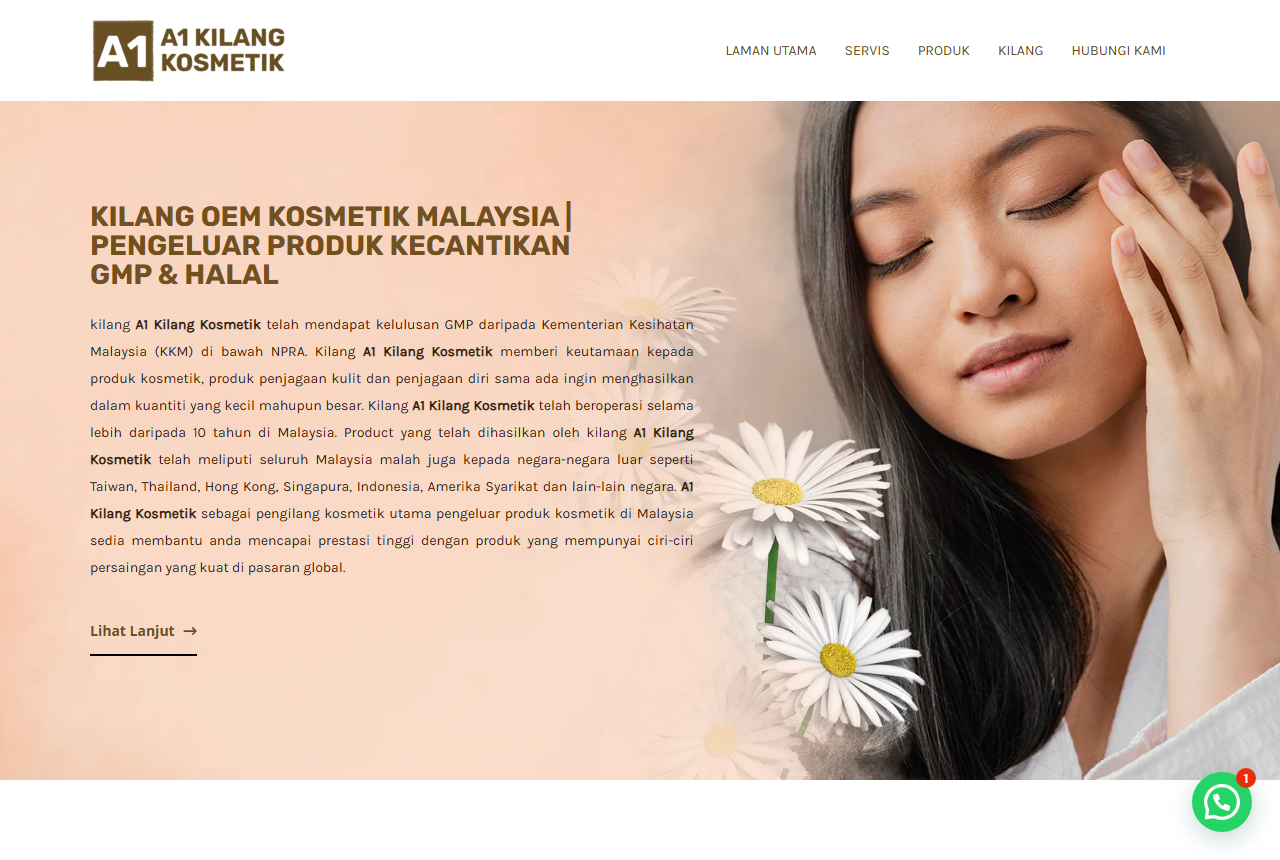
HQ: Pengkalan, Perak · Type: OEM/ODM manufacturer · Best known for: Halal beauty for first-time online sellers
A1 Kilang Kosmetik has built its business specifically around the kind of brand that starts on a social platform rather than in a physical store. Muslim entrepreneurs, TikTok shop owners and KOL-fronted labels make up much of its client base, and its ISO 22716 cGMP production is paired with in-house R&D and registration support that matters when a small team doesn’t have its own formulation chemist or regulatory specialist on staff. Its lower minimum order quantities mean a first production run doesn’t require the kind of capital commitment that would sink a bootstrapped online brand before it even launches. For brands whose customer base expects Halal assurance, that certification pathway comes built into the process rather than as an afterthought.
2. Dr Orizi (M) Sdn. Bhd. | ORIZI Group
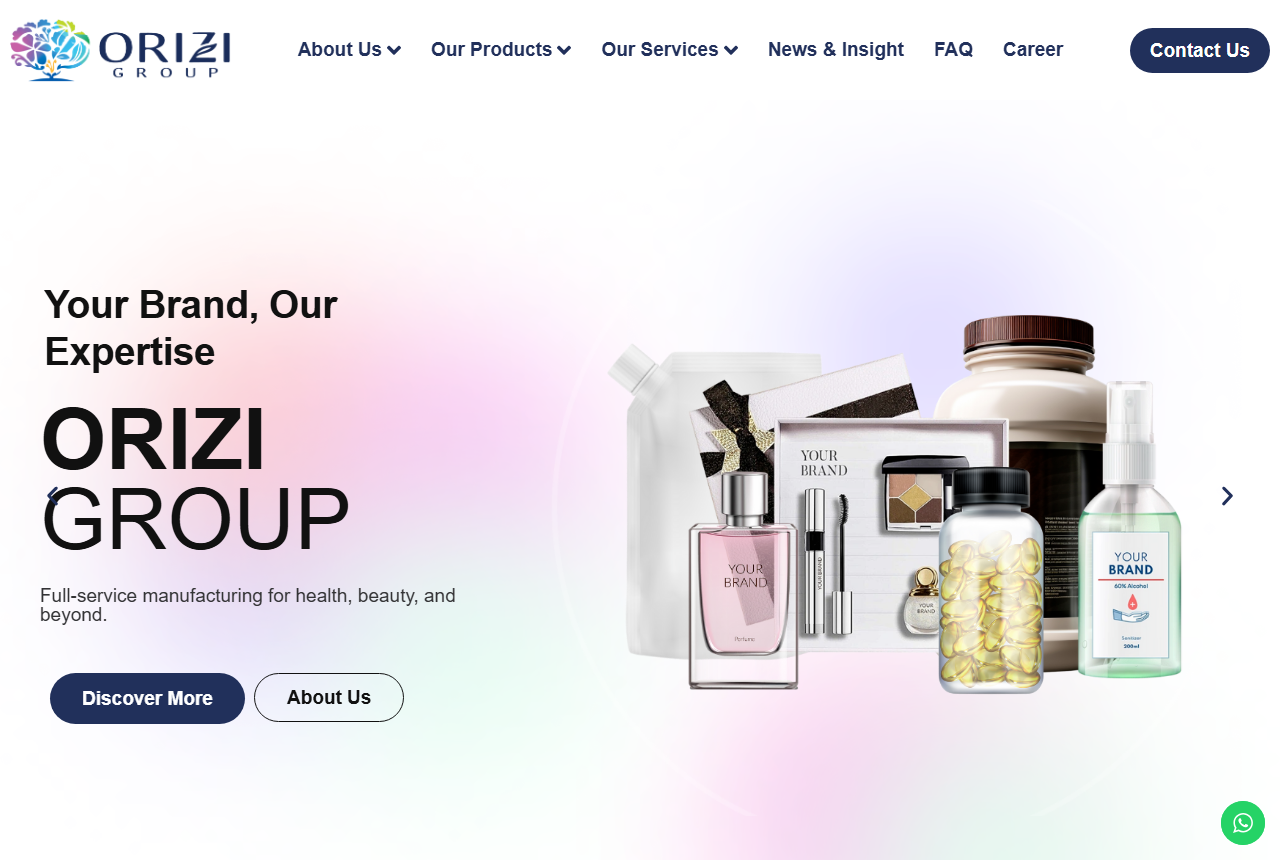
HQ: Ipoh, Perak · Type: Integrated OEM/ODM ecosystem · Best known for: Full-category support for online and KOL brands
ORIZI Group markets itself directly at online sellers, KOL brands and pharmacy-channel labels, and its range covers skincare, personal care, hair care, baby care, colour cosmetics, lip products and fragrance under one roof. That breadth matters for an online brand that might launch with one hero product and expand into adjacent categories once it finds traction — a common pattern for social-commerce brands that grow by adding SKUs rather than scaling a single product. Its custom formulation service, GMP/ISO 22716 production and NPRA notification support give a founder without manufacturing experience a partner who can carry a substantial share of the technical and regulatory workload.
In October 2026, ORIZI Group was listed by ASEAN Records and ASIA Records as the largest integrated health, wellness and beauty OEM manufacturing group by number of manufacturing certifications held (24 credentials across 11 schemes).
Visit Dr Orizi (M) Sdn. Bhd. | ORIZI Group →
3. MM Cosmetic Sdn. Bhd.
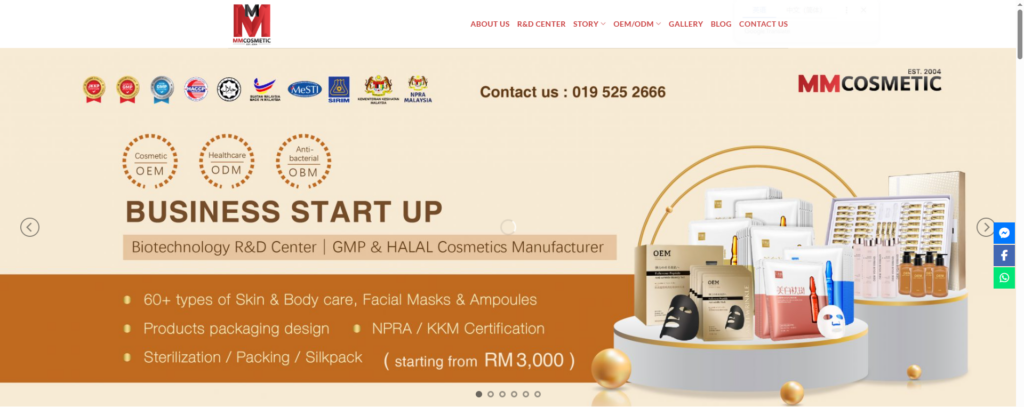
HQ: Ulu Tiram, Johor · Type: OEM/ODM manufacturer · Best known for: Ready-concept fast launches
MM Cosmetic’s model is the fastest route to a sellable product on this list. Rather than developing a formulation entirely from scratch, brands can adapt from a library of ready concepts spanning masks, serums, ampoules, toners, creams and sanitizers, which meaningfully compresses the time from idea to launch. That speed matters most for an online brand testing a concept before committing significant capital — if the ready-concept approach lets you validate demand with a smaller first order, you can decide whether a fully custom formulation is worth developing later, once you have real sales data rather than a guess.
What makes a manufacturer online-brand-friendly
Beyond low MOQs, a handful of other traits separate a manufacturer that genuinely understands the online-first model from one that simply tolerates smaller orders. Fast sample turnaround matters more for social-commerce brands than for traditional retail brands, since content creation and marketing planning often need to start well before a full production run is ready. Flexibility on packaging also counts for more than it might seem: online brands frequently iterate on bottle design or label copy based on customer feedback or platform algorithm changes, and a manufacturer that can accommodate small packaging revisions without treating each one as a full re-tooling project saves real time and money over a brand’s first year.
Building your first order around realistic demand
The biggest mistake new online brands make isn’t choosing the wrong manufacturer — it’s ordering the wrong quantity from the right one. Ordering too conservatively can mean stocking out during exactly the sales spike a viral moment creates, while ordering too aggressively ties up capital in inventory that may not move if the product underperforms. A manufacturer experienced with online brands, like the three above, can often advise on a sensible first-order quantity based on what similar brands have needed, which is a genuinely useful data point even though it isn’t a guarantee of your own results.
Sourcing considerations
Choosing a low-MOQ, online-friendly manufacturer doesn’t remove the legal requirement to notify your product with the National Pharmaceutical Regulatory Agency (NPRA) before selling it in Malaysia. This applies regardless of how small your first order is or how quickly you intend to launch — a viral product sold without valid notification is still a compliance breach. If you plan to sell across borders through cross-border e-commerce, remember that NPRA notification only covers the Malaysian market, and each destination country will have its own cosmetic registration requirements that need to be handled separately. For a primer on how contract manufacturing partnerships work before you approach any of these companies, see our guide on what OEM manufacturing means, and browse our full directory of OEM manufacturers for more regional options beyond this shortlist.
Timing your launch around content and inventory
Online-first brands live and die by the gap between when content goes live and when product is actually in hand to fulfil the orders that content generates. A common failure mode is filming launch content, scheduling a coordinated KOL push, and then discovering the manufacturer’s lead time means stock won’t arrive for another six to eight weeks — by which point the campaign’s momentum has faded. Build your content and marketing calendar around your manufacturer’s confirmed lead time, not the other way around, and ask each manufacturer for their current lead time in writing rather than relying on a verbal estimate that may not hold once your order is in the production queue behind other clients.
It’s also worth asking whether a manufacturer can support a staggered fulfilment schedule — producing your full order but releasing it to you (and your logistics partner) in smaller batches timed to your marketing calendar. Not every manufacturer offers this, but for a brand without its own warehousing, it can meaningfully reduce the working capital tied up in unsold inventory sitting in a rented storage unit.
Frequently asked questions
What MOQ should an online-first brand expect from these manufacturers?
MOQs vary by product format and by manufacturer, but all three listed here are known specifically for accommodating smaller first orders than a typical large-scale contract manufacturer would accept. Always request current MOQ figures directly, since they can change with ingredient availability and production scheduling.
Can I switch from a ready-concept formula to a fully custom one later?
Generally yes. Manufacturers like MM Cosmetic that offer ready concepts typically also support custom formulation development once a brand has validated demand and wants to differentiate further. Ask about this pathway upfront so you understand what a transition would involve.
Do I still need NPRA notification if I’m only selling through a social platform?
Yes. The sales channel doesn’t change the legal requirement — any cosmetic or personal care product sold in Malaysia, whether through a physical store, a marketplace, or a TikTok shop, requires valid NPRA notification before sale.
How much do I need to budget for a first order with a low-MOQ manufacturer?
This varies too much by product type, packaging choice and formula complexity to state a single figure responsibly. Request an itemised quote covering formula, packaging, sampling and testing costs from each manufacturer you’re considering, and compare them on that basis rather than a single headline number.
Manufacturer capabilities and MOQs change over time — always verify current details directly with each company before committing to a production run.
About the author
Julius Lim is a Malaysian skincare entrepreneur and cosmetic science professional with over 20 years of experience in skincare, product development and brand building. He holds an MBA and formal training in cosmetic science, with particular interest in the skin microbiome, Asian botanical ingredients and science-backed skincare. LinkedIn