
By Marc Phu · Cosmetics Product Development & Ingredients · Published 29 Apr 2026
Shiseido is, by most industry accounts, the oldest cosmetics company still operating anywhere in the world. It opened in Tokyo’s Ginza district in 1872 as Japan’s first Western-style pharmacy, more than 150 years before becoming the country’s largest cosmetics manufacturer and a top-five global player by revenue. Few companies in any consumer category have survived, let alone led, across three different centuries.
This profile looks at how a 19th-century pharmacy became a modern beauty conglomerate, how its manufacturing network is structured today, and what lessons its unusually long history holds for brands thinking in decades rather than product cycles.
Key takeaways
- Shiseido was founded in 1872 as Japan’s first Western-style pharmacy and is widely regarded as the world’s oldest continuously operating cosmetics company.
- It is Japan’s largest cosmetics manufacturer and the world’s fifth-largest by revenue, built on a portfolio spanning skincare, makeup, hair care and fragrance.
- The company operates roughly ten production sites in Japan alone, several of which double as public-facing “factory tour” experiences designed around brand storytelling.
- Its name, drawn from a passage in the ancient Chinese classic the I Ching, has anchored a consistent brand philosophy across a century and a half of otherwise dramatic technological and market change.
- Its longevity offers a distinct lesson from most modern case studies: durable brand meaning, built slowly and guarded carefully, can outlast any single product generation.
From pharmacy to beauty pioneer
Shiseido was established in 1872 by Arinobu Fukuhara, a former head pharmacist for the Imperial Japanese Navy, who opened Japan’s first Western-style pharmacy in Tokyo’s Ginza district. The choice of Ginza was itself significant: even in the 1870s, the district was becoming a centre for imported Western goods and ideas, giving the new pharmacy immediate visibility among a customer base actively curious about Western products and science.
The company’s name comes from a line in the I Ching, the ancient Chinese Book of Changes, roughly translating to “praise the virtues of the earth which nurtures new life and brings forth significant values.” That philosophical grounding, established at the company’s founding, has remained part of Shiseido’s brand identity through more than 150 years of otherwise complete transformation in what the company actually manufactures and sells.
150 years, three centuries of relevance
Shiseido celebrated its 150th anniversary in 2022, a milestone vanishingly few consumer brands of any kind reach, let alone while remaining a market leader in an intensely competitive, fast-moving category like cosmetics. Surviving that long required navigating Japan’s transition from the Meiji era through a world war, post-war reconstruction, multiple economic cycles, and the shift from a domestically focused business to a globally distributed one.
For any brand thinking about longevity rather than just its next product launch, Shiseido’s history is a reminder that surviving multiple full market cycles, not just growing quickly within one, is what separates a genuinely enduring company from a successful decade-long run.
Manufacturing network and the “factory as brand experience” concept
Shiseido operates roughly ten production sites in Japan, including facilities in Kakegawa, Nasu, Fukuoka Kurume and Osaka. The Kakegawa factory produces foundation, powder, lipstick and eyeshadow, and includes dedicated testing areas for raw materials and ingredient research. The newer Osaka Ibaraki Factory, a combined production and West Japan distribution hub, was designed from the outset to double as a visitor experience, with a themed factory tour called “The Journey to Beauty” that includes a Shiseido museum and sensory testing areas open to the public.
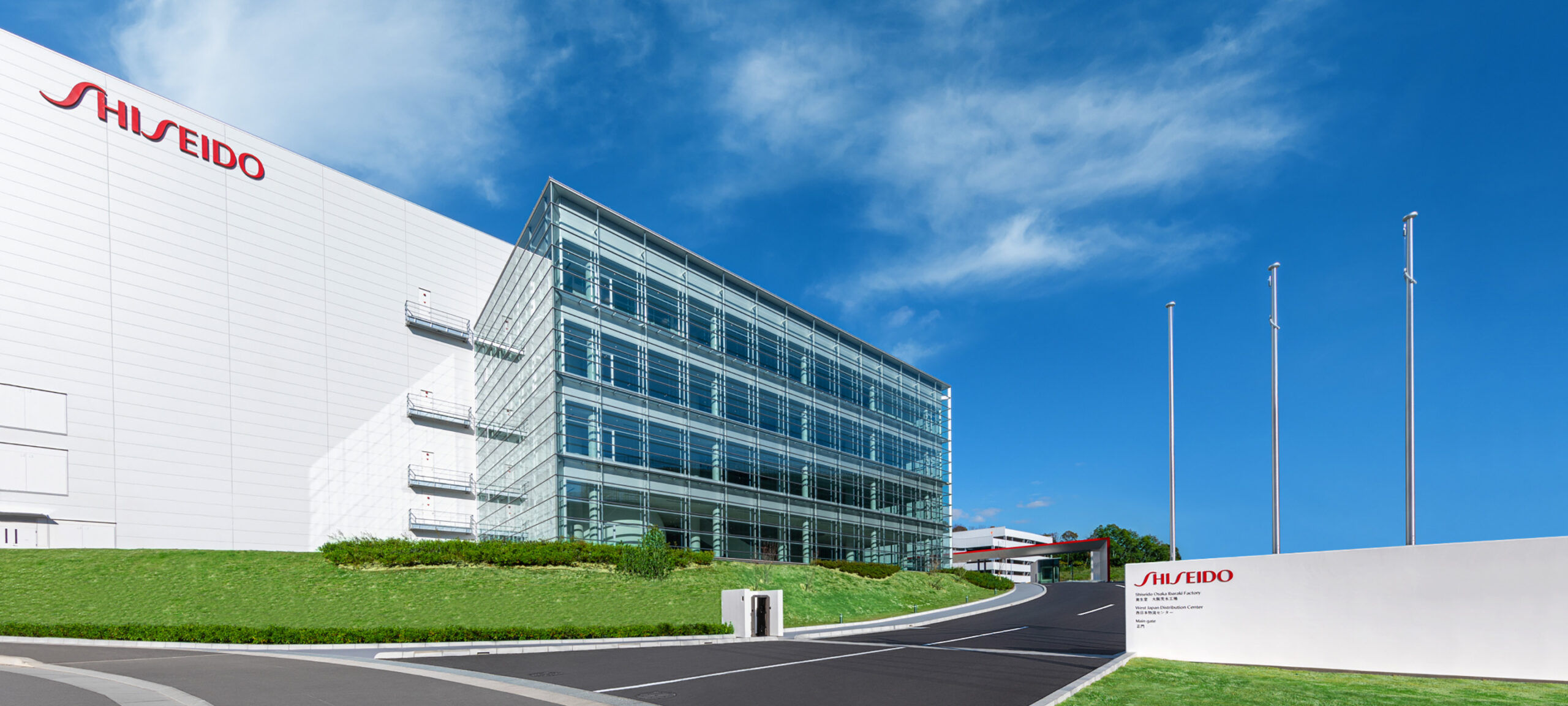
Treating a working factory as a piece of brand storytelling, rather than purely a production cost centre, is a deliberate choice, and one most manufacturers, especially smaller OEM operations, never consider. It reflects a broader principle worth noting even at a much smaller scale: manufacturing transparency, shown rather than merely claimed, can itself become a meaningful part of how a brand builds consumer trust.
Global scale built on a Japanese foundation
While Shiseido has expanded aggressively into markets across Asia, Europe and North America, the company has kept its manufacturing and R&D roots firmly in Japan, leaning into “Japanese quality” and “Japanese skincare science” as core parts of its international brand positioning rather than diluting that identity as it globalised. This is a notably different strategy from competitors that build a more placeless, globally generic brand identity.
For brands built around a specific national or regional identity — Malaysian halal formulation expertise, for instance, or Korean skincare science — Shiseido’s approach is a useful reference point: a strong, specific origin story can travel internationally without needing to be sanded down into something more generic.
Surviving disruption without losing brand identity
A company operating continuously since 1872 has, by definition, weathered technological shifts that eliminated entire product categories and business models elsewhere. Shiseido’s ability to keep its founding philosophy intact while completely reinventing its actual product range multiple times over is arguably the single hardest thing for any long-lived brand to pull off: most companies either ossify around an outdated identity or drift so far from their origins that the original brand meaning disappears entirely.
The practical takeaway for a newer brand is less about the specific decisions Shiseido made and more about the discipline behind them: revisiting what a brand actually stands for periodically, deliberately, rather than letting it drift unexamined as products and markets change around it.
Lessons for OEM and private label brands
Several patterns in Shiseido’s history apply well below its own scale. A consistent, well-articulated brand philosophy, established early and genuinely maintained rather than merely repeated in marketing copy, can anchor a brand through market changes no single product ever could. Manufacturing transparency, when genuinely offered rather than just claimed, builds a different kind of consumer trust than advertising alone. And a strong national or regional identity, leaned into rather than diluted, can become a durable competitive advantage rather than a limitation on a brand’s growth.
None of these require anything close to Shiseido’s scale or history to apply. A newer brand that is clear and consistent about what it actually stands for, and willing to show its manufacturing process rather than only describe it, is applying the same underlying principle at a much smaller scale.
Where the company stands today
Shiseido remains Japan’s largest cosmetic company and is widely reported as the world’s fifth-largest cosmetics manufacturer by revenue, with a product range spanning skincare, makeup, body care, hair care and fragrance sold through both mass and prestige channels internationally. Its shares trade on the Tokyo Stock Exchange, where the company is a constituent of the Nikkei 225 index.
How Shiseido approaches product research
Shiseido has maintained dedicated skin research programmes for decades, including long-running studies of Japanese and Asian skin specifically, at a time when much of the global cosmetics industry’s foundational research was built primarily around Western skin types. That regionally specific research base gave Shiseido a genuine technical head start when the company began expanding more aggressively across other Asian markets, since its formulations were already grounded in research relevant to a large share of those new customers.
The broader lesson travels well beyond Shiseido’s specific market: research and formulation built around the actual population a brand intends to serve, rather than adapted after the fact from research designed for a different market, tends to produce more credible, better-performing products for that audience, and gives a brand a genuine technical story to tell rather than a purely marketing-driven one.
Frequently asked questions
When was Shiseido founded?
Shiseido was founded in 1872 in Tokyo’s Ginza district by Arinobu Fukuhara, opening as Japan’s first Western-style pharmacy.
Is Shiseido really the oldest cosmetics company in the world?
It is widely described as such in industry coverage, having operated continuously since 1872 and celebrated its 150th anniversary in 2022.
Where does Shiseido manufacture its products?
Primarily across roughly ten production sites in Japan, including factories in Kakegawa, Nasu, Fukuoka Kurume and Osaka, alongside additional facilities supporting its international markets.
What can a smaller brand learn from Shiseido’s history?
That a consistent, genuinely maintained brand philosophy can anchor a company through enormous market change, and that manufacturing transparency can be a meaningful trust-building asset rather than just an operational detail.
Further reading
- Shiseido Company — official corporate website
- Shiseido — Wikipedia
- Shiseido: Company History (official)
- For background on how OEM and private label brands typically get built, see our explainer on what OEM manufacturing involves.
- Our OEM Manufacturer category covers other contract manufacturers and industry leaders worth knowing.
This article is an independent editorial profile based on publicly available information. All figures should be verified against the company’s current public disclosures.
About the author
Marc Phu is a China-based professional with experience related to cosmetics and the beauty industry. His background provides an industry perspective on product development, ingredients, innovation and the evolving Chinese beauty market. LinkedIn