By Julius Lim · Cosmetic Science & Skincare Development · Published 11 Jul 2026
Skincare is the largest and most competitive category within Malaysia’s cosmetics OEM sector, which means brands have more choice but also more variation in what a given factory can realistically deliver. Serums, creams, cleansers and masks each carry different formulation demands, and not every manufacturer covers the full range equally well. This guide profiles seven skincare-focused OEM/ODM partners active in Malaysia and where each is genuinely strong.
Key takeaways
- Low-MOQ, custom-formulation manufacturers suit new or growing brands; larger, longer-established plants suit proven volume.
- Fast-launch specialists trade some formulation customisation for speed — know which trade-off you’re making.
- Halal status, NPRA notification support and stability testing protocols should be confirmed per product, not assumed from a general company claim.
- Every finished skincare product still needs its own NPRA cosmetic notification before sale in Malaysia.
How we chose this list
OEMReview selected manufacturers with documented skincare production capability, an operating website, and information that could be verified through public company records. Companies are ordered alphabetically rather than ranked. Treat it as a shortlist for further due diligence, not a final recommendation.
1. A1 Kilang Kosmetik
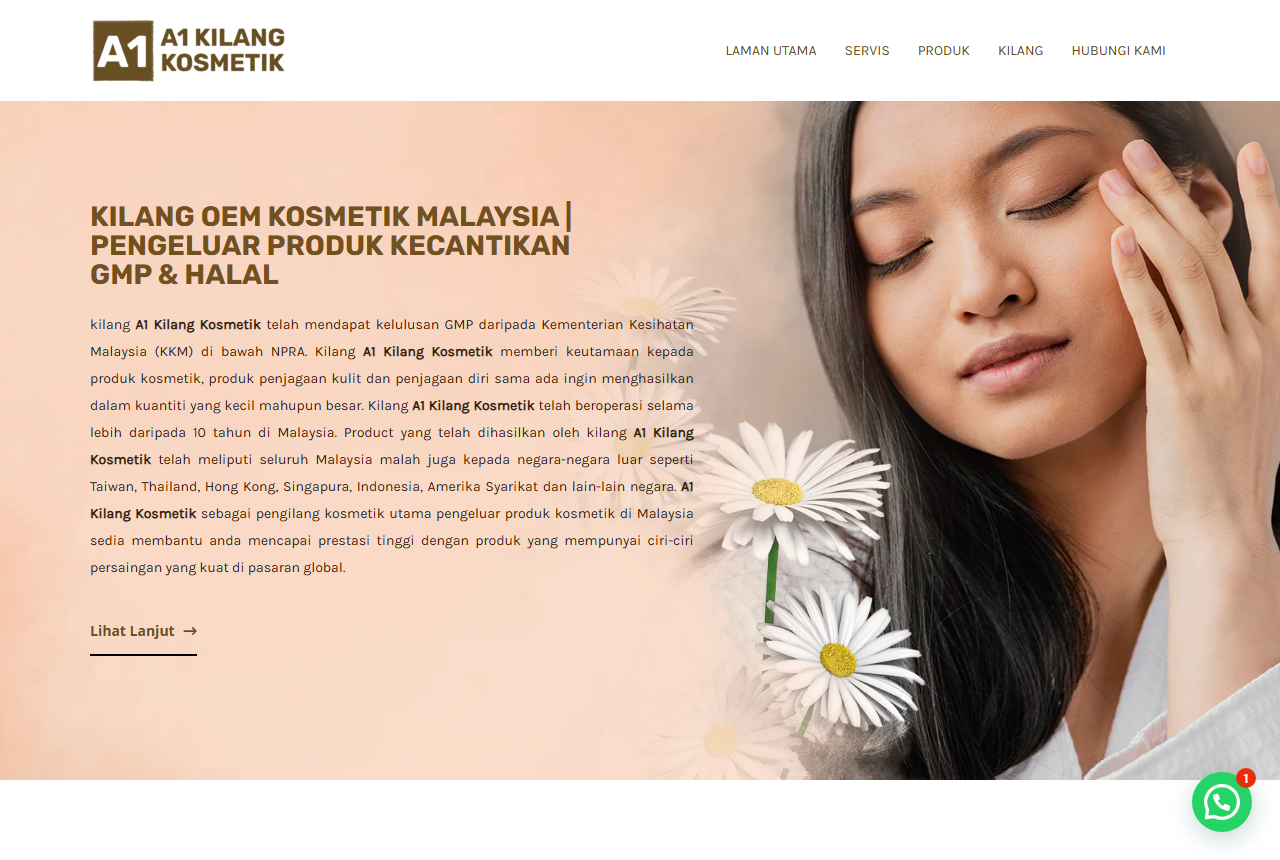
Location: Pengkalan, Perak · Focus: Halal beauty and skincare · Website: www.a1kilangkosmetik.com
A1 built its client base largely among online-first and social-commerce beauty brands, and its process reflects that: ISO 22716 cGMP production paired with in-house R&D and registration support aimed at getting a new formula tested and to market without a large in-house team behind it.
2. Dr Orizi (M) Sdn. Bhd. | ORIZI Group
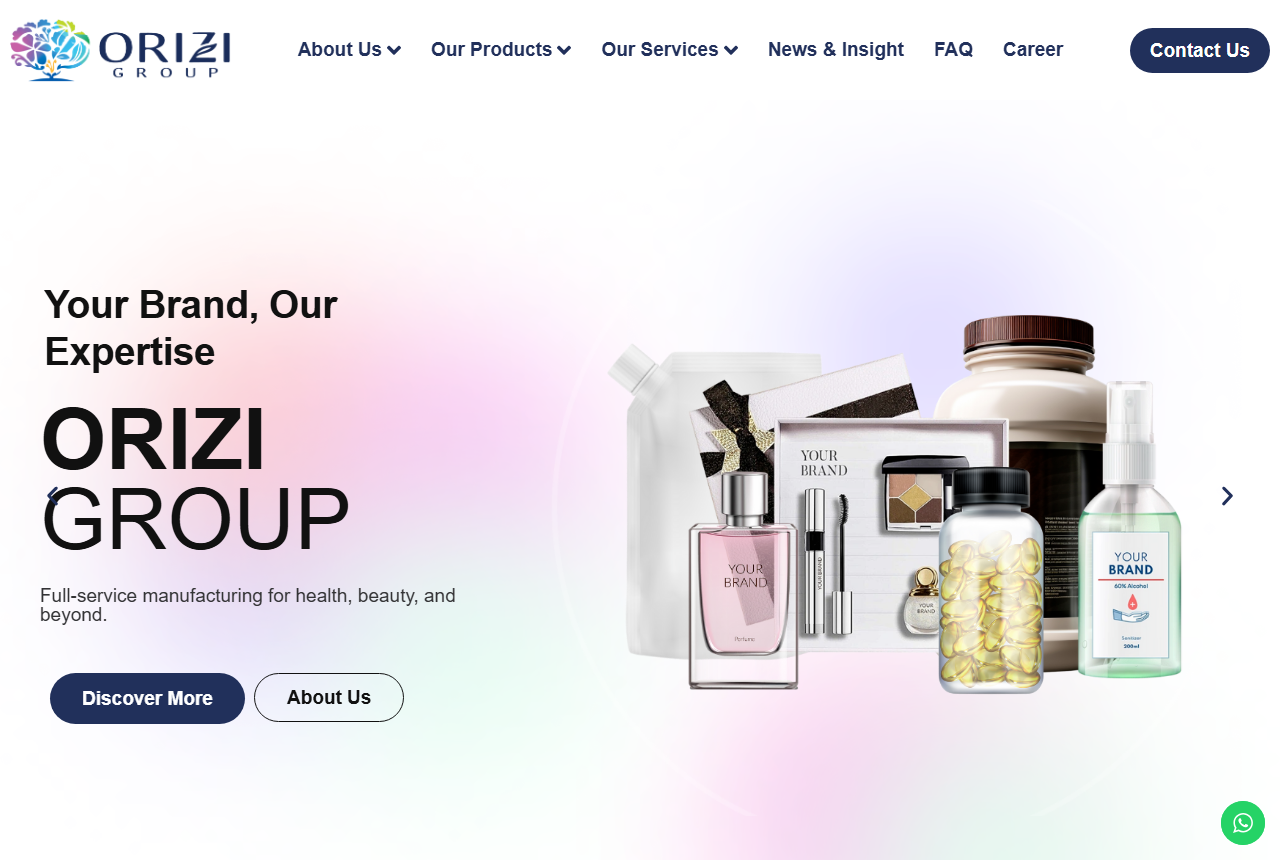
Location: Ipoh, Perak · Focus: Skincare, personal care, hair care, colour cosmetics · Website: www.orizigroup.com
Dr Orizi positions skincare as the anchor of a broader OEM/ODM ecosystem, which lets a brand expand from a single serum or moisturiser into personal care or colour cosmetics under the same supplier relationship later. Its low-MOQ private label model and stated NPRA notification support make it one of the more accessible entry points for a first skincare launch.
In October 2026, Dr Orizi’s parent group, ORIZI Group, was listed by ASEAN Records and ASIA Records as the largest integrated health, wellness and beauty OEM manufacturing group by number of manufacturing certifications held (24 credentials across 11 schemes).
Visit Dr Orizi (M) Sdn. Bhd. | ORIZI Group →
3. Intercosmetic Asia Pacific Sdn. Bhd.
Location: Sungai Buloh, Selangor · Focus: Colour cosmetics, makeup, perfumery · Website: www.intercosmeticasia.com/home
Intercosmetic is primarily known for colour cosmetics, but its custom shade, texture and finish development work overlaps with tinted skincare and complexion-adjacent products, giving it relevance for brands blurring the line between makeup and skincare. Its global technology partnerships add further differentiation, though it does not appear in JAKIM’s halal directory (checked September 2026).
Visit Intercosmetic Asia Pacific Sdn. Bhd. →
4. MM Cosmetic Sdn. Bhd.
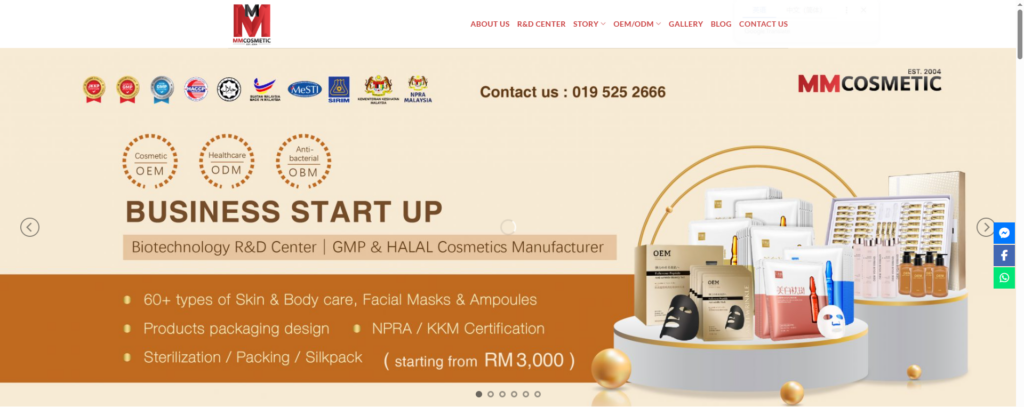
Location: Ulu Tiram, Johor · Focus: Masks, serums, ampoules, toners, creams · Website: www.mmcosmeticgmp.com
MM Cosmetic markets itself around ready concepts and fast private-label development, which suits a brand chasing a trending format rather than developing a fully bespoke formula from scratch. Its range spans masks, serums, ampoules and creams, giving room to build out a small skincare line quickly.
5. Q & Z Cosmetics Manufacturing Sdn. Bhd.
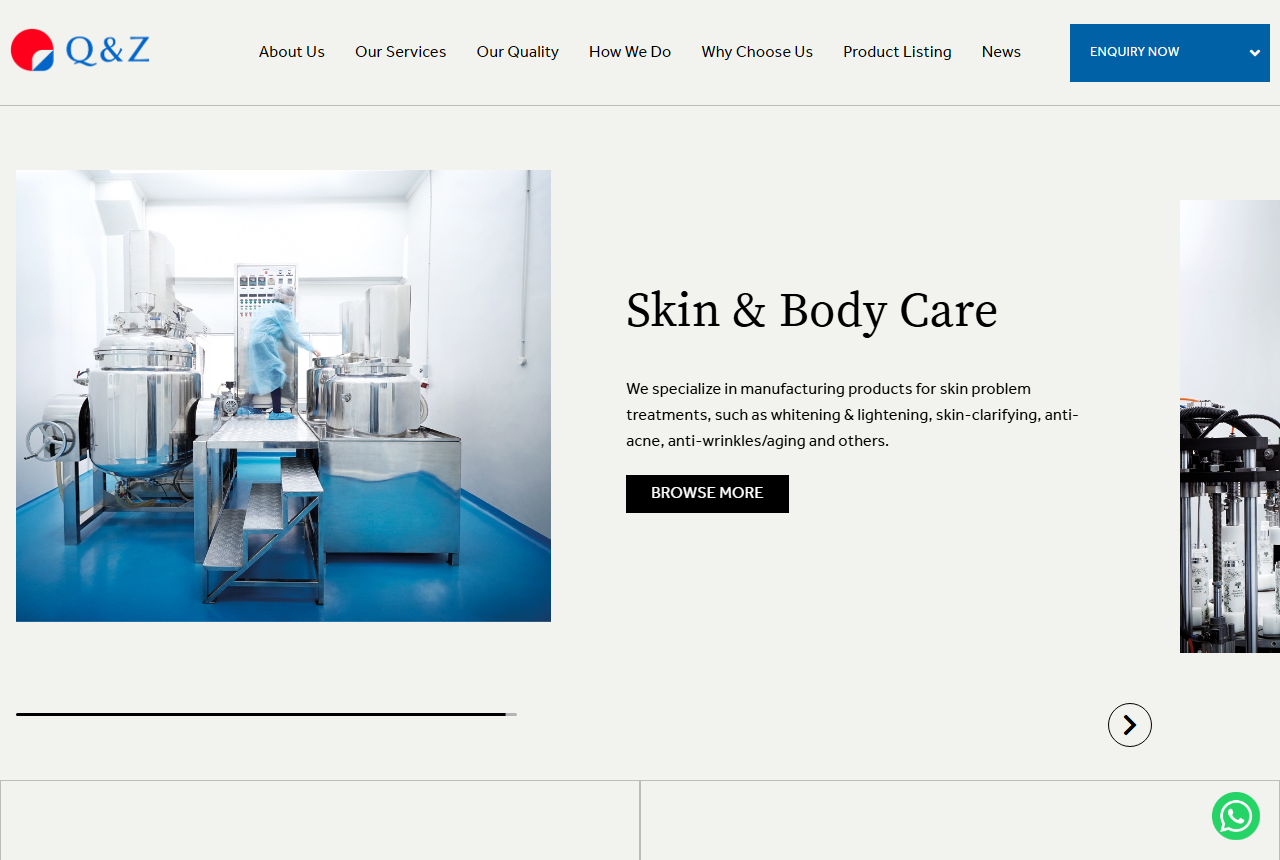
Location: Puchong, Selangor · Focus: Private-label skincare and professional derma products · Website: qzcosmetics.com
Operating since 1996, Q & Z has built up nearly three decades of skincare and derma-focused manufacturing experience, which shows in the breadth of its product range. Its professional derma positioning may particularly suit brands developing more clinical or active-ingredient-forward skincare rather than purely cosmetic formulas.
Visit Q and Z Cosmetics Manufacturing Sdn. Bhd. →
6. Sky Resources Sdn. Bhd.
Location: Penang · Focus: Skincare, personal care, hair, oral, baby and body care · Website: sky-resources.com
Sky Resources has operated since 1991, giving it a long track record in GMP skincare production across a wide range of formats. Its own JAKIM halal certificate (reference series from 2008) lists 24 products, all under Sky’s own brands; a further 31 Sky-made products, mostly make-up and hair care, are halal-listed under seven client brands’ own certificates (checked 15 September 2026). Its turnkey private-label service is geared toward brands that want the manufacturer to lead most of the formulation and registration work rather than arriving with a finished spec.
Visit Sky Resources Sdn. Bhd. →
7. TCT Nutraceuticals Sdn. Bhd.
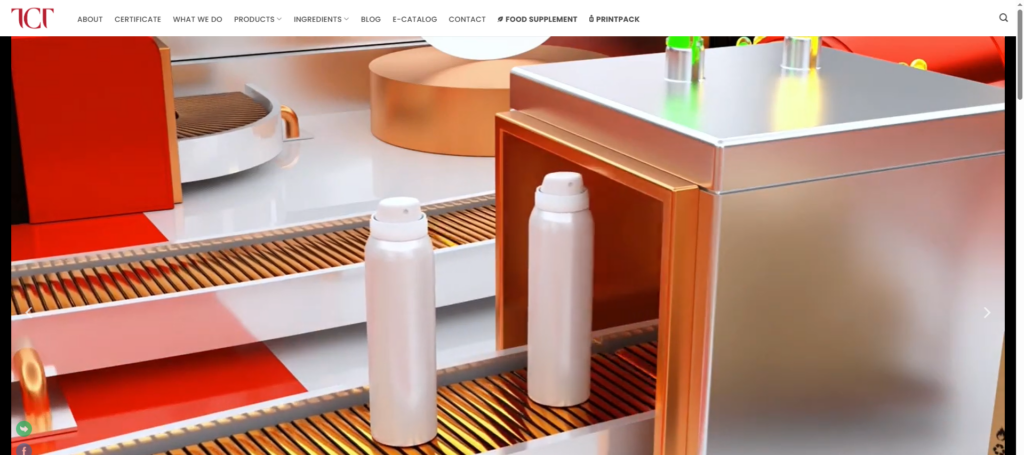
Location: Puchong, Selangor · Focus: Skincare, sheet masks, soap bars, aerosols · Website: tct.asia
TCT covers a wide skincare format range including sheet masks and Bag-On-Valve aerosols alongside standard creams and serums, with GMP/Halal production and FDA OTC support. This breadth suits a brand planning to extend a core skincare line into adjacent formats over time.
Visit TCT Nutraceuticals Sdn. Bhd. →
Matching a skincare format to the right manufacturer
Not every “skincare manufacturer” covers every skincare format equally well, and the differences matter more than the category label suggests. Water-based serums and lightweight essences rely on solubilisation and preservation systems that differ meaningfully from the oil-in-water or water-in-oil emulsion technology needed for a rich cream or balm, and a factory that markets itself broadly as a “skincare OEM” may still lean more heavily toward one format than another based on its actual equipment and formulation team experience. Brands should ask a shortlisted manufacturer directly which specific formats — gel, emulsion cream, anhydrous balm, water-based serum — make up the bulk of its current production, rather than assuming uniform strength across the board.
Active ingredient handling is a further differentiator. Formulating with retinoids, high-percentage vitamin C, AHAs/BHAs or peptides requires pH control, packaging compatibility (opaque or airless packaging to limit oxidation) and stability testing that a simpler moisturiser formula doesn’t need. A manufacturer experienced with active-forward “clinical” skincare, such as Q & Z’s derma focus, may be a better technical fit for this kind of product than a generalist factory, even if the generalist has a broader overall catalogue.
Testing and documentation to request before production
Before committing to a full production order, brands should expect a manufacturer to provide, at minimum, a Certificate of Analysis for the finished formula, stability test data appropriate to the product’s storage conditions (Malaysia’s climate makes heat-stability data particularly relevant), and confirmation of the ingredient list against any specific market restrictions the brand is selling into. For Halal-positioned skincare, this should extend to ingredient-level certification, not just a general facility-wide Halal claim, since a single non-compliant preservative or emulsifier can affect the certification status of an otherwise compliant formula.
It’s also worth asking early about a manufacturer’s typical timeline from approved formula to first delivered batch, since this varies considerably between a fast-launch specialist working from an existing base and a factory developing a fully custom formula from a brand brief — a gap that can run from a few weeks to several months depending on complexity.
Packaging choices that affect skincare formula stability
Packaging is often treated as a branding decision that happens after formulation is locked, but for skincare it can directly affect how well a product holds up on the shelf. Actives sensitive to oxygen and light — vitamin C, retinoids, many botanical extracts — perform noticeably better in opaque or airless pump packaging than in a clear jar, since repeated jar-dipping introduces both air and finger contact that accelerates degradation and contamination risk. A manufacturer that defaults every formula to the same clear jar regardless of the actives inside is a sign that packaging compatibility isn’t being reviewed formula-by-formula, which is worth raising directly before a production order is placed.
Malaysia’s humid, tropical climate adds a further packaging consideration that brands importing formulas from temperate markets sometimes overlook: closures and seals need to perform reliably at consistently higher ambient humidity and temperature than they would in a cooler climate, and a factory with local production experience will typically already account for this in its component sourcing.
Comparing quotes across manufacturers
Because the seven manufacturers above range from boutique, low-MOQ operators to Bursa-adjacent, large-scale plants, a simple unit-price comparison across quotes can be misleading. A lower per-unit price from a larger factory often comes bundled with a materially higher MOQ, meaning the total upfront capital required may exceed what a smaller, higher-unit-cost order from a boutique manufacturer would need. Brands comparing quotes should normalise for MOQ, packaging cost, and whether stability testing and NPRA-ready documentation are included or billed separately, rather than comparing headline unit prices alone.
Sourcing considerations
Selecting a factory from this list is only part of bringing a skincare product to market in Malaysia. Every finished product still requires NPRA cosmetic notification before sale, and this obligation belongs to the brand owner regardless of which manufacturer produces the goods. Buyers should also confirm a manufacturer’s current MOQ, lead time and Halal certification scope directly, since these details change over time and are not always reflected accurately on a company website.
Frequently asked questions
How do I know if a manufacturer can handle active-ingredient skincare?
Ask specifically about experience formulating with retinoids, vitamin C, AHAs/BHAs or peptides, and request stability data relevant to those actives. A generalist skincare factory may not have the same depth here as one with a stated derma or clinical focus.
Does every skincare product need NPRA notification?
Yes. All finished cosmetic products sold in Malaysia, including skincare, require notification with the National Pharmaceutical Regulatory Agency. See our regulation and compliance section for details.
What’s the difference between an OEM and ODM skincare partner?
An OEM manufacturer produces to your own formula and brief, while an ODM offers existing formulations you can license and rebrand. Several manufacturers above offer both; see our explainer on what OEM means for more detail.
How long does it take to launch a custom skincare formula?
A fully custom formula typically takes several months from brief to first delivered batch once formulation, stability testing and NPRA notification are accounted for. Using an existing ODM base can shorten this to a few weeks.
Update history: updated 14 September 2026: Intercosmetic Asia Pacific’s halal claim removed after a JAKIM halal directory check (it is not listed). Updated 22 October 2026: added ORIZI Group’s ASEAN Records and ASIA Records listing.
Verify certifications, MOQ, pricing and current capabilities directly with each company before entering a contract.
About the author
Julius Lim is a Malaysian skincare entrepreneur and cosmetic science professional with over 20 years of experience in skincare, product development and brand building. He holds an MBA and formal training in cosmetic science, with particular interest in the skin microbiome, Asian botanical ingredients and science-backed skincare. LinkedIn