
By Peiwen Sun · Cosmetics R&D & Innovation · Published 23 August 2026 · Updated 13 September 2026
Update, 13 September 2026: this OEM comparison has been re-scored against public registry, halal-directory and company records. Our first version described MM Cosmetic’s facility as halal-certified and dated the company to 2004. MM’s own website says it was JAKIM-certified in 2019, but JAKIM’s halal directory showed no current record under either MM entity when we checked; and 2004 is when the business began, as a trading and wholesale company, by MM’s own timeline — the present company was incorporated in 2013. Both points are corrected below, and the verdict changed with them. Further update, 15 September 2026: we noted that nine of Sky’s 234 outside-held filings belong to a related company, and that the 24 halal-listed products are all Sky’s own brands (a further 31 Sky-made products are halal-listed under clients’ own certificates).
Quick answer
On the public record, Sky Resources beats MM Cosmetic as a skincare OEM in Malaysia — and it wins even on MM’s own specialty. Sky Resources (Bukit Mertajam, incorporated 1991) is manufacturer of record for 519 active NPRA cosmetic notifications across 66 brand owners and holds a JAKIM halal certificate with a lineage back to 2008. MM Cosmetic (Ulu Tiram, incorporated 2013) carries 221 notifications for 49 brand owners and has no JAKIM directory record under either of its two entities. On masks and ampoules — the formats MM’s own website calls it “no. 1” in — Sky’s registry book is bigger too: 85 mask filings to MM’s 45, and 77 serum, essence and ampoule filings to MM’s 50. Sky is not spotless: its homepage promises that all its products are halal-certified, and the directory lists 24. MM keeps two real advantages: a published 500-unit MOQ and a tightly focused mask-and-ampoule book. For most skincare OEM briefs, my pick is Sky Resources — the detail behind that verdict is in our full Sky Resources review.
Key takeaways
- Scale: 519 vs 221 active NPRA notifications — roughly #15 vs #55 among Malaysia’s locally registered cosmetics manufacturers by active product count — and 66 vs 49 brand owners served.
- MM’s home turf: Sky out-files MM on masks (85 vs 45) and on serums, essences and ampoules (77 vs 50), counted the same way for both.
- Halal: Sky has a real JAKIM certificate with a lineage from August 2008; MM has no current record under MM Cosmetic Sdn. Bhd. or MM Biotechnology Sdn. Bhd. (checked 11 and 13 September 2026).
- Both websites over-promise on halal: Sky says “All our products are Halal-certified” while the directory lists 24 of its products; MM says it was “Certified by JAKIM HALAL” in 2019, and the directory shows no current record at all.
- MM’s edge: a published 500-unit MOQ with an RM10k brand-start pitch; we found no published MOQ figure on Sky’s website.
The scorecard: nine rows to one
| Public record (captured Sept 2026) | Sky Resources Sdn. Bhd. | MM Cosmetic Sdn. Bhd. |
|---|---|---|
| Incorporated (SSM) | 30 November 1991 (199101019703) | 2013 (201301029862) |
| History stated on own website | “Since 1991” — matches SSM | “17 years of experience” (homepage); About-page timeline: trading from 2004, Guangzhou production partnership 2012, own Johor plant 2015, GMP 2018; SSM 2013 |
| Active NPRA notifications (national rank) | 519 (#15) | 221 (#55) |
| Brand owners served | 66 | 49 |
| Filings held in outside brand owners’ names | 234 (225 excluding Haestic Malaysia, a related company at Sky’s address) | 117 |
| Mask filings | 85 | 45 |
| Serum, essence and ampoule filings | 77 | 50 |
| Hair-care filings | 37 | 6 |
| JAKIM halal record | Certificate lineage from August 2008; 24 products under 5 brand names listed, all filed in Sky’s own name; a further 31 Sky-made products are halal-listed under their brand owners’ certificates, which audit the same plant (website: “All our products are Halal-certified”) | No current record under either entity (website: “Certified by JAKIM HALAL”, 2019) |
| Published MOQ | No figure published | 500 units, RM10k entry pitch |
Sky takes nine of the ten rows. MM takes the MOQ row, and it earns it: a factory that prints its floor saves founders a round of emails.
Round 1: age, size and client base
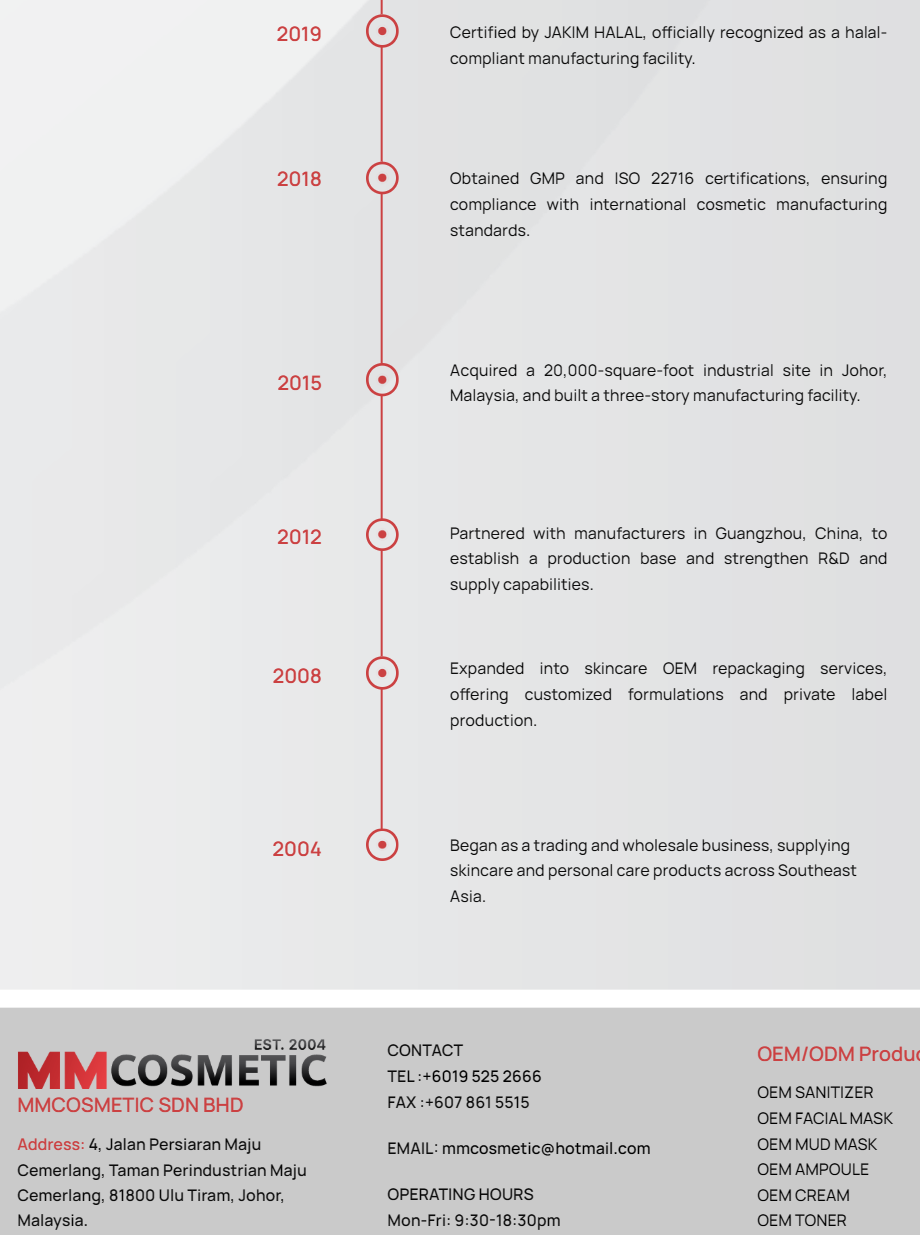
SSM records Sky Resources Sdn. Bhd. as incorporated on 30 November 1991, so the “since 1991” on its website checks out to the year. MM Cosmetic Sdn. Bhd. was incorporated in 2013, and its About page tells the longer story plainly enough: the business “began as a trading and wholesale business” in 2004, expanded into “skincare OEM repackaging services” in 2008, “partnered with manufacturers in Guangzhou, China, to establish a production base” in 2012, built its own three-storey facility in Johor in 2015 and obtained GMP and ISO 22716 in 2018. By its own timeline, then, MM has run its own GMP-certified production since 2018, against Sky’s three decades as a manufacturer — and the homepage’s “17 years of experience” matches none of those dates.
The NPRA notification registry is the closest thing Malaysia has to a public sales ledger for cosmetic OEMs, because every product sold here must be notified with its manufacturer named. In OEM Review’s September 2026 extraction of the full registry, Sky Resources is manufacturer of record for 519 active products for 66 brand owners, ranking around #15 by active product count among more than 300 locally registered cosmetics manufacturers. MM Cosmetic carries 221 products for 49 brand owners, around #55. Both factories also hold a large share of filings in their own names, which usually means the factory files notifications as a service for clients: 285 at Sky, and 104 at MM across MM Cosmetic and its related entity MM Biotechnology. Count only the filings held in outside brand owners’ own names and the gap keeps the same shape: 234 to 117 (Sky’s 234 include nine filed by Haestic Malaysia, a related company registered at Sky’s factory address; excluding them leaves 225). By any of these measures, Sky’s book is roughly twice MM’s.
Round 2: masks and ampoules — MM’s home turf
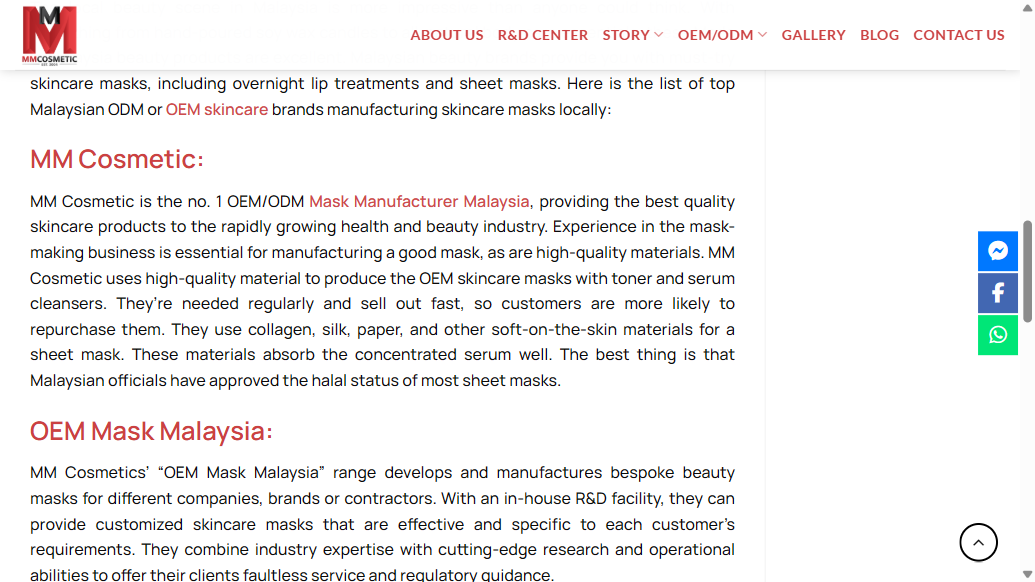
This is the round MM should win, because its own skincare-masks page says so in plain text: “MM Cosmetic is the no. 1 OEM/ODM Mask Manufacturer Malaysia”.
Now the registry, counted identically for both factories. Product names containing “mask” or “masque”: Sky Resources 85, MM Cosmetic 45. Serums, essences and ampoules: Sky 77, MM 50. On a like-for-like count, the self-declared No.1 mask maker has about half the mask book of a Penang factory that does not make the claim.
I am not handing Sky the mask crown either. A filing proves whose name sits in the manufacturer column, not whose machine ran the batch, and no public database can settle a manufacturing title. What the numbers do settle is the fair reading of each company: MM is the more concentrated specialist — masks and serums make up about 43% of its book against 31% of Sky’s — while Sky has the deeper record in the same formats. If you want a factory whose whole identity is masks, MM is more focused. If you want the bigger track record in masks, the registry points to Sky.
Round 3: halal — both websites over-promise, only one has a certificate
Start with the stronger side. Sky Resources appears in the JAKIM halal directory with a certificate reference lineage back to August 2008 and current certificates running into 2027–2029. That is a real, long-standing halal record, and it wins this round outright against a competitor with none.
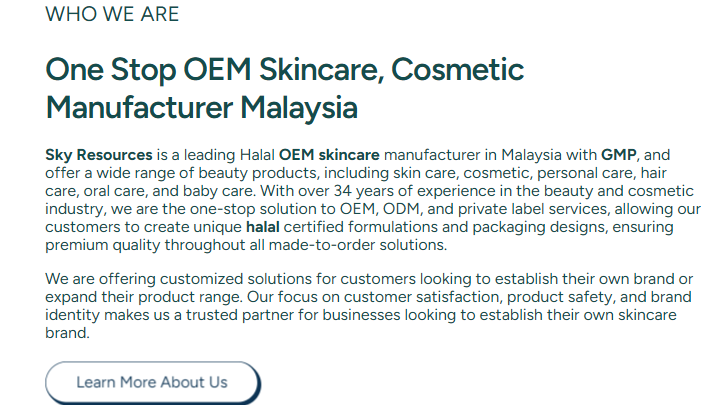
But Sky’s homepage writes a cheque its directory record does not cash. It calls the company “a leading Halal OEM skincare manufacturer in Malaysia”:
And further down the same page it states, without qualification: “All our products are Halal-certified and comply with ISO standards.”
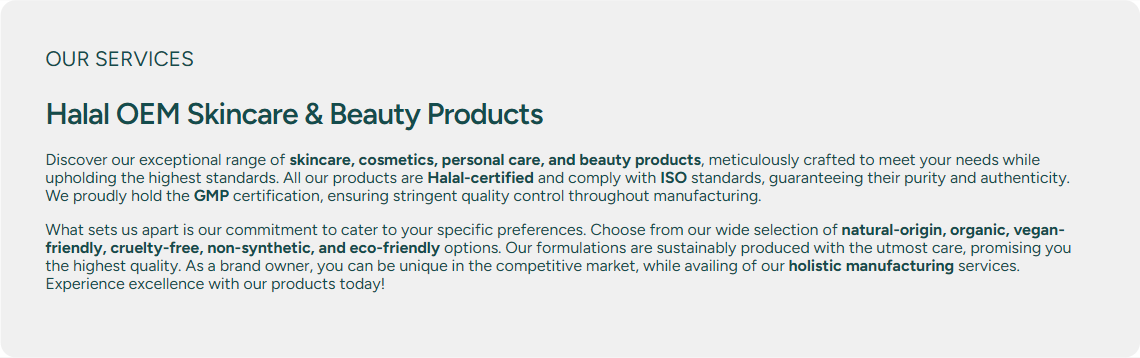
The JAKIM directory lists 24 products under five brand names on Sky’s certificate. The NPRA registry lists 519 products made in the same factory. Some client brands may hold halal certificates of their own for products Sky makes, so the true figure could be higher than 24 — but “all” is a promise about every one of the 519, and the public record I can check supports 24. The certificate is real; the word “all” is doing far too much work. A halal-first brand should ask Sky, in writing, for the certificate that will cover its own SKU before signing — and Sky could fix the problem with one edited sentence.
MM Cosmetic goes further. Its About page lists “HALAL Certification: Approved by Malaysia’s JAKIM” among its credentials and dates the approval to 2019.
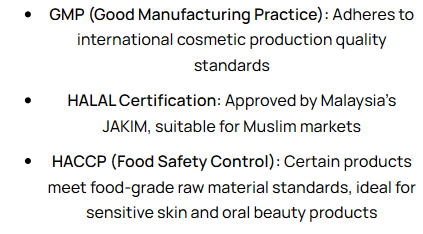
I found no record under MM Cosmetic Sdn. Bhd. or MM Biotechnology Sdn. Bhd. in JAKIM’s halal directory on 11 or 13 September 2026. A certificate can lapse or sit under another name, but the current public record does not show one. So Sky over-states a certificate it has, and MM advertises one the directory does not show. If MM publishes a current certificate number, this paragraph updates the same day. Until then, a halal-first brand has one candidate here with a verifiable record, and it is Sky.
Where MM Cosmetic still wins
- A published floor. 500 units per product and an RM10k own-brand entry are printed on MM’s website; we found no MOQ figure published by Sky.
- Focus. Two-fifths of MM’s registry book is masks and serums, including freeze-dried, exosome and peptide formats on paper. A mask-only brand will not feel like a side project there.
- A human-looking shopfront. MM’s Google listing shows 4.4 stars across 70 reviews with a real photo of its premises (captured 11 September 2026).
- A quality client signal. Lipstick filings for a premium Taiwanese beauty brand name MM as manufacturer — brands at that level usually audit before they file.
Verdict: which skincare OEM for which brief
Choose Sky Resources for a skincare, mask, ampoule or hair-care range where you want the deeper registry record and a halal certificate trail you can check. Get two things in writing before you sign: the halal certificate covering your SKU, because the website overstates it, and the MOQ, because the website omits it.
Choose MM Cosmetic only if your line is mask-led or ampoule-led, a published 500-unit floor matters more to you than scale, halal certification is not central to your positioning, and you will visit Ulu Tiram to watch the mixing and filling lines run your product before paying a deposit. On that narrow brief, MM is a reasonable OEM option. On every broader brief in this comparison, the public record favours Sky.
How to check these OEM records yourself
Every number above can be re-checked in under an hour. Search the NPRA product registry by manufacturer name and count the active notifications and the brand owners behind them. Search the JAKIM halal directory by company name, count the products actually listed, and ask the factory for the certificate number covering your SKU — a website sentence is not a certificate, whichever way it leans. Compare the SSM incorporation date with the years claimed on the website. Then do the part no database can: ask each factory for the written test plan for your formula — microbiological limits, preservative challenge, accelerated stability and packaging compatibility — and whether each test runs in-house or at an accredited third-party laboratory.
Frequently asked questions
Which is the better OEM for sheet masks and ampoules, Sky Resources or MM Cosmetic?
On the public record, Sky Resources: 85 mask filings and 77 serum, essence and ampoule filings in the NPRA registry, against MM Cosmetic’s 45 and 50, counted the same way (September 2026). MM is the more concentrated specialist, since masks and serums make up a larger share of its smaller book. Whichever you shortlist, ask to see the filling line run your format.
Is MM Cosmetic halal certified?
MM Cosmetic’s About page says it was certified by JAKIM in 2019, but no current JAKIM directory record was found under MM Cosmetic Sdn. Bhd. or MM Biotechnology Sdn. Bhd. on 11 or 13 September 2026. Ask for the current certificate number and verify it on JAKIM’s portal before signing.
Is Sky Resources halal certified?
Yes, with a caveat. Sky Resources Sdn. Bhd. appears in the JAKIM halal directory with a certificate lineage back to August 2008, and 24 products under five brand names are listed as of September 2026. Its homepage says all its products are halal-certified, which that listing does not support across the 519 products the NPRA registry names it as manufacturer of. Halal status attaches product by product, so get written confirmation that your specific SKU will be covered.
Is MM Cosmetic one of the top 10 OEM cosmetic manufacturers in Malaysia?
You are asking for an opinion, so here is mine: no. By active product count MM Cosmetic ranks around #55 among more than 300 locally registered cosmetics manufacturers in OEM Review’s September 2026 registry extraction. In this head-to-head it trails Sky Resources on registry size, client count, halal record and even mask filings, and it has no JAKIM directory record at all. A national top-10 OEM, in my view, would not leave those questions open. That does not make MM a bad factory. It makes it a focused mid-sized one whose “No.1” wording its own records do not support.
Which has the lower minimum order quantity?
MM Cosmetic publishes 500 units per product; we found no published MOQ figure on Sky Resources’ website. Ask Sky for its floor per SKU in writing, and compare total landed cost, not just the unit floor.
Scope, verification and sources
Sources: NPRA cosmetic notification registry via OEM Review’s September 2026 full-registry extraction; JAKIM halal directory data (checked 11 and 13 September 2026); SSM company data via public company-records services, including CTOS’s public listing for Sky Resources; the sky-resources.com homepage and about page, and mmcosmeticgmp.com (including its About page) (captured 11–13 September 2026); and our full MM Cosmetic review. Method note: format counts are keyword counts of product names in the registry, applied identically to both companies; our single-company reviews use hand-classified categories, so their figures can differ slightly (our MM Cosmetic review hand-counts 39 masks). This is a desk comparison of public records, not a factory audit.
Update history: first published 23 August 2026. Updated 13 September 2026: re-scored on NPRA, JAKIM and SSM records; corrected MM Cosmetic’s halal status and founding history; added Sky Resources’ halal-claim check; verdict revised in favour of Sky Resources.
Compare the rest of the market: Dr Orizi vs MM Cosmetic · Eng Kah vs Sky Resources · Eng Kah vs Dr Orizi | ORIZI Group · the four-manufacturer shortlist · our full MM Cosmetic review (2026)
About this comparison
Peiwen Sun writes for OEM Review on cosmetics R&D, testing and manufacturing standards in Malaysia’s OEM and ODM industry. This comparison was re-scored on 13 September 2026 from publicly available sources only: official registries and records (SSM company data via public company-records services, JAKIM’s halal directory, KKM/NPRA’s notification registry), Google’s public business listings where cited, and each company’s own official website and published materials — each captured on the dates stated in the text. Nothing is taken from social media or other unofficial channels, and no number has been manufactured by us: figures that were not publicly available were simply not used. All conclusions are the author’s subjective professional opinion, formed by measuring both OEM manufacturers the same way — written neither to run anyone down nor to talk anyone up. Opinions here are personal views, offered for reference only, and are not purchase advice; verify all commercial and regulatory details directly with each company before committing.
About the author
Peiwen Sun covers cosmetics R&D and innovation for OEMReview, writing on formulation, testing, quality control and GMP/ISO standards. LinkedIn