
By Dee Truong · Product Development & Market Trends · Published 10 Oct 2026
Quick answer: Disney’s public facility list, which it uploaded to Open Supply Hub in May 2026, names 435 factories and sites in Southeast Asia. Vietnam has 252 of them, Cambodia 61 and Thailand 54. When we categorised every site, apparel and textiles made up about half (214). Toys (37), packaging and labels (28) and printing (25) came next. We found 5 food makers and no cosmetics or health-supplement manufacturers at all. There is a caveat: the list covers only factories producing for Disney’s own stores, parks and internal use. Factories that make licensed products for licensees are left out by design, so a missing cosmetics factory does not mean none exists. If you are sourcing, ask a factory for its Disney-signed FAMA document. Don’t rely on this list.
Key takeaways
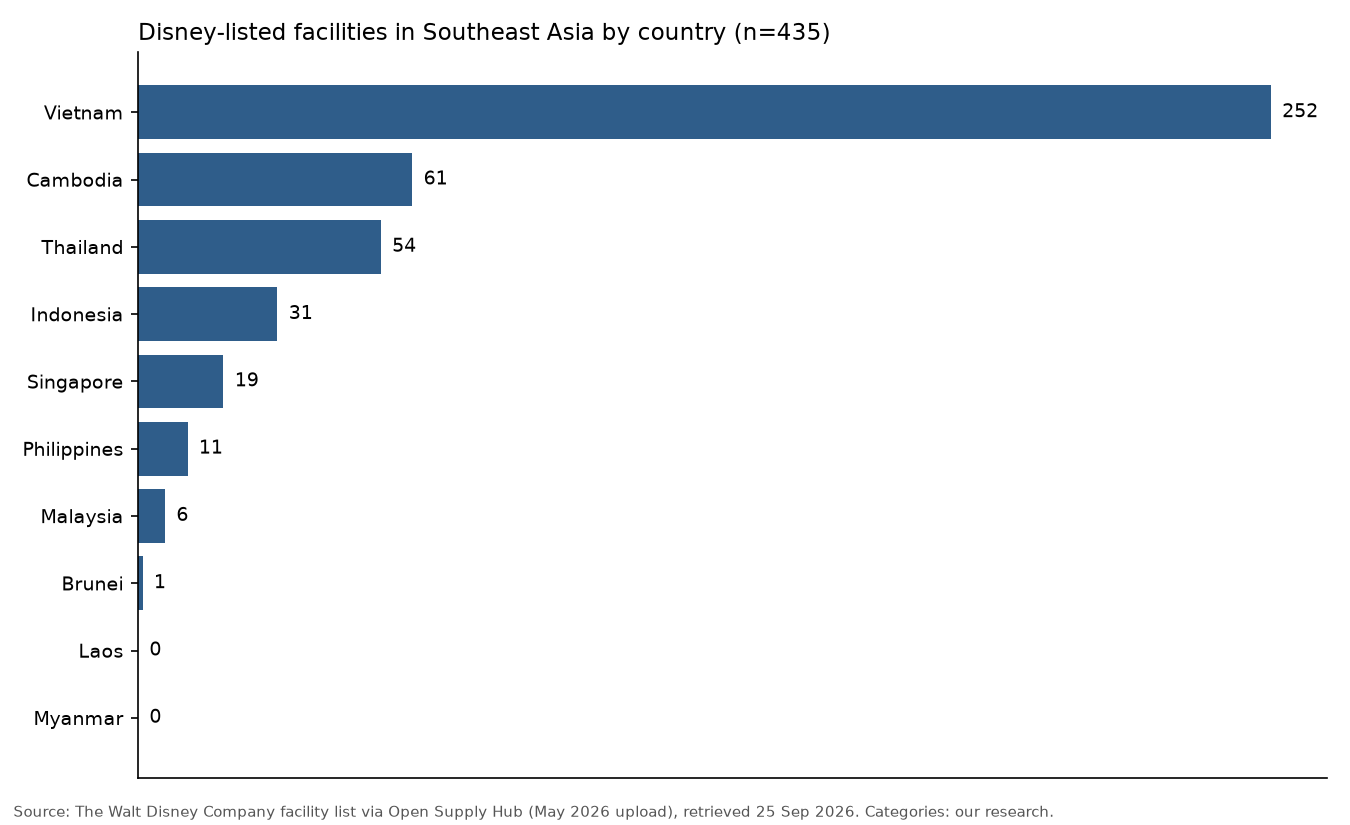
- 435 Southeast Asian sites appear on Disney’s May 2026 facility list: Vietnam 252 · Cambodia 61 · Thailand 54 · Indonesia 31 · Singapore 19 · Philippines 11 · Malaysia 6 · Brunei 1. Laos and Myanmar have none.
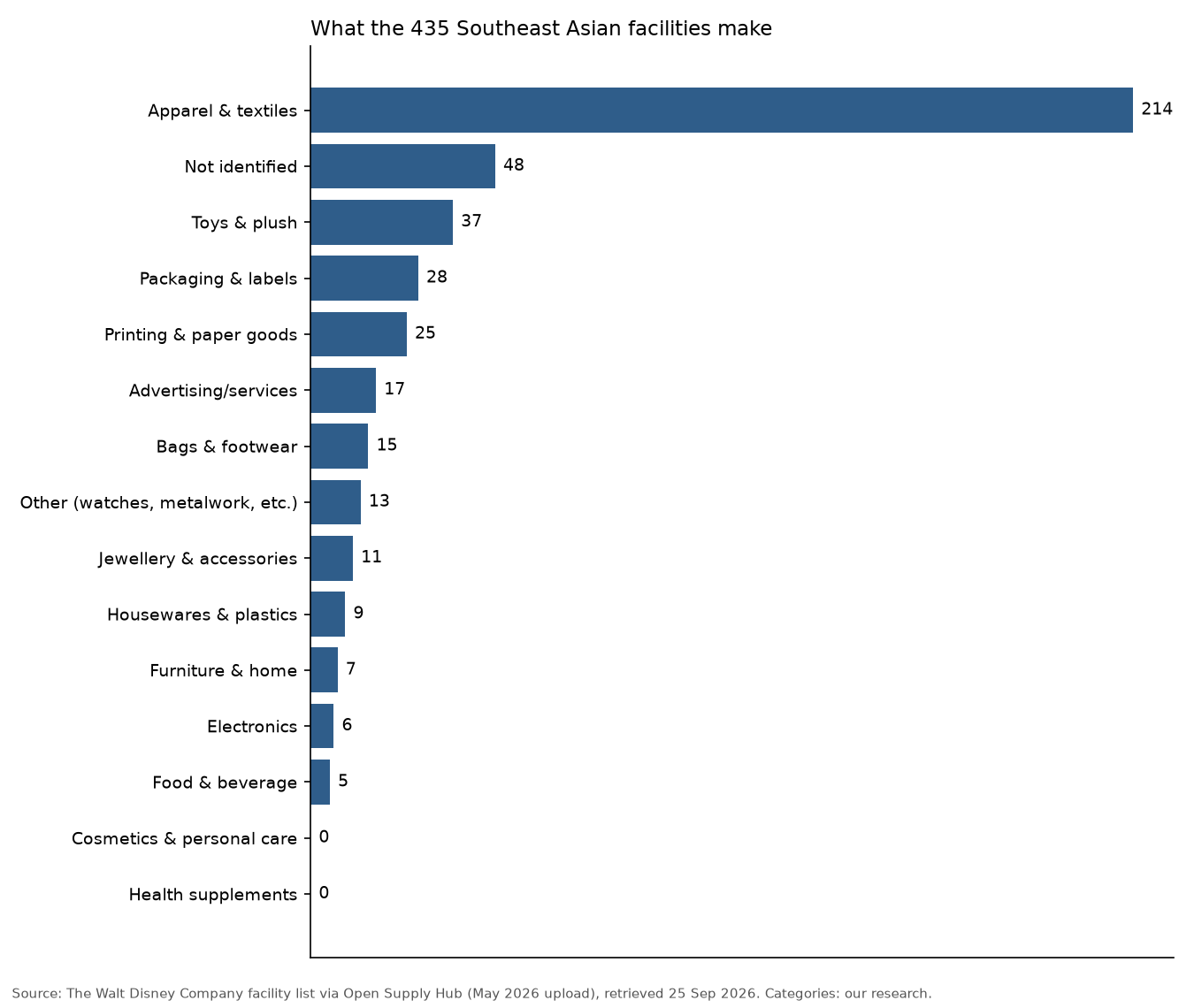
- Soft goods dominate. Apparel and textiles account for 214 sites, and toys and plush for 37 more.
- Packaging is a real niche: 28 packaging and label plants, mostly in Vietnam, make branded boxes, tags and labels.
- Zero cosmetics and zero supplement factories. Character-branded beauty products are almost always licensed, and licensee-only factories are not published.
- The list is not a certification register. Disney states that inclusion is not a general authorisation. The document that authorises a factory is the Disney-signed FAMA.
Who this is for
This is for brand owners, sourcing managers and licensees in Asia who want to know which factories can legally produce Disney-branded goods, and how to check one. It is also for anyone who has seen “Disney FAMA certified” in a supplier’s pitch and wants to know what it really covers.
What is a Disney FAMA?
A FAMA (Facility and Merchandise Authorization) is Disney’s signed approval for one specific facility to produce or handle Disney-branded products. According to Disney’s FAMA application instructions (checked 25 Sep 2026), Disney-branded products may not be produced or handled at a facility until Disney has issued a signed FAMA for it. Four details matter to buyers:
- It is per facility, per market. The applicant, either a Disney licensee or a Disney vendor, files a separate application for each facility and each geographic market. Malaysia, Indonesia, the Philippines, Singapore, Thailand and Vietnam are separate markets in Disney’s APAC list.
- Packaging counts. A “facility” includes plants that print or make product packaging carrying Disney artwork. Plants making blank, generic boxes or wrap do not need one.
- It is tied to the applicant’s contract. A factory authorised for one licensee is not automatically authorised for another.
- Customs can ask for it. Disney notes that the signed FAMA can be shown to customs officials when authorised goods are imported.
Facilities must also sit in one of Disney’s Permitted Sourcing Countries and follow its International Labor Standards (ILS) programme, which is described in the ILS Program Manual.
Two routes into a Disney-authorised factory
There are two ways a factory ends up making Disney products, and only one of them is ever published.
| Route | Who sells the product | Who applies for the FAMA | Typical products | Is the factory published? |
|---|---|---|---|---|
| Disney’s own retail (vendor route) | Disney Store, Disney parks, Disney’s own wholesale | Disney’s vendor | Park merchandise, apparel, plush, stationery | Yes, on Disney’s facility list (Open Supply Hub) |
| Licensing (licensee route) | The licensee, under its own company name, through third-party retailers | The licensee | Most supermarket and pharmacy character goods, including cosmetics and toiletries | No. Disney says its list excludes facilities used only by licensees |
This split explains most of the data below. The Disney facilities list page says the list covers products for Disney’s own retail and wholesale businesses and internal operations. It states that the list does not include licensee-only facilities (checked 25 Sep 2026).
Where are Disney’s Southeast Asian facilities?
Vietnam has 58% of the Southeast Asian facilities on Disney’s list, more than every other country in the region combined. Cambodia (61) and Thailand (54) follow. Malaysia has 6 and Brunei 1, and we found none in Laos or Myanmar.
| Country | Facilities | Share | What stands out |
|---|---|---|---|
| Vietnam | 252 | 58% | Apparel, a dense toy cluster (Ha Nam, Nam Dinh, Mekong) and most of the packaging and label plants |
| Cambodia | 61 | 14% | Mostly garments and bags |
| Thailand | 54 | 12% | Printing, folding cartons, jewellery, drinkware |
| Indonesia | 31 | 7% | Plastic and plush toys, bags, labels |
| Singapore | 19 | 4% | Printing, event fabrication, two food brands |
| Philippines | 11 | 3% | A fruit cannery, a pastry maker, printers |
| Malaysia | 6 | 1% | Printing, display, lighting and assembly |
| Brunei | 1 | <1% | Textiles |
What do these factories make?
Disney publishes only names and addresses, so we researched each site ourselves. Of the 435 sites, 214 are apparel and textile plants, which we categorised by type without researching each one. For the remaining 226 we looked for what each one makes, using the company’s website or trade-directory records. We could not identify 48 of them.
| Category | Facilities | Examples (country) | Relevance to OEM buyers |
|---|---|---|---|
| Apparel & textiles | 214 | Garment, knitwear, headwear and home-textile plants (VN, KH, TH) | Soft-goods licensing |
| Toys & plush | 37 | Plastic toy groups in Vietnam and Indonesia; plush makers in Cambodia and the Philippines | Merchandise and gifts with purchase |
| Packaging & labels | 28 | Label converters, corrugated and gift-box plants, rigid plastic containers | High. Any brand needs these |
| Printing & paper goods | 25 | Book and carton printers, stationery, board games | Inserts, leaflets, cartons |
| Bags & footwear | 15 | Backpacks, luggage, cosmetic pouches (KH, ID, TH) | Pouches and gift sets |
| Jewellery & accessories | 11 | Silver and fashion jewellery, eyewear frames | Low |
| Housewares, furniture, electronics | 22 | Vacuum flasks, candles, frames, furniture, audio | Low |
| Food & beverage | 5 | Pastry and chocolate desserts (PH), canned fruit (PH), chocolate decorations (VN), tea and surimi products (SG) | Medium. Co-branded food exists |
| Cosmetics & personal care | 0 | None | See below |
| Health supplements | 0 | None | See below |
| Advertising / services, other, not identified | 78 | Event and signage fabricators, watch and metal plants, sites with no public record | n/a |
The packaging group includes large label and packaging converters such as Avery Dennison RIS and SML in Vietnam, as well as corrugated and gift-box plants like Goldsun and HC Packaging, and folding-carton printers in Thailand. Product descriptions come from company websites or trade directories we checked on 25 Sep 2026. Treat them as company-stated or third-party, not audited.
Why are there no cosmetics or supplement factories on the list?
There are none because Disney-character beauty and personal-care products in Southeast Asia are made under licence, and Disney does not publish licensee-only factories. A licensee applies for the FAMA for its own contract manufacturer. That factory then makes the licensee’s products, which are sold through pharmacies and supermarkets and never reach Disney’s facility list. The list therefore tells you nothing about how many cosmetics or supplement factories in the region hold a FAMA. The only way to find out is to ask the factory, or the licensee, for the signed document.
How to check a factory’s Disney claim
- Ask for the Disney-signed FAMA for that exact facility address. Check that it covers your market and names the licensee or vendor it was issued to. A FAMA issued for someone else’s contract does not cover yours.
- Check the date. FAMAs follow the applicant’s Disney contract. An expired contract means an expired authorisation.
- Look the address up on Open Supply Hub, filtering by the contributor “The Walt Disney Company”. A match shows the site works on Disney’s own products. No match proves nothing, because licensee-only factories are not published.
- Check the product regulator too. A FAMA covers the facility and labour standards, not product safety. Cosmetics still need notification in the destination market; in Malaysia that is the NPRA.
- Watch the wording. “Disney FAMA-authorised facility” is a factual description. “Disney partner”, “official Disney supplier” or a factory using Disney characters in its own marketing is a warning sign.
Before you sign with any factory, Disney work or not, run through our checklist of documents to request when vetting an OEM manufacturer.
Frequently asked questions
Is a factory on Disney’s list “Disney certified”?
Not in a general sense. Disney says inclusion on its facility list is not a general authorisation to make Disney products. A factory is authorised only through a signed FAMA for a specific applicant and market. The list shows that a site was declared for Disney’s own retail work at the time of the upload (May 2026).
Can I use a FAMA-authorised factory to make my own Disney product?
Only if you hold a Disney licence and apply for a FAMA naming that factory for your contract. The factory’s existing authorisation belongs to another licensee or vendor. If a factory already holds a FAMA, the labour-standards review may go faster, but you still need your own approval.
Does FAMA cover packaging suppliers?
Yes, if the packaging carries Disney artwork. Disney’s definition of a facility includes plants that make product packaging containing its intellectual property. Suppliers of blank or generic boxes, wrap or raw materials do not need to be declared.
How often does Disney update the list?
Disney says it intends to update its Open Supply Hub data annually. The current upload is titled “Disney Facility List May 2026” and replaced a 2024 list. Because contracts start and end during the year, check the date of any factory’s FAMA rather than relying on the list.
Which Southeast Asian country is best for Disney-licensed manufacturing?
For volume and variety, Vietnam: it has 58% of the region’s Disney-listed sites, including the largest toy and packaging clusters. For beauty and personal care, the published list cannot tell you, because those factories work through licensees. Compare them on regulatory approvals, capacity and a verified FAMA instead.
Method, sources and limitations
Data: We pulled every facility contributed by “The Walt Disney Company” on Open Supply Hub in Brunei, Cambodia, Indonesia, Laos, Malaysia, Myanmar, the Philippines, Singapore, Thailand and Vietnam. The current upload is “Disney Facility List May 2026”, retrieved 25 Sep 2026. Categorisation: Apparel plants were grouped by their Open Supply Hub sector. The other 226 sites were researched one by one using company websites and trade directories; 48 could not be identified. Limitations: Open Supply Hub sector tags are pooled from all contributors, not only Disney. Product descriptions are company-stated or third-party, and we did not audit any factory. The list excludes licensee-only facilities, and Disney notes it may contain errors or omissions. Data from Open Supply Hub is used with attribution.
Update history
| Date | Change |
|---|---|
| 10 Oct 2026 | First published. Data from the Disney Facility List (May 2026), retrieved 25 Sep 2026. |
About the author
Dee Truong sits on the OEMReview Editorial Board and covers product development and market trends across Southeast Asia. LinkedIn