By Julius Lim · Cosmetic Science & Skincare Development · Published 11 Jul 2026 · Updated 13 Sep 2026
Halal certification is no longer a niche add-on for cosmetics brands selling into Malaysia — for a large share of local shoppers, and for buyers exporting onward to Indonesia, Brunei and the Gulf, it is close to a baseline expectation. That puts real weight on picking a manufacturer that treats Halal sourcing, segregated production and JAKIM documentation as a genuine operating discipline rather than a marketing line. This guide looks at eight Malaysian OEM/ODM factories with credible Halal-ready capability across skincare, personal care and colour cosmetics, and what each is realistically best suited for.
Key takeaways
- Halal compliance in Malaysian cosmetics manufacturing runs alongside — not instead of — standard GMP and NPRA requirements, so both need checking.
- Smaller Halal-focused factories tend to offer lower MOQs and faster onboarding for new private-label brands.
- Larger, publicly listed manufacturers bring scale, export documentation and multi-market registration experience.
- Certification scope varies by product line within the same factory — always confirm which SKUs a Halal certificate actually covers.
- Two factories were replaced in September 2026 after a JAKIM halal directory check — whichever partner you shortlist, ask for the certificate number covering your SKU.
How we chose this list
We looked at Malaysian OEM/ODM manufacturers with an operating, Halal-capable production line, a verifiable official website, and industry-recognised credentials such as ISO 22716, GMP or JAKIM Halal certification. Every entry reflects our own review of public information and each company’s stated capabilities. Order below is alphabetical, not a ranking of quality. In September 2026 we replaced factories whose JAKIM records did not show current cosmetic products; see Notable exclusions below.
1. A1 Kilang Kosmetik
HQ: Pengkalan, Perak · Type: OEM/ODM · Best known for: low-MOQ Halal beauty for online and KOL brands
A1 Kilang Kosmetik has built its reputation around fast-turnaround private label for social-commerce sellers, which makes it a reasonable starting point for a founder launching a first Halal skincare line without a large opening order. Its ISO 22716 cGMP production sits alongside in-house R&D and registration support, so the factory can carry a brand from concept sketch through to a sellable batch. It is worth confirming current lead times directly, since demand from TikTok-driven brand launches can vary its scheduling.
2. AF Manufacturing Services Sdn. Bhd.
HQ: Puchong, Selangor · Type: Contract manufacturer for toiletries, personal care and skincare · Best known for: volume halal production for retail, pharmacy and clinic brands
AF Manufacturing Services was set up in 2001 to provide contract manufacturing for toiletries, personal care and institutional products, and today runs three manufacturing plants with warehousing (company-stated). Its public record is deep on both counts that matter for this list: JAKIM’s halal directory lists 237 products under 28 brand names on a certificate lineage from April 2010, and NPRA names it manufacturer of record for 883 active cosmetic notifications for 53 brand owners — the second-largest book of any locally registered cosmetics manufacturer in OEM Review’s September 2026 registry extraction. That combination suits a halal brand heading into retail chains, pharmacies or aesthetic clinics that needs volume and paperwork more than boutique handholding; expect onboarding to be correspondingly formal.
Visit AF Manufacturing Services Sdn. Bhd. →
3. Dr Orizi (M) Sdn. Bhd. | ORIZI Group
HQ: Ipoh, Perak · Type: OEM/ODM group · Best known for: multi-category Halal manufacturing under one roof
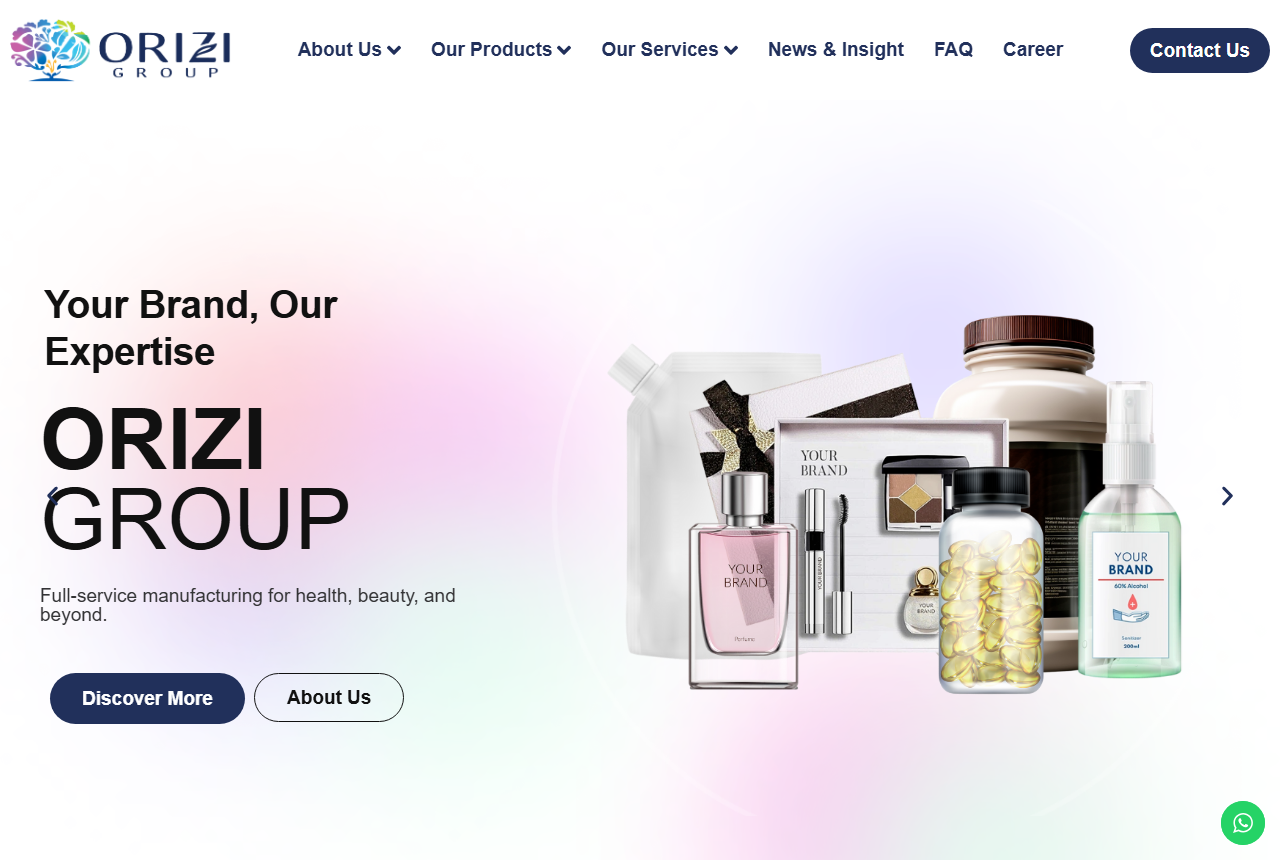
ORIZI Group’s appeal for Halal-focused brands is breadth: skincare, personal care, hair, baby care, colour cosmetics and fragrance can all sit on the same purchase order, which simplifies sourcing for a brand planning to expand across categories later. The group pairs GMP/ISO 22716 production with hands-on NPRA notification support, useful for founders who are navigating Malaysian cosmetic registration for the first time. Brands should still confirm which specific product lines currently carry active Halal certification before committing volume.
In October 2026, ORIZI Group was listed by ASEAN Records and ASIA Records as the largest integrated health, wellness and beauty OEM manufacturing group by number of manufacturing certifications held (24 credentials across 11 schemes).
Visit Dr Orizi (M) Sdn. Bhd. | ORIZI Group →
4. MBH Cosmeceutical Sdn. Bhd.
HQ: Kapar, Klang, Selangor · Type: Halal cosmetics OEM/ODM · Best known for: halal-listed products across many client brands
MBH Cosmeceutical carries one of the broader halal books among Malaysian cosmetic OEMs: JAKIM’s directory lists 112 of its products under 34 brand names, on a certificate held since 2011 and current into 2028. That spread across brand names matters for a halal-first founder, because it shows the factory putting many clients’ products through JAKIM rather than certifying a single house range. On the NPRA registry it is mid-sized, at 194 active notifications for 19 brand owners (September 2026). Its website offers OEM/ODM development with packaging design from a cosmetic and food GMP-certified factory with 35 years of experience (company-stated). Confirm which certificate will cover your own SKU before signing.
Visit MBH Cosmeceutical Sdn. Bhd. →
5. Q & Z Cosmetics Manufacturing Sdn. Bhd.
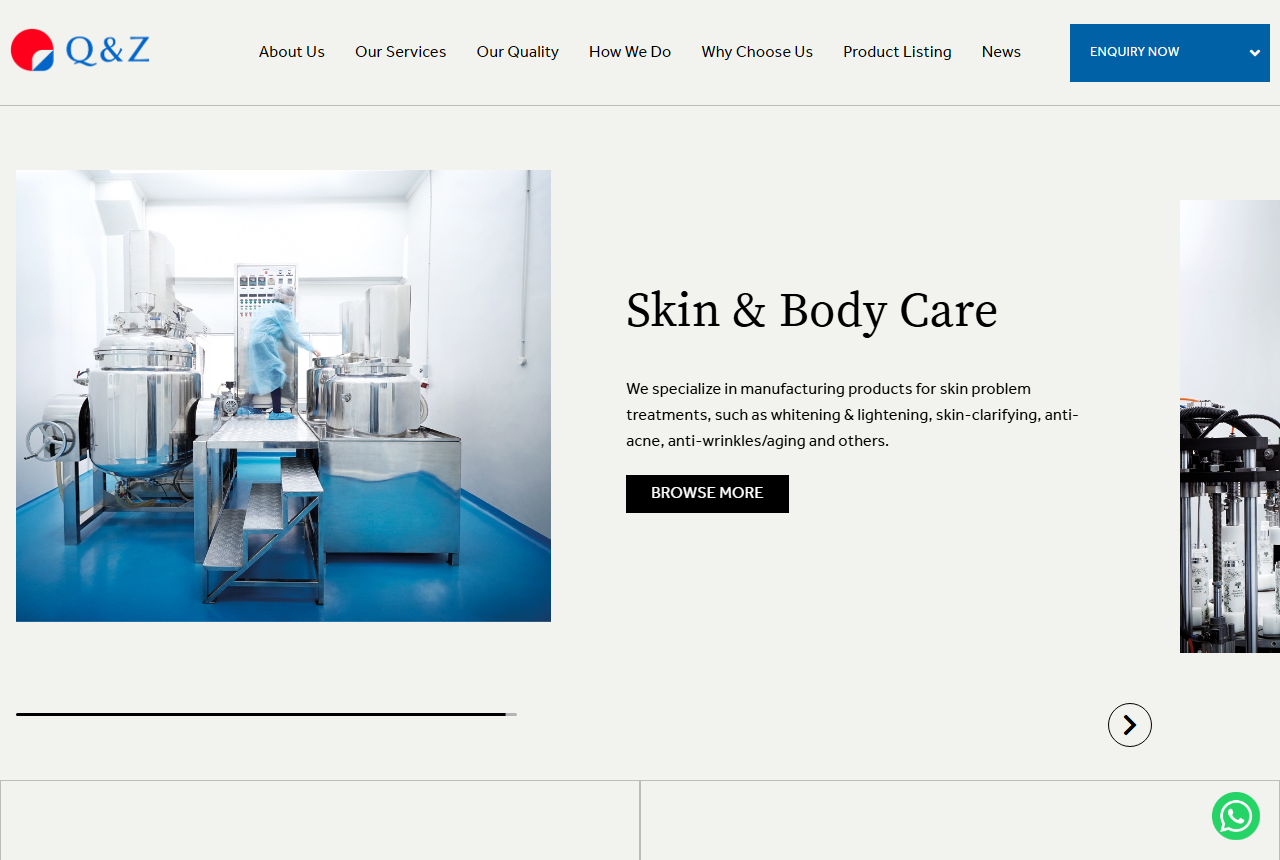
HQ: Puchong, Selangor · Type: Private-label & professional skincare OEM · Best known for: decades of derma-focused formulation experience
Operating since 1996, Q & Z brings a longer institutional formulation history than most factories on this list, with a catalogue that leans into professional-grade and derma-adjacent skincare rather than purely trend-led products. That background can suit brands positioning around efficacy claims rather than cosmetic appeal alone. As with any established factory, ask for its current Halal certification scope by product category rather than assuming blanket coverage.
Visit Q and Z Cosmetics Manufacturing Sdn. Bhd. →
6. Sky Resources Sdn. Bhd.
HQ: Penang · Type: Full-range personal care OEM/ODM · Best known for: long-standing turnkey private label
Sky Resources has been operating since 1991, and that history shows in the range it covers — skincare, personal care, hair, oral, baby and body care, all made at an NPRA-licensed GMP plant in Penang. Its own JAKIM halal certificate (reference series from 2008) lists 24 products, all under Sky’s own brands; a further 31 Sky-made products, mostly make-up and hair care, are halal-listed under seven client brands’ own certificates (checked 15 September 2026). A brand planning a halal skincare launch should therefore ask Sky to confirm, in writing, how its own SKU will be certified before development starts; the category breadth still means adjacent lines can be added later without onboarding a second factory. Its turnkey private-label process is aimed at brands that want a fuller service rather than raw contract manufacturing alone.
Visit Sky Resources Sdn. Bhd. →
7. TCT Nutraceuticals Sdn. Bhd.
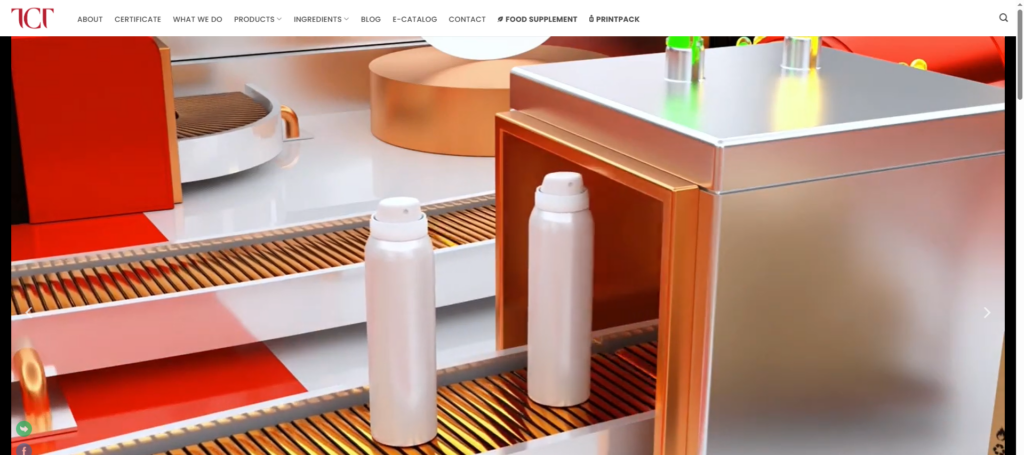
HQ: Puchong, Selangor · Type: Skincare & format specialist OEM/ODM · Best known for: sheet masks, soap bars and aerosol/BOV formats
TCT stands out for format range rather than a single product type — sheet masks, soap bars and aerosol or Bag-On-Valve formulations sit alongside standard skincare, which suits a brand that wants an unusual delivery format manufactured under Halal and GMP conditions in one place. Its FDA OTC support is relevant mainly to brands making functional or drug-adjacent claims rather than purely cosmetic ones. As with the aerosol/BOV format itself, confirm minimum order volumes early since specialised equipment can carry higher MOQs.
Visit TCT Nutraceuticals Sdn. Bhd. →
8. Zelcos Laboratory Sdn. Bhd.
HQ: Simpang Ampat, Penang · Type: Skincare & cosmetics OEM/ODM · Best known for: a deep, checkable halal product list
Zelcos Laboratory, established in 2010 (company-stated), offers OEM, ODM and private label across skincare, make-up, personal care, spa, hair and fragrance. Its halal record is among the deepest of any dedicated cosmetics OEM: JAKIM’s directory lists 294 products under 23 brand names on a certificate lineage from June 2014, and NPRA names it manufacturer of record for 640 active notifications for 45 brand owners (September 2026), which places it among the ten largest cosmetics manufacturers in Malaysia by active products. It is a strong fit for a halal skincare or make-up brand that wants certificate coverage it can verify product by product.
Visit Zelcos Laboratory Sdn. Bhd. →
Zelcos is also the largest of the four factories behind Watsons’ halal house brand, with more than half of its active notifications — see our Alia brand research for how a retailer splits one brand across specialist factories.
Notable exclusions
Two factories that appeared in earlier versions of this guide were replaced on 13 September 2026 after a check of JAKIM’s halal directory. MM Cosmetic Sdn. Bhd. says on its website that it was certified by JAKIM in 2019, but the directory showed no current record under the company or its related entity MM Biotechnology Sdn. Bhd. (our full MM Cosmetic review has the detail). Intercosmetic Asia Pacific Sdn. Bhd. remains a capable colour-cosmetics and perfumery specialist, but the directory showed no record under its company name. Either can return to this guide as soon as a current certificate number is published.
Eng Kah Enterprise Sdn. Bhd. (Penang), part of the Bursa-listed Eng Kah Corporation Berhad, was removed on 14 September 2026. It holds JAKIM certificates with a lineage from 2009, but the halal directory lists only two products under them, both fabric starch, and no cosmetics. It remains a strong fragrance manufacturer — see our guide to fragrance and perfume contract manufacturers in Malaysia — and can return here once cosmetic products appear under its certificate.
Sourcing considerations
Halal certification from JAKIM is a Malaysian standard, and it is not automatically recognised by every export market a brand might later target — some importing countries require their own Halal authority’s approval on top of, or instead of, JAKIM’s. Buyers exporting from Malaysia should ask each manufacturer directly which export markets their current Halal certificate is recognised in, rather than assuming it travels automatically.
Halal manufacturing is also a separate question from general cosmetic safety notification. In Malaysia, every finished cosmetic product still needs to go through the NPRA cosmetic notification process regardless of Halal status, so a factory’s Halal certificate does not substitute for that filing. For a primer on how OEM manufacturing actually works before you approach any factory, our guide to what OEM means is a useful starting point, and our broader roundup of cosmetics suppliers in Malaysia covers factories beyond the Halal-specific shortlist here. For a related but distinct regulatory category, our review of private label personal and medical lubricant suppliers in Malaysia covers manufacturers where JAKIM Halal certification was not confirmed for any candidate as of 2026, a useful contrast to the certified shortlist above. Buyers specifically sourcing micellar water or makeup-remover formulations can see this site’s dedicated review of OEM/ODM micellar water manufacturers in Malaysia, where all three candidates reviewed do hold current JAKIM Halal certification.
Frequently asked questions
Does every product from a Halal-certified factory count as Halal?
Not necessarily. Certification is typically granted per product line or production run, not blanket-applied to an entire factory. Always ask which specific SKUs or formulation categories are covered by a manufacturer’s current JAKIM certificate before assuming a new product will qualify automatically.
Is JAKIM certification recognised outside Malaysia?
JAKIM Halal certification carries strong recognition across much of Southeast Asia and is respected internationally, but some export markets maintain their own accreditation requirements. Confirm recognition in your specific target market rather than assuming universal acceptance.
How long does Halal certification typically add to a production timeline?
This varies by factory and whether the certification is already active on the relevant product line. Established Halal-certified manufacturers can often fold it into standard lead times, while a brand-new formulation seeking first-time certification should expect additional weeks for documentation and audit.
What should I ask a Halal-focused manufacturer before signing an OEM contract?
Beyond certification scope, ask about ingredient traceability, segregated production lines or cleaning validation between Halal and non-Halal runs (if the factory produces both), MOQ, and whether NPRA notification support is included in the manufacturing fee or billed separately.
Update history: first published 11 July 2026. Updated 13 September 2026: MM Cosmetic and Intercosmetic Asia Pacific replaced by AF Manufacturing Services and Zelcos Laboratory after a JAKIM halal directory check; entries renumbered alphabetically. Updated 14 September 2026: Eng Kah Enterprise replaced by MBH Cosmeceutical and moved to Notable exclusions after a JAKIM directory check showed no cosmetic products under its certificates. Updated 22 October 2026: added ORIZI Group’s ASEAN Records and ASIA Records listing.
Manufacturer details, capabilities and certifications change over time — verify current information directly with each company before entering into a contract.
About the author
Julius Lim is a Malaysian skincare entrepreneur and cosmetic science professional with over 20 years of experience in skincare, product development and brand building. He holds an MBA and formal training in cosmetic science, with particular interest in the skin microbiome, Asian botanical ingredients and science-backed skincare. LinkedIn