Quick answer
Cosmo Beauty is an Osaka- and Tokyo-based cosmetics OEM/ODM founded in 1949 that, in my judgement, is the most flexible Japanese option for Asian brands: 11 factories across Japan, Vietnam and China, 1,300 employees, more than 2,000 client companies, 190 million units a year and stated halal certification (company-stated, checked 26 September 2026). My verdict: endorsed for brands that want Japanese formulation with a choice of production country, and for halal-sensitive markets such as Malaysia and Indonesia. The condition: with six plants in Japan and five overseas, you must write the exact filling plant into your contract — otherwise "made by a Japanese OEM" and "made in Japan" can quietly become two different things.
The numbers, in the company’s own words
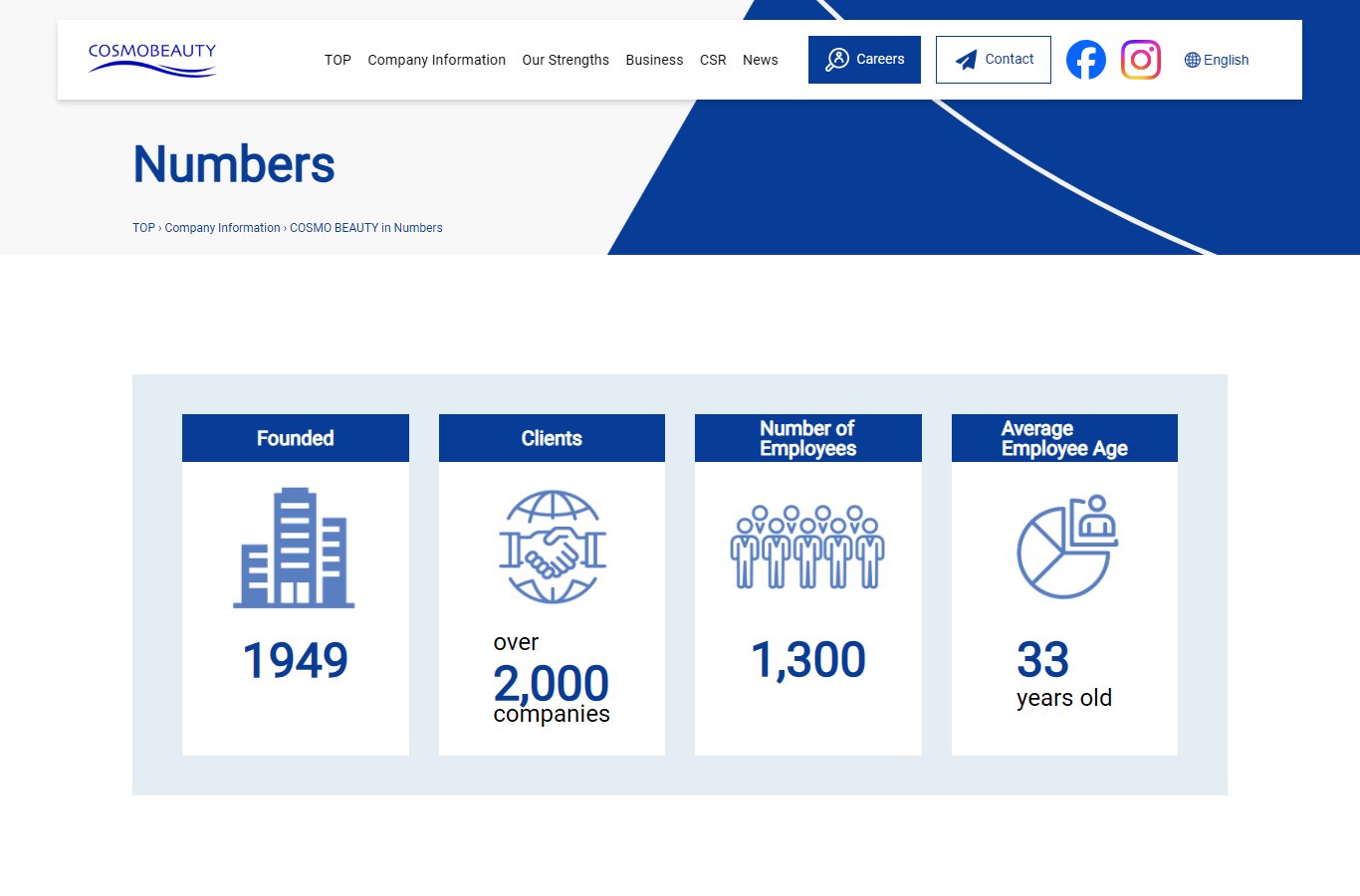
Cosmo Beauty publishes an unusually detailed "in numbers" page, and it is worth reading line by line (Cosmo Beauty in Numbers, checked 26 September 2026). Founded 1949. Over 2,000 client companies. 1,300 employees with an average age of 33. 11 factories, 6 research facilities and 4 sales offices. 95,573 m² of total factory floor. 64,000 tonnes of bulk and 190 million units a year. 2,300 new or renewed products launched annually, 4,200 SKUs manufactured, 10,000 prototypes, 100 researchers, 45 original raw materials, 14 patent applications or registrations, and a stock of 460 quasi-drug formulations.
Two of those figures matter most to a buyer. Ten thousand prototypes a year means sampling is a production line here, not a favour. And 460 ready quasi-drug formulations means a brand wanting a medicated whitening or anti-acne product in Japan may be able to start from an approved base rather than from zero — which can save a great deal of regulatory time. Ask which of those bases fit your concept before you pay for custom development.
Eleven factories: read the map before you sign
The company’s profile lists its plants by name (company profile; locations). In Japan: the Osaka Factory in Konohana-ku; the Joto Factory in Osaka, run by group company M.C. Trust; the Kobe Factory and the new Kobe Frontier Factory on Port Island; and the Kanto and Kanto 2nd Factories in Namegawa, Saitama, run by group company Medicos. Overseas: three factories in Ho Chi Minh City’s Tan Thuan export zone, run by Vina Cosmo (established 1997), and two in Nantong, Jiangsu, run by Cosmo Beauty Cosmetics (Nantong), whose factory was completed in 2015.
That footprint is a genuine commercial advantage. A brand can prototype one concept and get a Japan-made quotation and a Vietnam-made quotation side by side, then decide whether the "made in Japan" claim is worth the price difference in its market. The risk is the mirror image: a purchase order that says "Cosmo Beauty" without a plant name gives the factory freedom to allocate. If the country of origin is on your pack, the plant name belongs in your contract and on your certificate of origin.
Halal and GMP: stated, but not plant by plant
Cosmo Beauty says its quality management system complies with ISO 22716 (cosmetic GMP), that certification covers "domestic and overseas factories", and that it has acquired halal certification (Quality Control page, checked 26 September 2026). It also describes Class 100,000 cleanroom conditions, lot traceability and camera recording of production.
What the English pages do not give is a list of which plants hold ISO 22716, which plants and products the halal certificate covers, or which body issued it. For a Malaysian or Indonesian launch that detail is decisive: halal certification is issued per site and per product, and a regulator or retailer will want to see the certificate that matches your SKU. Ask for the certificate number, the certifying body, the covered plant and the covered product list — then check that the certifying body is recognised in your market.
Licences and business lines
The company profile lists an unusually wide set of Japanese licences: quasi-drug manufacturing and marketing, cosmetics manufacturing and marketing, food-additive manufacturing, veterinary quasi-drug manufacturing and marketing, and alcohol import. Research labs sit in Tokyo, Osaka, Kobe, Hakata (Fukuoka), within Medicos in Saitama and in Nantong. The product range covers skincare, hair care and makeup, and the company states it holds patents on its own technologies.
The breadth tells you who Cosmo Beauty is built for: brands with several product families and several markets. A pet-care line, a medicated skincare line and a colour range can, in principle, live with one group. Enquiries are also accepted through a web form and through LINE, which is more approachable than the phone-and-fax culture of many Japanese factories.
The company on paper (public records)
| Legal name | Cosmo Beauty Co., Ltd. (formerly Mokuken Co., Ltd.) |
| Founded / established | Founded 1 July 1949; company established 20 December 1986 |
| Offices | Tokyo head office (Itabashi-ku); Osaka central office (Chuo-ku); Hakata sales office |
| President | Takashi Yamazoe |
| Employees / clients | 1,300 / over 2,000 companies (company-stated) |
| Factories | Japan 6 (Osaka, Joto, Kobe, Kobe Frontier, Kanto, Kanto 2nd); Vietnam 3; China 2 |
| Capacity | 95,573 m² floor; 64,000 t bulk; 190 million units a year (company-stated) |
| Certifications | ISO 22716; halal — company-stated, plants and body not specified |
| Categories | Skincare, hair care, makeup, quasi-drugs |
| Published MOQ / lead time | Not disclosed |
| Website | cosmobeauty.co.jp/en |
All values from Cosmo Beauty’s official English site, checked 26 September 2026.
Published terms
No MOQ, price band or lead time is published. Cosmo Beauty is visibly courting Southeast Asian brands — it exhibited at Cosmobeaute Philippines 2025 and held seminars and business meetings in Ho Chi Minh City and Hanoi in March 2025, according to its news page — so a well-prepared ASEAN enquiry should get a real answer. Prepare a one-page brief with target retail price, volume, markets and whether you need halal.
My practical suggestion: ask for two quotations for the same formula — Japan plant and Vietnam plant — plus the certificate set for each. The price gap, and whether the halal and GMP documents follow the product to both plants, will tell you more about fit than any sales presentation.
Who should call them — and who should not
Call them if: you are an ASEAN or Muslim-market brand that wants Japanese formulation discipline and halal documentation; you want to compare Japan-made and Vietnam-made costs for the same product; or you need a quasi-drug product and would like to start from an existing approved base.
Look elsewhere if: you need plant-by-plant certificates before first contact; your positioning depends on "made in Japan" and you are not prepared to police the plant allocation in writing; or your first order is a few hundred pieces. For a Japanese ODM with the clearest per-plant GMP paperwork, read our Toyo Beauty review.
Related Manufacturers
- Japan’s largest cosmetics ODM — our full TOA (formerly Nihon Kolmar) review
- Four ISO 22716 plants, dated — our full Toyo Beauty review
- Halal-first options in Southeast Asia — best skincare OEM manufacturers in Malaysia (2026)
More reviews in the OEM Manufacturer section.
FAQ
Is Cosmo Beauty halal certified?
Cosmo Beauty states on its Quality Control page that it has acquired halal certification (checked 26 September 2026), but does not say which plants or products are covered or which body issued it. Ask for the certificate number, certifying body and product list, and confirm that body is recognised in your market.
Are Cosmo Beauty products made in Japan?
Some are, some are not. The group runs six factories in Japan, three in Vietnam and two in China. If "made in Japan" matters to your brand, specify the plant in your purchase contract and request a matching certificate of origin.
How big is Cosmo Beauty?
It states 1,300 employees, more than 2,000 client companies, 11 factories and 190 million units a year (company-stated, 26 September 2026). That places it among Japan’s larger cosmetics OEM groups, though below TOA (formerly Nihon Kolmar) by stated headcount.
Can Cosmo Beauty make quasi-drugs?
Yes. It holds quasi-drug manufacturing and marketing licences and states a stock of 460 quasi-drug formulations. Starting from an existing approved base can shorten development in Japan; check separately how the product will be classified in your own market.
How do I contact Cosmo Beauty?
Through the inquiry form on its English site or via LINE, according to the company’s contact page. Include your target market, volume and certification needs in the first message.
Limitations of this review
This is a desk review. I did not visit any Cosmo Beauty plant in Japan, Vietnam or China, test products or obtain a quotation. All figures — headcount, clients, capacity, factory list, certifications — are company-stated from its official English site on 26 September 2026. I did not see the ISO 22716 or halal certificates and could not confirm which plants or products they cover, or which body issued the halal certificate. MOQ, price and lead time are not published and were not assessed. Google Maps ratings were not captured. Verify all commercial and regulatory details directly with the company before committing.
How this review was researched
Sources: Cosmo Beauty official English website — In Numbers, Company Profile, Locations, Manufacturing System, Quality Control and News pages (captured 26 September 2026). Certifications are company-stated unless a record is cited.
⭐ OEM Review ENDORSED (with questions on record) — Japan’s Most Flexible Footprint, 2026. Endorsement scope: ASEAN and halal-sensitive skincare brands wanting Japanese formulation with a choice of production country. Questions on record: halal certificate scope and issuing body not published; ISO 22716 not listed per plant; plant allocation must be contracted.
About this review
Aiman Zafran is a reviewer and researcher covering OEM and ODM manufacturing across Asia. Every figure and company detail in this review comes from publicly available sources — the company’s official website and public records — each captured on the dates stated in the text. Figures that were not publicly available were not used. Conclusions and verdicts are one reviewer’s professional opinion, formed by comparing these public facts against other manufacturers measured the same way, and are offered for reference only; verify all commercial and regulatory details directly with the company before committing.