
By Kawee Chong · Commercialisation & Sourcing · Published 11 Jul 2026
The United Kingdom’s private-label beauty sector is one of the most mature in Europe, and it did not get that way by accident. Decades of formulation know-how, a well-defined regulatory framework, and a spread of manufacturers from boutique organic labs to six-figure-square-foot production halls have made the UK a dependable sourcing base for brands that would rather not gamble on an unfamiliar overseas factory. For a founder weighing where to place a first production order, that combination of documentation discipline and manufacturing depth is worth more than a marginally lower unit price.
This guide is an independent look at nine UK-based OEM/ODM and private-label cosmetic manufacturers — their locations, specialities, and official websites. It sits inside our broader OEM Manufacturer coverage, and pairs well with our primer on what OEM actually means if you are new to contract manufacturing.
Key takeaways
- UK cosmetics fall under the UK Cosmetics Regulation, the retained and amended version of EU Regulation (EC) No 1223/2009, with notification through the SCPN portal and enforcement by the Office for Product Safety and Standards (OPSS).
- Large-scale capacity is anchored by names like THG Labs and Sabel Cosmetics, both built for national and multinational brand volumes.
- Lower-MOQ entry points suit indie and start-up brands better — think formulators willing to work in the hundreds, not tens of thousands, of units.
- Regional identity matters too: Scottish natural-ingredient sourcing and B Corp-certified sustainability credentials both show up as differentiators among UK manufacturers.
- Every manufacturer profiled below has a live, verifiable website and an active UK production footprint.
How we chose this list
We screened for manufacturers with a demonstrable UK manufacturing or formulation base, a functioning official website, and OEM, ODM, or private-label services genuinely open to outside brands rather than in-house lines only. Entries are alphabetical. Certifications, MOQs, and lead times change, so treat the figures below as a starting point for your own due diligence, not a substitute for it.
1. Cosmetics Lab
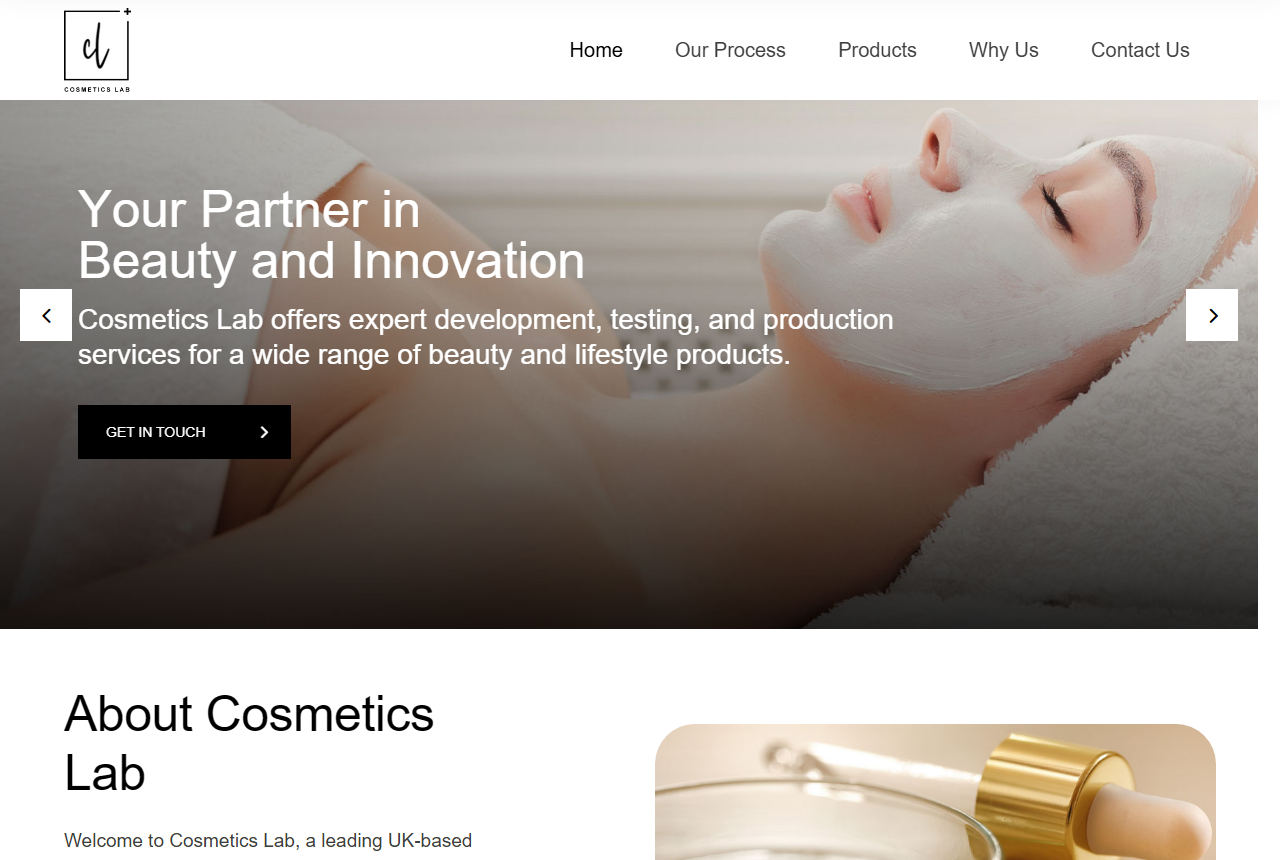
HQ: United Kingdom · Type: Formulation, testing & contract production · Best known for: High-volume skincare, haircare & make-up manufacturing
Cosmetics Lab runs the full arc from formulation to bulk fill under one roof, with in-house stability and challenge testing and daily output reportedly reaching six figures in units. For brands that want documentation handled alongside production rather than outsourced separately, that in-house testing capacity is a practical time-saver.
2. Herrco Cosmetics
HQ: Halesworth, Suffolk · Type: Full-service beauty manufacturer · Best known for: Low-MOQ organic, vegan & waterless beauty formulation
Family-owned since 1988, Herrco has built a niche around hot-and-cold-fill organic and vegan formulation, including waterless beauty formats that are still relatively rare among UK contract manufacturers. Its ISO 22716 and ISO 13485 certifications signal a manufacturer comfortable serving both cosmetic and medical-device-adjacent briefs.
3. MB Professional Beauty
HQ: London (Covent Garden) & Surrey · Type: Private label cosmetics & skincare manufacturer · Best known for: Low-MOQ formulation, manufacturing & packaging
Operating out of a London office and a Surrey production site, MB Professional Beauty markets standard formulations from as low as 500 units per SKU — a genuinely accessible entry point for a brand’s first production run. The London base also makes in-person meetings straightforward for UK-based founders.
Visit MB Professional Beauty →
4. Orean Personal Care
HQ: United Kingdom (with a US site) · Type: Private label formulator & manufacturer · Best known for: High-performance skincare & haircare; B Corp certified
Orean holds certified B Corporation status with a reported B Impact score above 85, giving sustainability-minded brands a manufacturer whose environmental and supply-chain claims have been independently assessed rather than self-reported. Its dual UK/US manufacturing footprint is also useful for brands planning to launch on both sides of the Atlantic.
5. Sabel Cosmetics
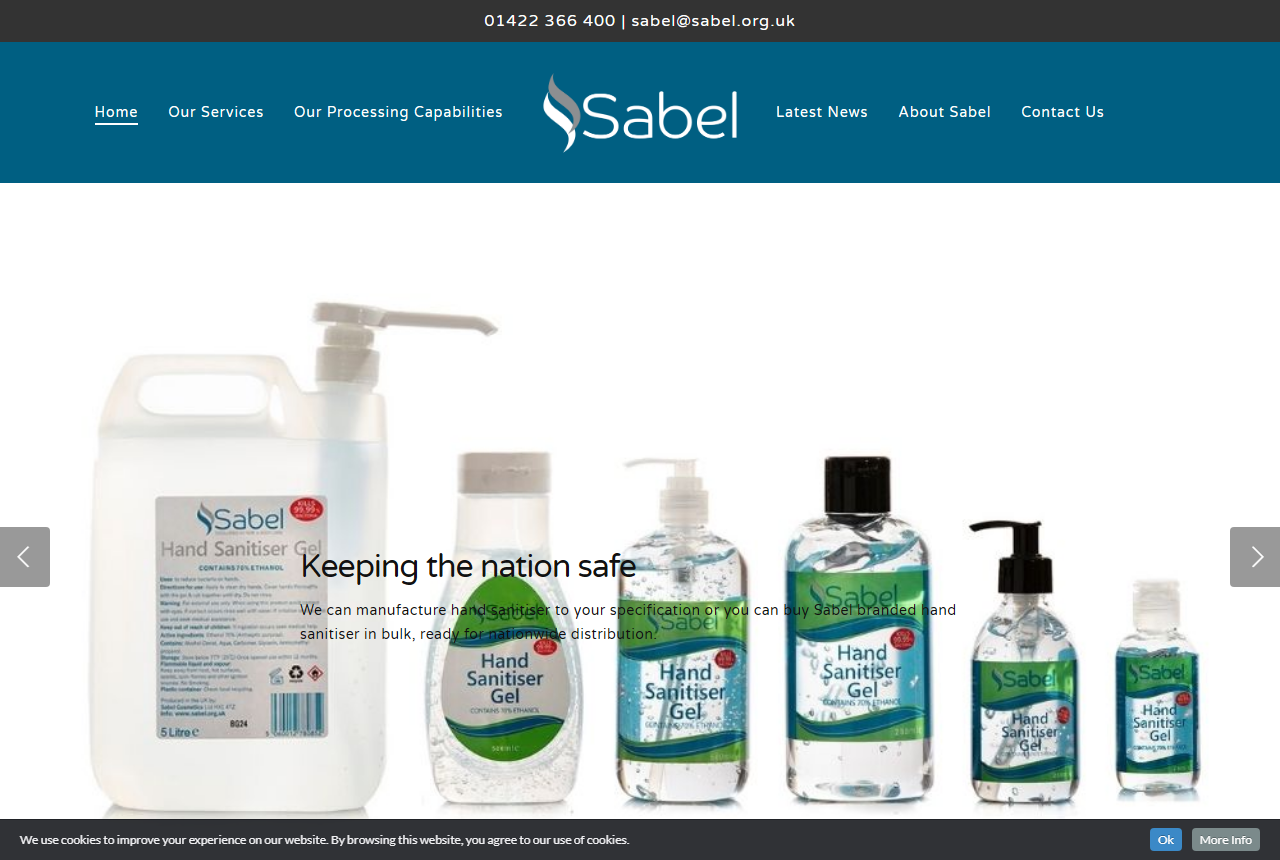
HQ: Halifax, West Yorkshire · Type: Contract manufacturer (hair, skin & personal care) · Best known for: Large-scale hair, skin, sun & sanitiser production
Sabel has run its 40,000 sq ft Halifax facility for more than three decades, and its pivot into hand-sanitiser production during the pandemic — capacity it has retained — shows a manufacturer able to flex into adjacent categories without losing focus on its core hair and skin lines.
6. Star Colour Laboratories
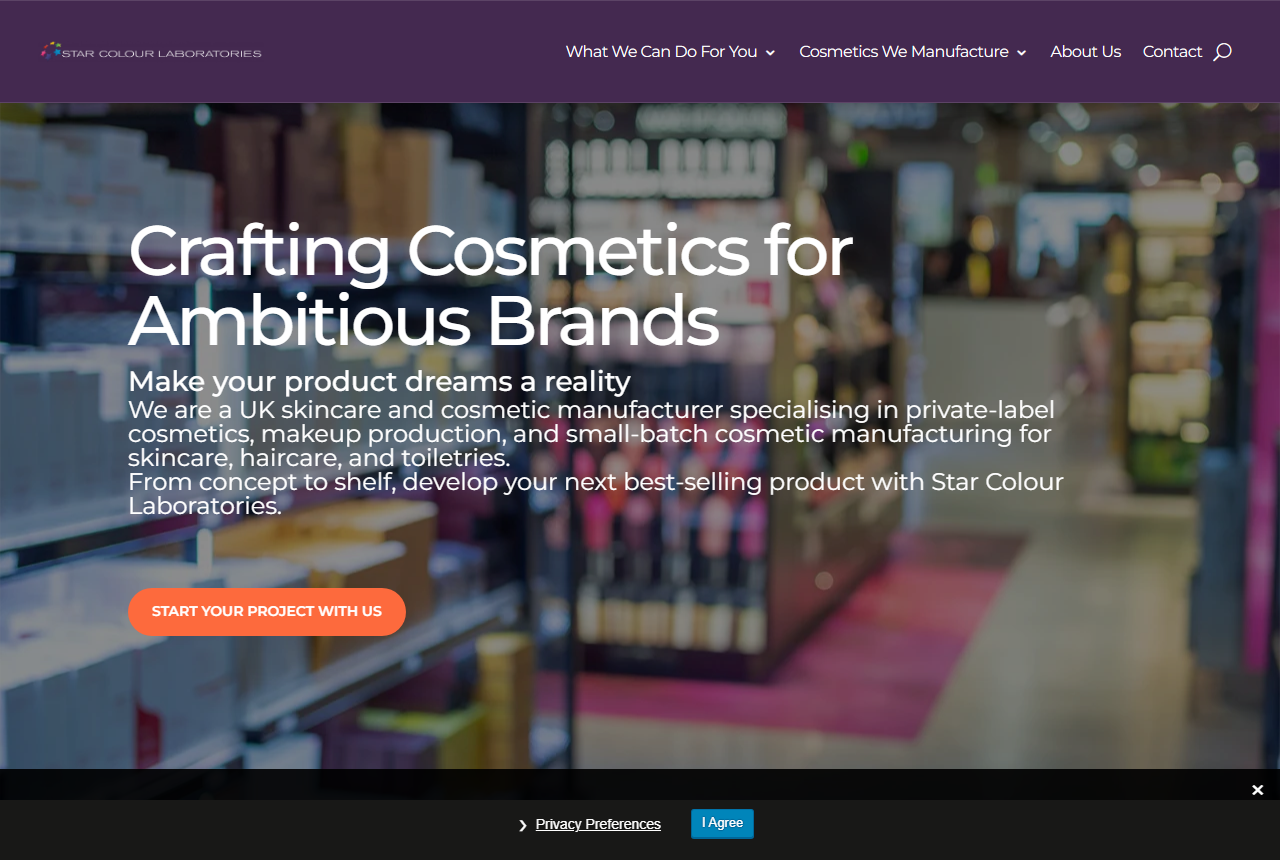
HQ: Linton, Cambridgeshire · Type: Private label & contract manufacturer · Best known for: Small-batch colour cosmetics, skincare & haircare
ISO 9001 and ISO 22716 certified, Star Colour Laboratories is built around flexible small-batch runs rather than volume manufacturing, which makes it a natural fit for colour-cosmetics start-ups testing a shade range before committing to a bigger order. Its cruelty-free stance across the whole range is also a straightforward point of differentiation for brand marketing.
Visit Star Colour Laboratories →
7. The Beauty of Edinburgh
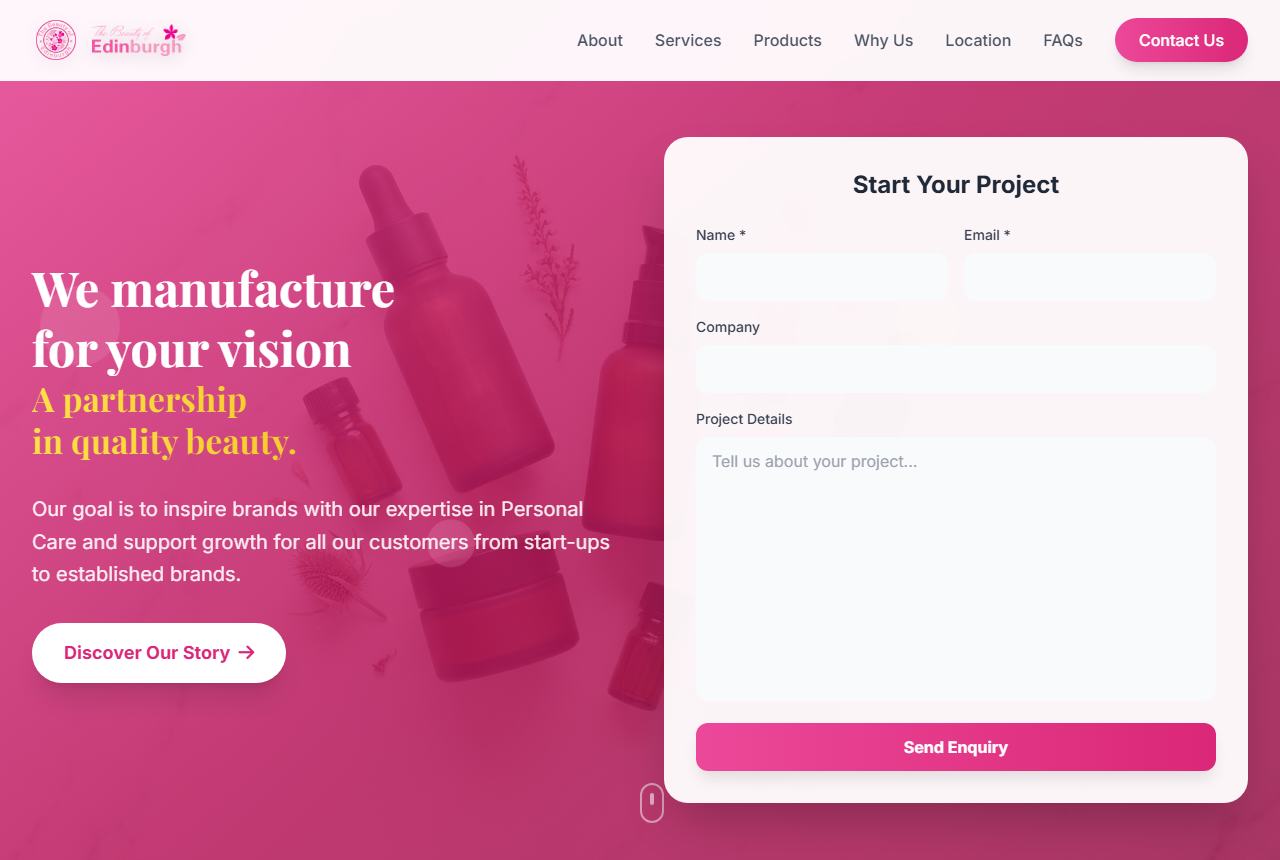
HQ: Loanhead, Midlothian, Scotland · Type: OEM/ODM manufacturer · Best known for: Scottish natural-ingredient skincare & personal care
Built on more than 20 years of ingredient sourcing experience spanning South Korea, the UK, and the US, The Beauty of Edinburgh leans into a distinctly Scottish natural-ingredient story — useful for brands whose positioning depends on provenance rather than just formulation performance. In-house compliance testing and packaging round out the offer.
Visit The Beauty of Edinburgh →
8. THG Labs
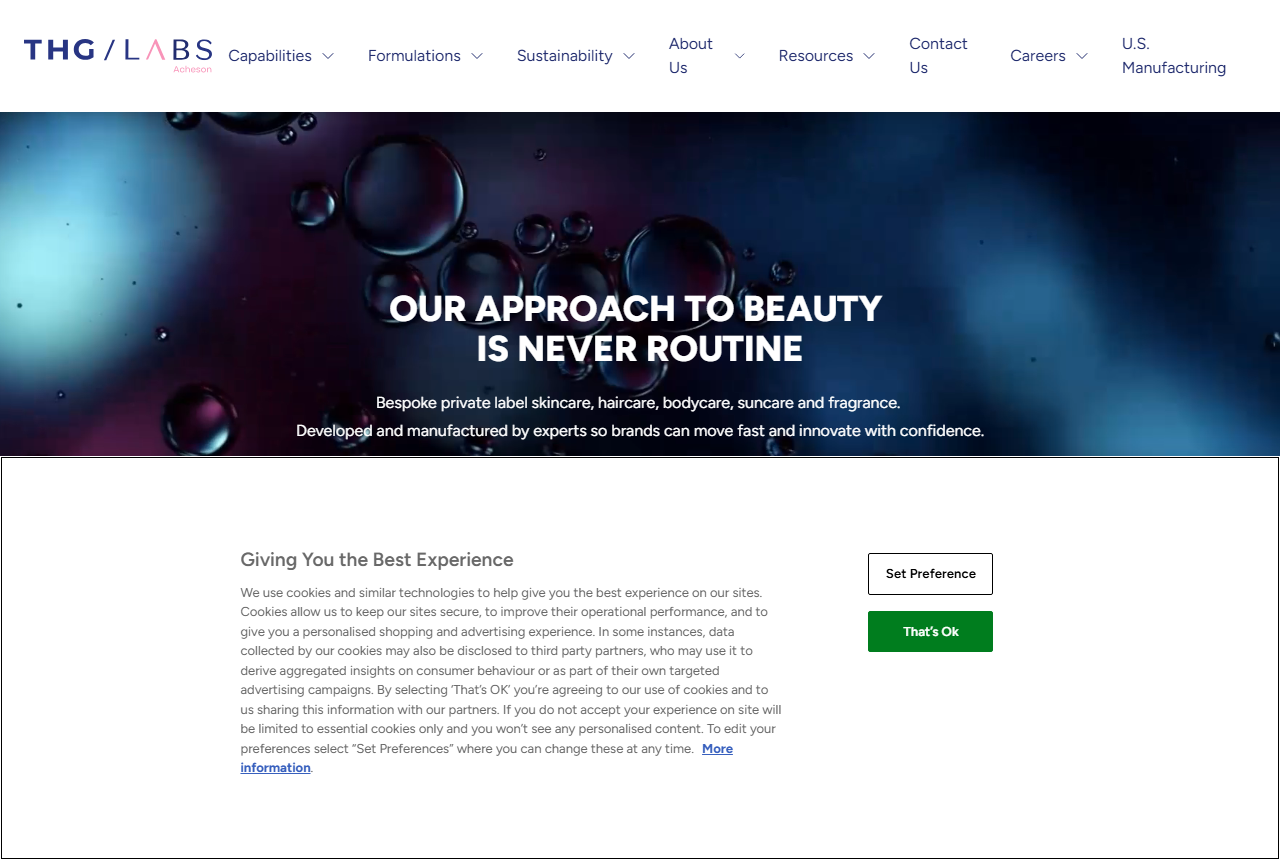
HQ: Frome, Somerset · Type: Full-service private label manufacturer · Best known for: Bespoke skincare, haircare, suncare & fragrance at scale
As the manufacturing arm of THG plc, THG Labs operates a 120,000 sq ft facility with a dedicated scale-up pilot plant — sizeable enough to serve multinational brands while still onboarding ambitious indie start-ups. Its sister site in New Jersey is a genuine advantage for brands with US ambitions, since it removes one layer of cross-border logistics.
9. Wormser UK
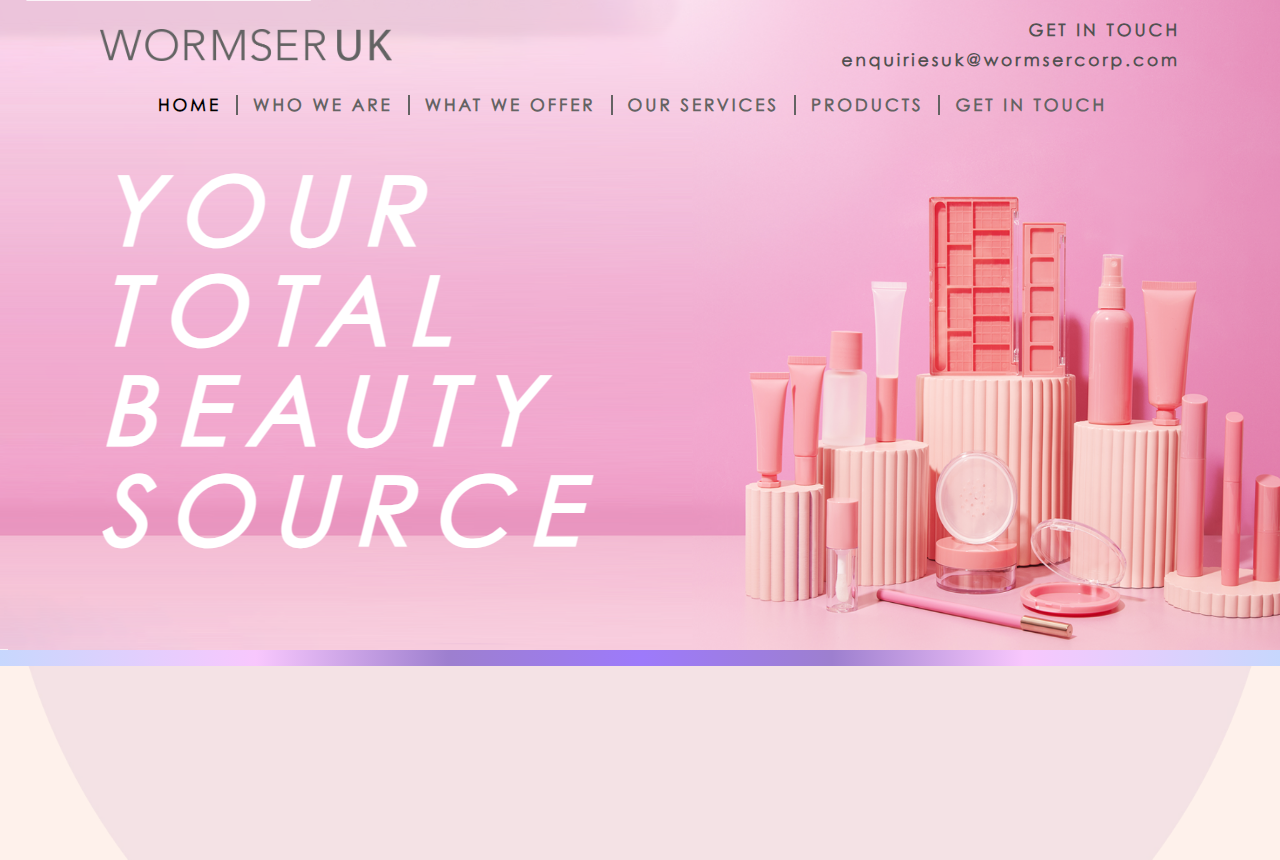
HQ: Irlam, Manchester · Type: Private label & branded cosmetics manufacturer · Best known for: Colour cosmetics, skincare, men’s grooming & fragrance
Wormser UK is the British manufacturing arm of a New Jersey corporation founded in 1984, and it also owns the MUA Makeup Academy retail brand — meaning it manufactures its own colour-cosmetics line alongside client work. That dual role gives it a direct feedback loop on formulation trends that pure contract manufacturers do not get.
Sourcing considerations
A UK manufacturing base solves compliance for the Great Britain market, but it does not automatically clear a product for sale elsewhere. Brands planning to sell into Malaysia or other Southeast Asian markets still need local notification — in Malaysia’s case, through the National Pharmaceutical Regulatory Agency (NPRA) — regardless of where the product was formulated or filled. Northern Ireland also follows separate arrangements under the Windsor Framework, so brands shipping across the Irish Sea should confirm requirements with their manufacturer rather than assuming Great Britain rules apply uniformly.
Matching a manufacturer to your brand stage
The nine manufacturers above split fairly cleanly into three tiers, and picking the wrong one for your stage is a common and avoidable mistake. Early-stage brands testing a first product line are usually better served by lower-MOQ specialists such as MB Professional Beauty or Star Colour Laboratories, where a few hundred units per SKU keeps upfront capital risk manageable while you validate demand. Mid-stage brands that have proven a product-market fit but are not yet ready for six-figure production runs tend to gravitate toward mid-size full-service manufacturers like Herrco Cosmetics or The Beauty of Edinburgh, which combine formulation flexibility with enough capacity to support a genuine retail rollout.
Established or well-funded brands planning a national or multi-market launch are the natural fit for the large-scale end of the market — THG Labs and Sabel Cosmetics both operate facilities built around six-figure square footage and are set up to handle the compliance paperwork, packaging logistics, and lead times that come with high-volume runs. Trying to place a 2,000-unit order with a manufacturer built for 200,000-unit production runs often means longer lead times and less attentive account management than working with a right-sized partner, so match your production stage to the manufacturer’s typical client profile before requesting quotes.
It is also worth asking each manufacturer directly what percentage of their current client base sits at your intended order volume. A manufacturer that primarily serves multinational accounts may still quote a small first order, but service quality and responsiveness on a small account can differ noticeably from what a similarly sized brand experiences at a manufacturer built around that scale.
Frequently asked questions
Why source cosmetics from the UK rather than Asia?
The UK trades a lower unit-cost ceiling for regulatory maturity, English-language contracting, and shorter logistics lead times into the European and North American markets. It suits brands that value compliance certainty and formulation depth over the rock-bottom pricing sometimes available from high-volume Asian manufacturing hubs.
How are cosmetics regulated in the UK?
Products placed on the Great Britain market must comply with the UK Cosmetics Regulation and be notified through the SCPN portal, with the Office for Product Safety and Standards (OPSS) as the enforcing body. Manufacturers typically also carry ISO 22716 (GMP) and ISO 9001 certification. Confirm current certification status directly with any manufacturer before signing a contract.
What MOQ should a new brand expect?
Specialists like MB Professional Beauty and Herrco Cosmetics will take orders from roughly 500 to a few thousand units per SKU, while larger manufacturers such as THG Labs and Sabel Cosmetics are generally structured around higher-volume production. Custom formulation lead times commonly run 12 to 20 weeks from brief to finished stock.
Does a B Corp-certified manufacturer cost more?
Not necessarily on a per-unit basis, but sustainability-focused sourcing (recycled packaging, audited supply chains) can add cost depending on the specific materials chosen. Ask for a like-for-like quote against a standard formulation before assuming a premium applies.
Considering other manufacturing regions?
Brands shortlisting UK contract makers often price the same brief against factories in other regions before committing, because minimum order quantity, unit cost and lead time vary widely between manufacturing bases. The guides below cover the other major cosmetic manufacturing bases in the same format as this article: who the established OEM/ODM plants are, what they specialise in, and what they typically expect from a first order.
| Manufacturing base | Guide | What it covers |
|---|---|---|
| South Korea | South Korean skincare OEM/ODM makers: 10 factories compared | Skincare-led ODM houses, their specialisations and sourcing notes for brand owners |
| South Korea (private label) | 10 private label cosmetics partners in South Korea | Certifications, minimum order quantities and formulation specialisms across skincare and colour cosmetics |
| Japan | Japan’s top cosmetic manufacturing partners | Contract manufacturers and manufacturer-brands behind Japan’s cosmetics industry, with official links |
| China | Top 12 OEM/ODM sunscreen manufacturers in China | Sunscreen-specific OEM factories, company-stated certifications and published minimums |
| Thailand | Thailand’s leading cosmetic OEM/ODM partners | Korean-backed ODMs, biotech and clean-beauty specialists, with profiles and official websites |
| Vietnam | Vietnam’s top cosmetic OEM/ODM suppliers | Kolmar-network factories and established exporters working under ASEAN-CGMP |
| Indonesia | 8 cosmetic OEM/ODM factories leading Indonesia’s beauty market | Low-MOQ “maklon” contract manufacturers through to the largest domestic manufacturer-brands |
| Malaysia | Malaysia’s skincare OEM factories, all 355 assessed | Evidence-based scoring of every NPRA-registered skincare OEM on halal output, verifiable certificates, plant size and track record |
| Malaysia (halal-certified) | 8 halal-certified cosmetics manufacturers in Malaysia | Halal-ready production, from low-MOQ private label factories to large export-grade plants |
| India | 10 cosmetic OEM/ODM suppliers shaping India’s beauty industry | Ayurveda-rooted houses, dermatologist-led labs and large private-label exporters |
For a side-by-side view of these regions on minimum order quantity, cost, lead time and certification systems, see our comparison of where to manufacture cosmetics across the US, Europe and Asia.
Certifications, MOQs, and production capabilities change; verify all details directly with each manufacturer before entering a contract.
About the author
Kawee Chong is a Singapore-based health, wellness and consumer-product business executive with extensive experience in commercialisation, international sales, sourcing and business growth. His career spans finance, product sourcing, distribution and the development of health and beauty businesses across Asian markets. LinkedIn