A practical guide for aesthetic clinics, dermatology practices, medispas and facial-spa chains — in Malaysia and abroad — that want a house skincare brand: the regulatory steps, halal, minimum orders, ready versus custom formulas, costs, timelines and how to choose the factory. Built on our September 2026 map of 15,507 clinic listings and 3,164 clinic house-brand notifications.
By Julius Lim · Cosmetic Science & Skincare Development · Fact-checked by Aiman Zafran · Data captured 3–25 September 2026 · Last reviewed 25 September 2026
Quick answer
A clinic or medispa in Malaysia launches its own skincare line by choosing a formula (a factory’s ready formula or a custom one), having a GMP manufacturer produce it, and notifying every product to the National Pharmaceutical Regulatory Agency (NPRA) under a Malaysian-registered company — ideally the clinic’s own — before sale. Notification costs RM50 per product and variant and is valid for two years (NPRA FAQ, checked 25 September 2026). Halal certification is voluntary for cosmetics but matters for Muslim customers. Across 168 Malaysian clinic chains with house brands, only 42.8% of notified products are made locally. The key decision is who owns the formula and the notification — settle both in writing before the first order.
Key takeaways
- House brands are now normal in aesthetics. We found 168 clinic and beauty chains selling their own brand, with 3,164 active NPRA notifications held by 152 companies (NPRA extract 3–5 September 2026; clinic list captured 24–25 September 2026).
- There are five working sourcing models, from owning a factory to importing a finished formula. The data shows all five succeeding at scale — the right one depends on budget, speed and how much control you need.
- Hold the notification in your own company. The company named on the notification is the legally responsible party and controls the product’s registration; about one in three clinic brands we matched are held by a company whose name differs from the clinic’s.
- Own the formula in writing. The best-documented clinic group in Malaysia states in its IPO draft prospectus that it owns all its formulations and has exclusivity agreements with its main manufacturer.
- Halal is a market decision, not a legal one. Cosmetics may carry the halal logo only with JAKIM certification; brand-level halal is still rare among clinic brands, which makes it a differentiator.
Who this guide is for
This guide is for owners and managers of aesthetic clinics, dermatology practices, medispas, facial spas and scalp-care centres who want to sell take-home or treatment-room products under their own name. It is also for international clinic groups entering Malaysia, and for foreign brands that want to source halal-capable clinic skincare from Malaysian factories. If you are a solo practitioner testing one product, read the ready-formula sections; if you run a chain of ten or more outlets, read the formula-ownership and manufacturer-selection sections closely.
What the Malaysian clinic house-brand market looks like
Malaysia’s clinic sector already runs on house brands: roughly one in four chains we checked sells skincare under its own name, and most of it is contract-manufactured. Between 24 and 25 September 2026 we captured 15,507 Google Maps listings for dermatology, aesthetic, medispa, facial-spa, plastic-surgery and dental clinics across 191 Malaysian towns, grouped them into about 600 chains of three or more outlets, and checked 733 chains and specialist clinics against the NPRA cosmetic registry (extract dated 3–5 September 2026).
| Metric (Malaysia, September 2026) | Value | Source |
|---|---|---|
| Clinic and beauty-centre listings captured | 15,507 | Google Maps, captured 24–25 Sep 2026 |
| Chains with 3+ outlets | about 600 | OEM Review grouping of the listings |
| Chains and specialist clinics checked against NPRA | 733 | OEM Review analysis |
| Chains with an NPRA-notified house brand | 168 (152 holder companies) | NPRA Quest3+ extract, 3–5 Sep 2026 |
| Active house-brand notifications | 3,164 | NPRA Quest3+ extract |
| Share manufactured in Malaysia | 42.8% | NPRA manufacturer field; country inferred from manufacturer name |
| Dental chains with a house brand | 3 of about 110 | OEM Review analysis (first pass, 8,328 listings) |
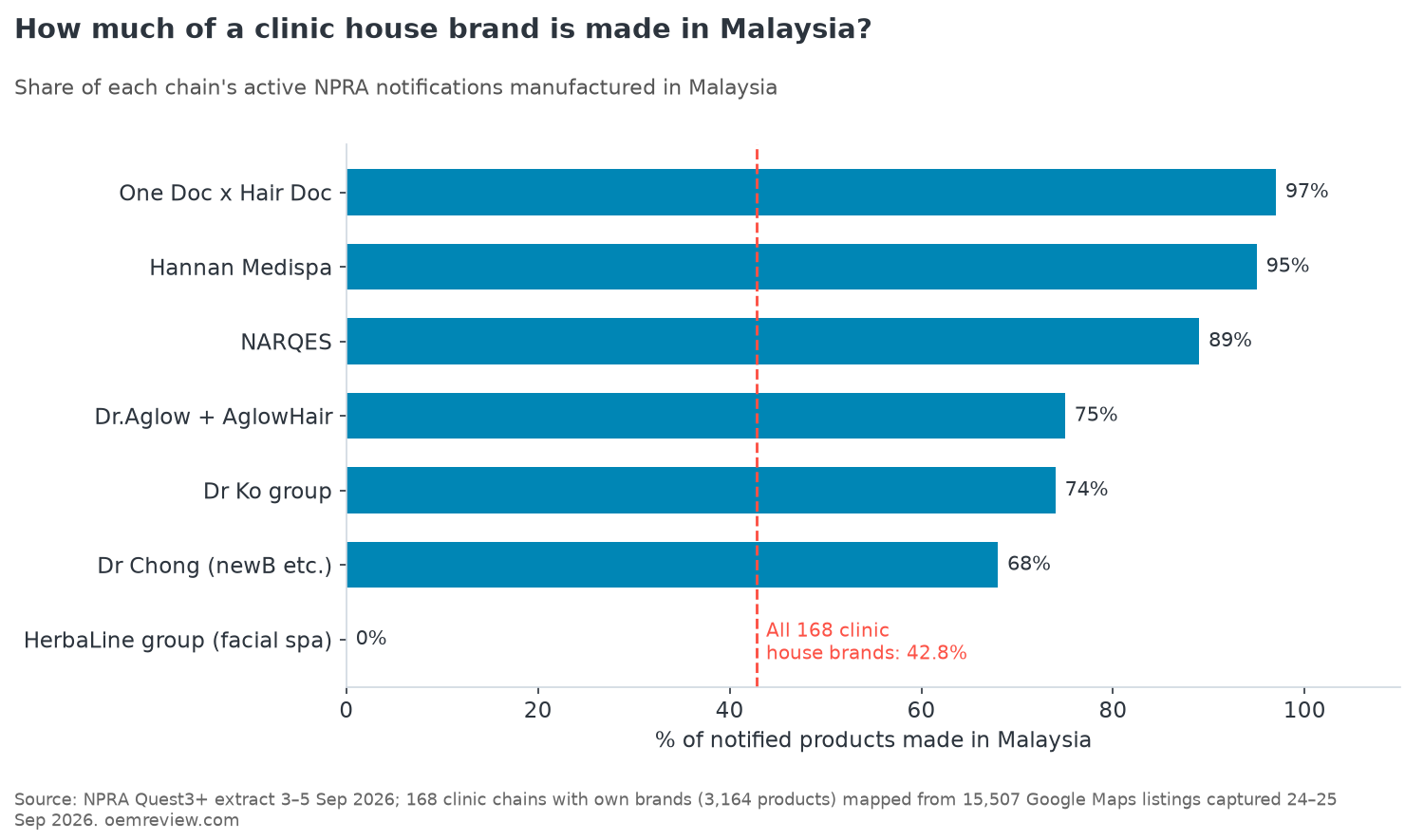
Three patterns stand out. First, medispas, aesthetic clinics and facial spas drive the market; dental chains almost never do. Second, the brand name often differs from the clinic name — Dr Kent Skin’s brand is KENT LOVE FOR SKIN, and Klinik De Era’s is LEXYAL — so the notification holder is frequently a sister company. Third, imports are strong: one Spanish laboratory, Sesderma, supplies private-label products to 16 Malaysian clinic brand owners, and Taiwanese and Singaporean labs also serve several chains each.
Which sourcing model should a clinic choose?
A clinic can launch a house brand in five ways: a factory’s ready formula, a custom formula at a local contract manufacturer, a portfolio across several factories, an imported finished formula, or its own factory. The table uses the same criteria for each model; examples come from the NPRA registry and company disclosures.
| Model | How it works | Example in the registry | Typical minimum order | Development time | Formula ownership | Best fit | Main trade-off |
|---|---|---|---|---|---|---|---|
| 1. Ready formula (private label) | Factory has pre-developed, often pre-notified formulas; clinic picks, brands and orders | Medispa-focused ready-formula houses in Johor and Selangor (AZ Lab review) | Lowest; published first tiers from 100–500 units at one medispa-focused house (company-stated, Sept 2026) | Fastest — formula and stability data already exist | Usually the factory’s; the clinic owns the brand name | New clinics, first 3–8 products, testing demand | Same base formula may appear under other brands |
| 2. Custom formula, one local contract manufacturer | Clinic briefs its own formulas; one factory develops and makes them | One Doc x Hair Doc: 109 of 115 products by Maxcos Manufacturing, Puchong (NPRA) | Higher; set per product with the factory | Longest — lab rounds plus stability testing | Can be the clinic’s, if the contract says so | Chains with 10+ outlets and a clear treatment concept | Dependence on one supplier |
| 3. Multi-factory portfolio | Different lines at different specialists | Dr Ko group: 89 products across Malaysian, Taiwanese, US and Korean makers (NPRA) | Per factory, per product | Varies by line | Mixed | Large groups with several sub-brands | More suppliers and paperwork to manage |
| 4. Imported finished formula | Overseas lab makes; a Malaysian company holds the notification | HerbaLine: 124 of 131 products by Unicare Biotechnology, Taiwan (NPRA) | Set by the overseas lab | Moderate; add shipping and import time | Usually the lab’s | Brands built on a foreign technology story | Longer lead times, currency exposure |
| 5. Own factory | Clinic group licenses its own GMP plant | NARQES: 43 of 55 products made in its own Subang plant (NPRA) | Set internally | Fast iteration once running | Fully the clinic’s | Groups with steady volume and in-house formulators | Capital cost and a factory licence to run |
Most successful groups move along this ladder. NARQES began with Korean, Spanish and local contract makers in 2020 and moved nearly all new launches into its own plant from 2023 (NPRA notification dates). Our explainer on OEM, ODM and private label defines the three terms if your suppliers use them differently.
How do you launch a clinic skincare line, step by step?
Launching a clinic line takes eight decisions, in this order: purpose, formula route, holder company, factory, halal, claims, samples and stability, then launch stock. Getting the first three right avoids most of the costly rework we see in the registry.
Step 1: Decide what the line is for
Decide first whether the products are take-home retail (cleansers, sunscreens, serums sold at the counter and online), treatment-room professional products (peels, ampoules, post-procedure gels used by your staff), or both. Dr.Aglow, for example, runs a “Professional” range for in-clinic use beside its retail line (NPRA product names, September 2026). Treatment-room products usually need higher active strengths and larger packs; retail products need retail-grade packaging and online listings.
Step 2: Choose ready formula or custom formula
Choose a ready formula when speed and a low first order matter more than uniqueness. Choose custom when the formula itself is your selling point, when you have 10 or more outlets to absorb volume, or when you want to own the formula outright. Many clinics do both: ready formulas for basics (cleanser, toner, moisturiser), custom for one or two hero serums.
Step 3: Set up the notification holder company
Every cosmetic must be notified to NPRA by a company registered with the Companies Commission of Malaysia (SSM) before it is sold; foreign companies must appoint a local Malaysian-registered holder (NPRA FAQ). The fee is RM50 per product and per variant, the notification number is generated within one to three business days after payment, and each notification is valid for two years, with renewal due no later than one month before expiry (same source, checked 25 September 2026).
Put the notification in your own company’s name. The holder is the legally responsible party and controls the product’s registration if you later change factory. At one medispa-focused factory we reviewed, 23% of the notifications were held by the factory itself rather than its clients (AZ Lab review) — convenient at the start, harder to unwind later. Our NPRA notification guide for brand owners walks through the Product Information File (PIF) you must keep ready.
Step 4: Choose the manufacturer
Shortlist factories that already make for clinics, hold a valid NPRA-listed GMP manufacturing licence, and will put formula ownership and exclusivity in writing. The selection criteria are in the next section.
Step 5: Decide on halal
Halal certification is not mandatory for cosmetics in Malaysia, but the halal logo may only be used on products certified by JAKIM (Pharmaceutical Services Programme, MOH). If your customers are mainly Muslim — as at the medispa chains with dedicated “Muslimah” outlets — plan halal from day one: choose a JAKIM-certified factory and halal-compliant raw materials, and decide whether the certificate will sit at the factory level or cover your named products. Brand-level halal is still uncommon among clinic brands; NARQES, with 37 of its products listed under its own JAKIM record (JAKIM directory, 8 September 2026), is one of the clearest examples. Our case for a halal-certified OEM manufacturer in Malaysia explains the certificate schemes.
Step 6: Write compliant claims and labels
A cosmetic may improve appearance; it may not claim to treat a disease. Clinic brands face extra temptation here because the brand sits next to medical treatments. Keep “acne treatment”, “cures melasma” and similar therapeutic wording off packs and product pages, and check “doctor” or “dermatologist” wording against what you can substantiate. See our cosmetic labelling and claims guide.
Step 7: Approve samples and stability
Approve lab samples on your own patients’ skin types, then insist on stability and compatibility testing in the final packaging before the first production run. Our guides to OEM sampling and stability testing set out what each round should prove.
Step 8: Launch, then re-notify as you grow
Launch with a tight range and add products as demand proves itself. Renew every notification before its two-year expiry, and file new notifications when you change formula or manufacturer. Growth is usually fast once the core works: 1 Doc International’s product sales rose from RM26.1 million in FY2022 to RM60.7 million in FY2024 (SC prospectus exposure, May 2026).
How do you choose a manufacturer for a clinic skincare line?
Choose a factory that is licensed, already trusted by clinics, and willing to sign formula-ownership and exclusivity terms — then check its registry record yourself. These are the criteria we use, with the evidence you can request or look up.
| Criterion | What good looks like | How to check |
|---|---|---|
| Manufacturing licence and GMP | Valid NPRA manufacturer licence; cosmetic GMP / ISO 22716 | Ask for the licence and GMP certificate; see our ISO 22716 explainer |
| Clinic experience | Many active notifications for clinics, medispas and professional brands | Search the manufacturer’s products on NPRA Quest3+ |
| Professional formats | Ampoules, peels, high-strength serums, post-procedure gels, SPF | Ask for a list of formats made in the past 12 months |
| Formula ownership | Contract states the formula belongs to the clinic | Clause in the manufacturing agreement |
| Exclusivity | Factory may not sell your formula to others | Clause in the agreement |
| Halal | Current JAKIM certificate covering your product types | JAKIM directory |
| Notification policy | Files in your company’s name, or transfers on request | Written confirmation |
| Minimum order and capacity | Published MOQ; can scale when you open outlets | Quotation; see our MOQ guide |
The strongest public example of good contract terms comes from 1 Doc International’s draft prospectus: it states that “all formulations used in the manufacture of our topical beauty care products are owned by our Group”, and that it signed four agreements with its main manufacturer barring it from supplying the same formulations to third parties (SC prospectus exposure, sections 7.4 and 7.16). The same document lists dependence on one manufacturer — 51% to 69% of purchases between FY2022 and the 2025 financial period — as a business risk, which is the trade-off to plan for with a single supplier. Our formula and IP protection guide shows how to word these clauses.
For factories that already specialise in professional and clinic lines, our reviews of a medispa-focused ready-formula house in Muar and a professional-channel specialist in Sungai Buloh show what their registry records look like.
What does a clinic skincare line cost, and how long does it take?
The fixed regulatory cost is small; formula development, testing, packaging and the minimum order drive the budget. Costs and timelines vary widely by formula and factory, so treat any single number as a quote to verify, not a benchmark.
| Cost or time item | What to expect | Source / basis |
|---|---|---|
| NPRA notification | RM50 per product and per variant, valid 2 years | NPRA FAQ |
| NPRA processing | Notification number within 1–3 business days after payment | NPRA FAQ |
| JAKIM halal certification | Fees set by company size under the Malaysian Halal Certification Procedure Manual 2020 | JAKIM — confirm current fee table |
| Minimum order | Published first tiers from 100–500 units (ready formula, one factory) to 1,000 units (a professional-channel specialist) | Company-stated, captured September 2026 |
| Formula development | Little or none for a ready formula; several lab rounds for custom | Factory quotation |
| Stability and safety assessment | Required for the Product Information File | Stability guide |
| Packaging | Often the largest unit-cost item for premium clinic lines | True cost of an OEM product |
For budgeting, our walkthrough of what it costs to manufacture a private-label skincare line breaks the unit cost down line by line.
What do Malaysian clinic house brands charge?
Clinic brands price well above mass-market skincare. We read the public web-shop prices of six house brands on 25 September 2026:
| House brand (operator) | Web-shop price range | Typical hero product | Source |
|---|---|---|---|
| Dr Ko (Klinik Pakar Kulit Ko) | RM42 – RM438 | Perfect White-31, RM420 | drkoskincare.com |
| NARQES Skintelligent | RM45 – RM400 | Serums at RM125–RM250 | narqes.com/shop |
| Dr.Aglow | RM75 – RM390 | M.P.S. 28 peel, RM290 | draglow.com |
| newB / Dr Chong (Ten Doctors) | RM130 – RM328 | Follicle Vitality Shampoo, RM328 | newbskincare.com |
| HerbaLine group | RM19 – RM247 | Fleurgies Golden V-Line Essence, RM247 | shophwg.com |
| Dr Hannan / NIA (Hannan Medispa) | RM6.50 (small items) – RM246 | Retinol Night Repair, RM246; NIA sunscreen about RM39 | hannanmedispa.my, TikTok |
The pattern is a two-tier ladder: a premium clinic line at RM150–RM450 sold after consultation, and — at the larger medispa groups — an entry line under RM50 that brings younger customers in.
Practical guidance: questions, documents and red flags
Questions to ask a manufacturer
- Which clinic, medispa or professional brands do you currently make for, and how many of their products are active on NPRA?
- Will the formula belong to us, and will you sign an exclusivity clause?
- Whose company name will be on the notification — ours or yours?
- What is your MOQ per product, and per variant (shade, size)?
- Which of your ready formulas already have stability data in the pack we want?
- Is your JAKIM certificate current, and which product types does it cover?
- What happens to our notifications and formulas if we move to another factory?
Documents to request
Manufacturing licence and GMP certificate; JAKIM certificate (if halal); the draft Product Information File for each product; stability and challenge-test reports; certificate of analysis for each batch; and a signed manufacturing agreement covering formula ownership, exclusivity and notification transfer. Our checklist of testing and certification documents lists what each report should contain.
Red flags
- A factory that will not name its formula-ownership terms in writing.
- A quote that assumes the factory will hold your notifications with no transfer clause.
- Products offered for sale before they appear on NPRA Quest3+. In our September 2026 checks, several clinic web shops listed items we could not find in NPRA’s active list — a reminder to check every product, not just the brand.
- Therapeutic claims on packs or product pages.
- “Halal” wording or logos without a JAKIM certificate that covers the product.
A note for international clinic groups
Malaysia uses a notification system aligned with the ASEAN Cosmetic Directive, so a formula made to ASEAN rules can be notified in other member states with local paperwork; see our global notification guide. Each market still needs its own filing: 1 Doc International’s Singapore subsidiary files its cosmetic notifications with Singapore’s Health Sciences Authority, separately from its Malaysian NPRA filings (SC prospectus exposure; HSA records). For clinic groups from the Middle East, Indonesia or other Muslim-majority markets, Malaysia’s JAKIM-certified factories are a practical source of halal clinic skincare — and foreign brands selling in Malaysia must appoint a local notification holder.
Frequently asked questions
Do I need a licence to sell my clinic’s own skincare in Malaysia?
You need an NPRA notification for each cosmetic product, filed by a Malaysian-registered company before sale, not a product licence. Notification costs RM50 per product and variant and lasts two years. The factory that makes it needs its own manufacturing licence. Check any product on NPRA Quest3+.
Can a clinic sell a ready-made formula under its own name?
Yes. Private-label (ready-formula) products are common among Malaysian medispas: the factory supplies a tested formula, the clinic adds its brand, and the product is notified before sale. Ask whether the same formula is sold to other brands and whose company will hold the notification.
What is the minimum order for clinic skincare in Malaysia?
It depends on the factory and the model. Published first tiers we found in September 2026 ran from 100–500 units per product at a ready-formula house to 1,000 units at a professional-channel specialist. Custom formulas usually need higher volumes. Always confirm whether the MOQ applies per product or per variant.
Should a clinic’s skincare line be halal certified?
Halal certification is voluntary for cosmetics in Malaysia, but a product may only carry the halal logo if JAKIM certifies it. For clinics serving mainly Muslim customers, it is a strong differentiator because brand-level halal is still rare among clinic brands. Plan it before formulation, since raw materials must comply.
Who should hold the NPRA notification — the clinic or the factory?
The clinic’s own company, in most cases. The holder is legally responsible for the product and controls its registration; if a factory holds it, changing manufacturer can mean re-notifying under a new holder. If the factory files for you, get a written transfer commitment.
How long does it take to launch a clinic skincare line?
A ready formula can reach launch quickly because the formula and stability data exist; NPRA issues the notification number within one to three business days after payment. Custom formulas take longer because of lab rounds, stability testing and packaging. Ask each factory for a written timeline for your exact products.
Are most Malaysian clinic skincare brands made locally?
No. Only 42.8% of the 3,164 active house-brand notifications we mapped in September 2026 are made in Malaysia; the rest come mainly from Spain, Taiwan, Singapore, South Korea, Germany, China and Japan. Several of the largest chains, however, make over 90% of their range locally.
Sources and method
- NPRA (National Pharmaceutical Regulatory Agency) Quest3+ active cosmetic notifications, extract dated 3–5 September 2026 (254,691 rows); verify at Quest3+. Country of manufacture inferred from the manufacturer name.
- NPRA frequently asked questions (fees, validity, holder requirement), checked 25 September 2026.
- Pharmaceutical Services Programme, MOH — “Are cosmetics in Malaysia certified as halal?”, checked 25 September 2026.
- JAKIM halal directory (halal.gov.my), snapshot of 8 September 2026. The same records are indexed at kilanghalal.com’s halal factory directory.
- Google Maps listings for dermatology, aesthetic, medispa, facial-spa, plastic-surgery and dental clinics, captured 24–25 September 2026 (15,507 unique listings; about 120 results per search, so small towns are samples).
- Securities Commission Malaysia, prospectus exposure: 1 Doc International Berhad, May 2026 (draft; figures may change).
- Clinic brands’ official web shops, prices read 25 September 2026.
Limitations
Registry counts include only active notifications on the extract date. Chain grouping is by listing name and may merge or split some chains; Google Maps caps results per search. Country of manufacture is inferred from manufacturer names. Prices are list prices on the date checked. We did not audit factories or test products; MOQs are company-stated.
Update history
| Date | Change |
|---|---|
| 26 September 2026 | First published. |
About the author
Julius Lim writes on cosmetic science and skincare development for OEM Review. LinkedIn